Engagement Rings
 Anniversary Rings
 Solitaire Rings
 Halo Rings
 Toi Moi Rings
 Three Stone Rings
 Nature Inspired Rings
 Rose Cut Rings
 Fancy Color Rings
 Antique Cut Rings
 Wedding Rings
 Wedding Band Rings
 Exclusive Lab Grown Diamond Rings
 All Lab Grown Diamond Ring
 Engagement Rings
 Three Stone Rings
 Fancy Color Rings
 Antique Cut Rings
 Daily Wear Rings
 Wedding Band Rings
 Exclusive Moissanite Rings
 Earrings
 Bracelet
 Pendant
 Necklace
 Men's Ring
 Bridal Sets
 Rings
Rings
 Earrings
 Tennis chain
 Cuban Chains
 Custom Pendant
 Custom Ring
 Custom Teeth Grillz
 Round
Round
 Oval
Oval
 Cushion
 Marquise
 Pear
Pear
 Emerald
 Heart
Heart
 Princess
 Rose Cut
 Radiant
 Antique Cut
 Brooch
 Cufflink
 Keychain
 Unique Products
 +91 9265051773
 Virtual Appointment
 log in




Short answer: A tennis chain is a necklace made of one continuous, flexible line of individually set stones — the most versatile iced out jewelry you can own. What matters most is setting quality (prong, bezel, or pavé), stone type (moissanite or lab grown diamond for real sparkle), stone size and metal weight, and a secure clasp. Buy solid metal, check the warranty, and never judge a chain by its photo alone.
- ✓ A tennis chain is one flexible line of stones. Each stone is individually set, so the chain moves, drapes, and catches light from every angle.
- ✓ The setting decides the look. Prong settings maximize light and sparkle; bezel settings protect stones; pavé adds extra flash between stones.
- ✓ Stone choice sets the price. Moissanite gives maximum fire per dollar; lab grown diamonds give real-diamond prestige at a sane price.
- ✓ The clasp is a safety device, not an accessory. A box clasp with a safety lock protects a chain worth hundreds or thousands of dollars.
- ✓ Buy solid metal with a warranty. Thin plating will not survive daily wear — solid gold or sterling silver will.
What Exactly Is a Tennis Chain?
A tennis chain is a necklace built from a single, continuous row of individually set gemstones, linked so the whole chain flexes and drapes like fabric. The name comes from tennis bracelets — the wrist version — which legend says were named when a player's diamond bracelet broke mid-match and she stopped the game to recover every stone.
What makes tennis chains special is how they wear. Unlike a Cuban link chain, which is all metal, a tennis chain is all stone — every link is a gem setting. It sparkles from every angle and lies flat against the collarbone or chest. It is the one iced out piece that works with a t-shirt, a suit, or a gown — the most versatile jewelry you can own.
The Three Classic Settings
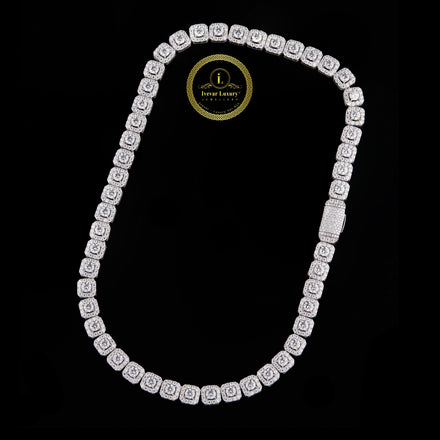
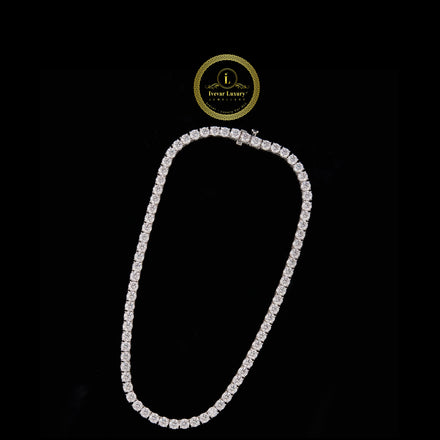
The classic tennis chain uses a prong (basket) setting: each stone sits in a small four-prong cup, linked to the next. It shows the most stone and lets in the most light — maximum sparkle. It is the traditional, brightest choice, and the right pick for a first tennis chain — but the prongs must be well-made, since they alone hold each stone.
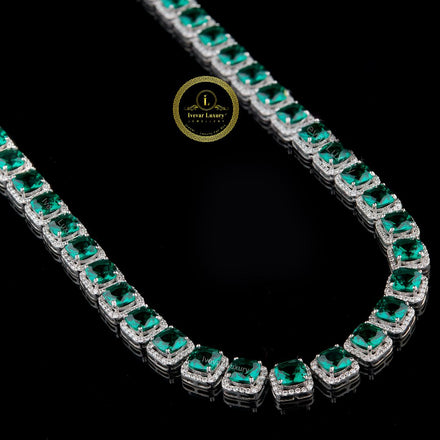
The bezel setting wraps each stone in a smooth rim of metal. It shows slightly less stone than prongs but is the most protective — stones rarely chip or snag — making it ideal for active lifestyles and daily wear. The look is sleeker and more modern, with clean metal lines between stones.
Pavé-set tennis chains add tiny accent stones between the main stones, or micro-pavé halos around each link. This is the maximum-ice option: no dark gaps, just an unbroken river of sparkle. It demands excellent craftsmanship — cheap pavé loses accent stones — so only buy pavé from makers who warranty their setting.

Stone Choices: Moissanite, Lab Diamond, or Something Else?
A tennis chain needs dozens of stones, so stone choice drives the price more than anything else. Moissanite is the value champion: lab-created, nearly as hard as diamond, with even more rainbow fire — blinding sparkle at a fraction of diamond cost. It is the most popular choice for hip hop style, and honestly the smartest buy for most people.
Lab grown diamonds are the upgrade pick: real diamonds — same chemistry, hardness, and tester results as mined stones — at a fraction of mined prices, giving you genuine diamond prestige in an unbroken line of certified stones. Cubic zirconia is the budget option, but be honest about it: CZ is soft, dulls over time, and fails every tester. For a piece worn for years, moissanite is the minimum quality worth buying.
Stone Size, Length, and Weight
Stone size is measured per stone in millimeters, and it transforms the look completely. Small stones (2–3mm) give a delicate, elegant line — beautiful for layering. Medium stones (3–5mm) are the sweet spot: clearly visible stones with serious presence. Large stones (5mm and up) are statement pieces — bold, heavy, unmistakable.
Length is personal and worth measuring: 18 inches sits at the collarbone, 20 on the chest, 22–24 hangs lower for layering. For bracelets, measure your wrist and add about half an inch for drape. Weight matters too — solid gold has satisfying heft, while hollow or plated chains feel light and wear out faster. When comparing prices, check the metal weight; it often explains the gap.

Metal and Clasp Quality: Where Cheap Chains Fail
Here is the uncomfortable truth about cheap tennis chains: the stones are rarely the problem — the failures happen in the metal and the clasp. Thin gold plating over brass wears through in months, exposing dull base metal. Weak clasps pop open and a valuable chain ends up on the sidewalk. When a tennis chain is suspiciously cheap, the savings came from the metal thickness and the clasp.
Buy solid metal: solid gold (10k, 14k, or 18k) or solid sterling silver at minimum. For the clasp, insist on a box clasp with a figure-eight safety lock — the industry standard for valuable chains. It clicks shut with a secondary catch and will not open if snagged. A spring ring or lobster claw on a heavy tennis chain is a red flag; those belong on light fashion jewelry, not on dozens of stones.
How to Style a Tennis Chain
The tennis chain's superpower is range. Worn solo with a simple top, it is quiet luxury — one clean line of light. Layered with a Cuban link chain or pendant, it becomes hip hop royalty: the tennis chain supplies the sparkle, the Cuban supplies the weight. Under a collared shirt, it reads classic and expensive without trying too hard.
A few styling rules: match your metals, keep one hero piece per outfit — a bold tennis chain plus a bold pendant plus a watch is plenty — and consider stone size when layering. A delicate 3mm chain layers beautifully; a chunky 5mm chain wants to be worn solo. Whatever you wear it with, it should sit flat and move freely; if it twists or kinks, see a jeweler.
| Setting | Look | Stone security | Best for |
|---|---|---|---|
| Prong (basket) | Classic — maximum light and sparkle | Very secure when prongs are well-made | A first tennis chain; brightest look |
| Bezel | Modern — smooth metal rims, sleek lines | Most protective — stones rarely chip or snag | Active lifestyles; everyday wear |
| Pavé / micro-pavé | Maximum ice — unbroken river of sparkle | Good, but demands quality workmanship | Boldest look; buy only with a setting warranty |
Shop Our Best Sellers


Swipe to see more → | View all best sellers
Frequently Asked Questions
What is the difference between a tennis chain and a tennis bracelet?
Only length and where it is worn. Both are a continuous flexible line of individually set stones — bracelet on the wrist, chain on the neck. The buying rules (setting, stone type, metal, clasp) are identical.
Which tennis chain setting is best?
Prong (basket) gives the brightest, most classic look and suits most buyers. Bezel is the most protective, best for active wear. Pavé delivers maximum flash — buy only from makers who warranty their setting.
Should I choose moissanite or diamond for a tennis chain?
Moissanite gives the most fire and presence per dollar — the most popular iced out choice. Lab grown diamonds give genuine, tester-proof diamonds at a fraction of mined prices. Both handle daily wear.
What length tennis chain should I get?
Measure and add room for drape. Common necklace lengths: 18 inches (collarbone), 20 (chest), 22–24 (layering). For bracelets, add about half an inch to your wrist measurement.
What clasp is best on a tennis chain?
A box clasp with a figure-eight safety lock — the industry standard for valuable chains. It clicks shut with a secondary catch so it cannot pop open if snagged. Avoid spring rings or lobster claws on heavy chains.
Will the stones fall out of a tennis chain?
Not from a well-made one. Quality prong and bezel work holds stones for years, and reputable makers warranty their settings. Have prongs checked yearly, and store the chain flat so links do not twist.
Can I wear a tennis chain every day?
Yes — that is what it is built for, provided the stones are moissanite or diamond and the metal is solid. Take it off for workouts and swimming, clean it in warm soapy water, and store it separately.
Sources
- Gemological Institute of America — GIA
- International Gemological Institute — IGI
- JCK — Jewelry Industry News
- National Jeweler

Aumsri Pradhan is the founder of Ivevar Luxury, a Surat-based fine jewelry brand that designs and handcrafts lab grown diamond and moissanite jewelry in its own workshop. She leads the brand's design and customer experience, from engagement rings and bridal sets to custom pieces made to each client's story. Through the Ivevar blog, she shares practical guidance on lab grown diamonds, moissanite, diamond grading and ring design to help buyers choose with confidence.