

 Engagement Rings
 Anniversary Rings
 Solitaire Rings
 Halo Rings
 Toi Moi Rings
 Three Stone Rings
 Nature Inspired Rings
 Rose Cut Rings
 Fancy Color Rings
 Antique Cut Rings
 Wedding Rings
 Wedding Band Rings
 Exclusive Lab Grown Diamond Rings
 All Lab Grown Diamond Ring
 Engagement Rings
 Three Stone Rings
 Fancy Color Rings
 Antique Cut Rings
 Daily Wear Rings
 Wedding Band Rings
 Exclusive Moissanite Rings
 Earrings
 Bracelet
 Pendant
 Necklace
 Men's Ring
 Bridal Sets
 Rings
 Earrings
 Tennis chain
 Cuban Chains
 Custom Pendant
 Custom Ring
 Custom Teeth Grillz
 Round
 Oval
 Cushion
 Marquise
 Pear
 Emerald
 Heart
 Princess
 Rose Cut
 Radiant
 Antique Cut
 Brooch
 Cufflink
 Keychain
 Unique Products
 +91-9265051773
 Virtual Appointment
 log in




Short answer: Diamond studs are the most versatile earrings you can own: they suit the office, weekends and evenings alike. For a pair you will wear for years, choose round or oval stones with an excellent or very good cut, near-colorless color (around G to H) and eye-clean clarity, set in 14K or 18K gold with secure screw or push backs. Lab grown diamonds give you the same look and hardness as mined diamonds at a lower price.
Some pieces of jewelry stand the test of time, and diamond stud earrings are at the top of that list. They work with a T-shirt or a saree, a business suit or an evening gown, and they suit every age. Their appeal is simple: a point of light on each ear that brightens the face without competing with anything else you wear.
Modern designs have refreshed the classic, introducing new shapes, halos, bezels and clusters, but the core idea has not changed. This guide explains why studs work so well, which styles are available, how to choose the right size and quality, how to style them, and how to care for them so they last. If you already know what you want, you can browse our diamond earrings as you read.
The Allure of Diamonds

Why diamonds suit earrings so well
A diamond is the hardest natural material, rating 10 on the Mohs scale, so it resists the scratches that dull softer stones. It also has a high refractive index of about 2.42, which means it bends and returns light strongly. On the ear, where the stone moves every time you turn your head, that light return is what creates the familiar flash of sparkle.
Lab grown diamonds: the same stone, a different origin
A lab grown diamond is chemically, physically and optically the same as a mined diamond. It is grown from carbon using CVD (chemical vapor deposition) or HPHT (high pressure, high temperature) and graded on the same 4Cs. Many lab grown stones come with an IGI or GIA report. Because they cost less than mined diamonds of the same grade, many buyers choose a larger or better-graded pair for the same budget.
Where moissanite fits in
Moissanite is not a diamond. It is a separate gem made of silicon carbide, rating 9.25 on the Mohs scale, with a higher refractive index of about 2.65. That gives it more rainbow fire than a diamond. Moissanite studs are a good choice if you love colorful sparkle or want a bigger look for less; diamond studs give a crisper, whiter sparkle.
Diamond Stud Earrings: A Timeless Classic

The enduring appeal
The beauty of diamond stud earrings lies in what they leave out. There is no dangle to catch on hair, no bold shape to clash with an outfit and no trend that will date them. That makes them the earrings people reach for every morning without thinking, and the pair most often given for milestones such as graduations, weddings and anniversaries.
Modern stud designs
The classic solitaire stud is still the best seller, but today's choices go well beyond it:
- Solitaire studs: One stone per ear in a four-prong, six-prong or bezel setting. The purest, most timeless look.
- Halo studs: A center stone ringed by small diamonds, which makes the earring look larger and adds sparkle.
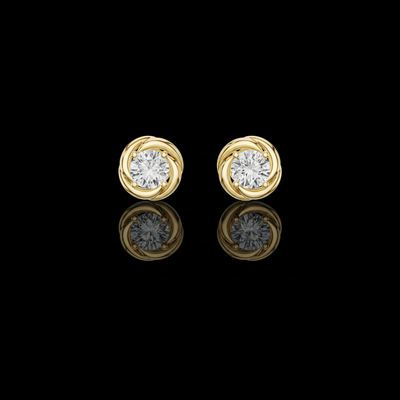
- Bezel studs: A rim of metal around the stone. Very secure, smooth to the touch and modern in style.
- Cluster studs: Several small stones grouped into a flower or round shape for a big look at a lower cost per carat.
- Fancy shape studs: Oval, pear, princess, emerald, heart or marquise stones for a more personal look.
- Climbers and three-stone studs: Small rows of stones that follow the line of the earlobe.
Comparing the main stud styles
| Style | Look | Best for |
|---|---|---|
| Four-prong solitaire | Most light, stone looks slightly square | Maximum sparkle |
| Six-prong solitaire | Rounder outline, extra security | Daily wear |
| Bezel | Clean, modern, metal frames the stone | Active lifestyles, sleeping in them |
| Halo | Larger, brighter face | Events and a bigger look |
| Cluster | Floral or round shape from small stones | Size on a tighter budget |
Versatility in Styling
One pair, many occasions
Studs work because they are small enough not to fight with clothing and bright enough to lift a plain outfit. The same pair can go from a morning meeting to dinner without a change. Here is how to get the most from them:
- Work: Small to medium solitaires (roughly a quarter to half carat each) look polished without drawing attention away from you.
- Weekends: Studs add a finishing touch to casual clothes; bezel studs in particular look relaxed and modern.
- Evenings and weddings: Larger solitaires or halo studs catch more light. Pair them with a pendant or tennis bracelet in the same metal.
- Traditional outfits: Diamond studs sit comfortably alongside heavier necklaces, letting the necklace lead.
Choosing size for your face and hairstyle
Smaller studs suit petite features and short hair, where the ear is fully visible. Larger studs balance longer faces and fuller hairstyles. If you usually wear your hair down, go a size up so the stones are still seen. Round stones soften angular faces; ovals and pears add length and suit rounder faces.
Stacking and multiple piercings
If you have more than one piercing, studs are the building blocks of a curated ear. Place the largest pair in the first hole and step down in size as you go up the ear. Mix in a small hoop or climber for variety, but keep the metal color consistent so the stack looks planned.
Tip: Unsure about size? Cut small circles of paper to the diameters you are considering, hold them at your earlobe in a mirror and take a photo from arm's length. It shows how each size reads to other people.
Quality Matters: Choosing the Right Diamonds
The 4Cs for earrings
Every diamond is graded on cut, color, clarity and carat weight. Earrings are seen from a distance and from the side, so you can be practical with some grades and should be strict with others.
- Cut: The most important C. A well-cut diamond returns more light and looks brighter and larger. Aim for excellent or very good.
- Color: G to H looks white once set, especially in white gold. In yellow gold, I can look perfectly fine.
- Clarity: Choose "eye-clean" stones. VS2 or SI1 is usually clean to the naked eye in earrings, since nobody inspects them up close.
- Carat: Stud weights are often given as total carat weight (ctw) for the pair. A 1 ctw pair means two stones of about half a carat each.
Practical quality guide by budget
| Priority | Where to spend | Where to save |
|---|---|---|
| Maximum sparkle | Excellent cut | Clarity down to SI1 if eye-clean |
| Biggest look | Carat weight, halo setting | Color down to H or I in yellow gold |
| Heirloom pair | Cut, color and a grading report | Very high clarity grades you cannot see |
Matching the pair
Two stones that look identical matter more in earrings than any single grade. Good jewelers match studs for size, color and cut so they look the same on both sides of your face. Ask how the pair was matched, especially for larger stones.
Choosing the metal and backs
14K gold is strong enough for daily wear and keeps its shape; 18K gold has a richer color and suits occasional pieces; 925 sterling silver is a lighter, more accessible option. White gold makes diamonds look whiter, while yellow and rose gold give a warmer frame.
The back matters as much as the front. Push backs are quick and common. Screw backs thread onto the post and are the most secure for larger or valuable stones. Locking backs are a middle ground. If you have sensitive ears, solid gold posts are kinder than plated or base metal.
Diamond vs Lab Grown vs Moissanite Studs
| Feature | Mined diamond | Lab grown diamond | Moissanite |
|---|---|---|---|
| Material | Carbon | Carbon | Silicon carbide |
| Hardness | 10 | 10 | 9.25 |
| Sparkle | White brilliance, moderate fire | Same as mined | Strong rainbow fire |
| Relative cost | Highest | Lower | Lowest |
For most shoppers who want the look and feel of diamond at a sensible budget, lab grown studs are the sweet spot. Moissanite is ideal if you want extra fire or a larger size for less.
Shop the styles in this guide
Choosing a Stone Shape
Round brilliants are the classic stud because their 57 or 58 facets are designed for maximum light return, and a round outline looks the same from every angle. But other shapes can give a pair more personality.
- Round: The brightest, most timeless option and the easiest to match into a pair.
- Oval: Looks slightly larger than a round of the same weight and adds a gentle vertical line that flatters most faces.
- Princess: A square, sharp-cornered shape with strong sparkle and a modern, geometric feel. Choose settings that protect the corners.
- Emerald and Asscher: Step cuts with long, mirror-like flashes rather than glitter. Elegant and quietly vintage, but they show clarity more, so choose higher clarity.
- Pear and heart: Romantic and distinctive. Pears usually point down to lengthen the look.
- Cushion: A softened square with rounded corners and a warm, antique-style sparkle.
Explore shape-led options in lab diamond oval jewelry if you like the elongated look.
Diamond Studs as a Gift
Studs are one of the safest fine jewelry gifts because they do not require a ring size and suit almost every taste. A few points make the choice easier:
- Check her metal: Look at the jewelry she already wears every day and match it, whether yellow, white or rose gold, or silver.
- Stay classic for a first pair: Round or oval solitaires in a four- or six-prong setting are almost always welcome.
- Consider her lifestyle: For someone active or who sleeps in her earrings, bezel studs with screw backs are the practical choice.
- Size modestly if unsure: A medium size is easier to wear daily than a very large pair.
- Remember pierced earring returns: Many stores, Ivevar included, accept pierced earrings back only if they are faulty, so be confident in the style before you order.
Diamond studs are also popular for men. A single stud or a pair in a bezel or four-prong setting, often in white gold or silver, gives a clean, understated look.
Caring for Diamond Studs
Earrings collect skin oils, hair products and makeup, all of which dull sparkle. Soak them in warm water with a little mild dish soap for a few minutes, scrub gently behind the stone with a soft toothbrush, rinse and dry with a lint-free cloth.
- Check the backs: Push backs loosen over time. If a back slides on too easily, replace it.
- Check the prongs: Look for bent or thin prongs every few months, especially if you sleep in your studs.
- Store separately: Diamonds can scratch other jewelry and each other, so keep pairs in their own pouch or compartment.
- Put them on last: Apply hairspray, perfume and lotion first, then your earrings.
When to see a jeweler
If a stone looks tilted, a prong looks flattened or the post feels bent, stop wearing the earring until it has been checked. A loose stone is easy to tighten but easy to lose from an earlobe without noticing. For studs worn every day, a quick professional inspection once a year is a sensible habit, and it is a good moment for a professional clean as well.
Tip: Keep a spare pair of gold backs in your jewelry box. Backs are the part most often lost, and a matching spare means you never have to wear one stud alone.
Conclusion
Diamond stud earrings earn their place as an essential fashion item because they do so much with so little. They suit every outfit and age, they work for daily wear and celebrations, and a well-chosen pair can last a lifetime.
The choice comes down to a few practical decisions: the setting style that suits your life, a size that flatters your face, a sensible balance of the 4Cs with cut first, the right metal and secure backs. Get those right and you will reach for the same pair for years.
At Ivevar, we make diamond studs with lab grown diamonds, many with IGI certificates, as well as moissanite studs, in 10K, 14K and 18K gold and 925 sterling silver. Browse lab diamond earrings or moissanite earrings. We deliver worldwide with free shipping and offer 30-day easy returns (for hygiene reasons, pierced earrings can be returned only if faulty).
FAQs on Diamond Stud Earrings
What makes diamond stud earrings a timeless fashion item?
Their simplicity. Studs suit any outfit and occasion, never clash with other jewelry and do not follow short-lived trends, so they stay in style year after year.
How do I choose the right quality diamonds for my earrings?
Prioritize cut, then choose color around G to H and an eye-clean clarity such as VS2 or SI1. Make sure the two stones are well matched in size and color.
What size diamond studs should I buy?
For everyday wear, many people choose between a half carat and one carat total weight for the pair. For a bolder look, go up from there. Try the paper-circle test to see sizes on your ear.
What are some of the modern diamond earrings designs available?
Beyond classic solitaires, popular options include halo, bezel, cluster, three-stone and climber studs, plus fancy shapes such as oval, pear, princess and heart.
How can diamond stud earrings be styled for different occasions?
Smaller solitaires suit work and daily wear; larger solitaires or halo studs suit evenings and weddings. Match the metal to your other jewelry for a coordinated look.
Are lab grown diamond studs real diamonds?
Yes. Lab grown diamonds are real diamonds with the same chemical, physical and optical properties as mined diamonds. Only the origin differs.
Which earring back is most secure?
Screw backs are the most secure because they thread onto the post. They are a good choice for larger or more valuable studs.
Can diamond stud earrings be customized?
Yes. You can choose the stone shape and size, the setting, the metal and the back type. Ivevar also creates custom pieces through virtual appointments.
How do I care for my diamond stud earrings?
Clean them regularly in warm, soapy water with a soft brush, store them separately to avoid scratches, and check backs and prongs every few months.
Are diamond stud earrings a good investment?
Think of them as an investment in something you will wear constantly rather than a financial asset. Resale prices for diamonds, especially lab grown ones, are usually well below retail, but a quality pair can be worn for decades.
How do I know my diamonds are responsibly sourced?
Buy from jewelers who state the stone type clearly and provide grading reports. Lab grown diamonds have a documented origin with no mining involved, and their reports from labs such as IGI and GIA state that they are laboratory grown.
Can I sleep in my diamond studs?
Many people do, especially with bezel studs and screw backs. Large prong-set studs with push backs can loosen or catch on bedding, so take those off at night.


