

 Engagement Rings
 Anniversary Rings
 Solitaire Rings
 Halo Rings
 Toi Moi Rings
 Three Stone Rings
 Nature Inspired Rings
 Rose Cut Rings
 Fancy Color Rings
 Antique Cut Rings
 Wedding Rings
 Wedding Band Rings
 Exclusive Lab Grown Diamond Rings
 All Lab Grown Diamond Ring
 Engagement Rings
 Three Stone Rings
 Fancy Color Rings
 Antique Cut Rings
 Daily Wear Rings
 Wedding Band Rings
 Exclusive Moissanite Rings
 Earrings
 Bracelet
 Pendant
 Necklace
 Men's Ring
 Bridal Sets
 Rings
 Earrings
 Tennis chain
 Cuban Chains
 Custom Pendant
 Custom Ring
 Custom Teeth Grillz
 Round
 Oval
 Cushion
 Marquise
 Pear
 Emerald
 Heart
 Princess
 Rose Cut
 Radiant
 Antique Cut
 Brooch
 Cufflink
 Keychain
 Unique Products
 +91-9265051773
 Virtual Appointment
 log in





Short answer: A well-cut 1 carat round stone measures about 6.4–6.5 mm across, which looks clear and elegant on most hands. With a lab grown diamond, a 1 carat ring costs far less than a mined one of the same quality, and the metal you choose (10K, 14K or 18K gold) changes the price more than almost anything else. For the best result, put your money into cut, choose near-colorless color and eye-clean clarity, and pick a setting that suits your daily life. Moissanite is a lower-cost alternative, but it is a different gem, not a diamond.
How Big Is a 1 Carat Stone?
Carat is a weight (1 carat = 0.2 grams), not a size. A round 1 carat stone is roughly 6.5 mm wide. Elongated shapes such as oval, pear and marquise spread the same weight over a longer outline, so they look a little larger from above. Cut quality also matters: a stone cut too deep hides its weight underneath and looks smaller.
On the hand, a 1 carat stone covers a good part of the finger's width without looking oversized. On a slim finger it looks generous; on a larger finger it looks refined and classic. It is the size many people picture when they think of an engagement ring, which is why it remains one of the most popular choices.
| Shape (1 ct) | How it faces up | Best for |
|---|---|---|
| Round | About 6.5 mm across; maximum sparkle | Classic, timeless rings |
| Oval | Longer outline; looks larger than a round | Making the finger look slimmer |
| Pear | Teardrop; long and graceful | A romantic, unusual look |
| Emerald | Rectangular step cut; calm flash | Minimal and Art Deco styles |
| Cushion | Soft square; romantic glow | Halo and vintage designs |
| Princess | Crisp square; bright sparkle | Modern, geometric looks |
Tip: Ask for a stone's measurements in millimeters as well as its carat weight. Two 1 carat stones can face up differently, and the millimeter size tells you what you will actually see.
1 Carat Compared With Other Sizes
It helps to see 1 carat next to the sizes around it. Because carat is a weight, diameter grows more slowly than carat: a 1.5 carat is 50% heavier than a 1 carat but only about 1 mm wider.
| Carat weight (round) | Approx. diameter | Look on the hand |
|---|---|---|
| 0.75 ct | 5.7–5.8 mm | Delicate and dainty |
| 1.00 ct | 6.4–6.5 mm | Classic, balanced |
| 1.25 ct | 6.8–6.9 mm | A subtle step up |
| 1.50 ct | 7.3–7.4 mm | Clearly larger, confident |
If 1 carat feels slightly small for your taste, a 1.25 carat or an elongated 1 carat often gives the extra presence you want. If it feels large, a 0.75 carat in a halo looks full and sparkly while staying delicate.
What Sets the Price of a 1 Carat Ring
A 1 carat ring price has two parts: the center stone and the setting. Here is what moves each one.
The stone
The gem type is the biggest factor. Lab grown diamonds cost far less than mined diamonds of the same grade, and moissanite costs less again. Within lab grown diamonds, cut, color and clarity grades and the certificate all change the price. Shape matters a little too, because some shapes keep more of the rough crystal than others when they are cut.
The setting
The metal you choose changes the price more than anything else in the setting. At Ivevar, rings are made in 10K, 14K and 18K gold. Higher karats contain more pure gold, so the same design costs more in 18K than in 14K, and more in 14K than in 10K. Halos, pavé bands and side stones add to the total because they add more small stones and more labor.
| Choice | Lower cost | Higher cost |
|---|---|---|
| Gem | Moissanite | Lab grown diamond |
| Metal | 10K gold | 18K gold |
| Setting | Plain solitaire | Halo or pavé band |
| Grades | Near-colorless, eye-clean | Colorless, very high clarity |
Gold and stone prices change over time, so always check each product page for the current price before you buy.
Choosing Cut, Color and Clarity
You do not need the highest grades to get a 1 carat stone that looks flawless. Here is where the money matters and where it does not.
- Cut: the most important grade. Choose Excellent or Ideal for round stones. A well-cut stone is brighter and looks larger than a poorly cut stone of the same weight.
- Color: D to F is colorless; G to H is near-colorless and looks white once set. In yellow or rose gold, G to I usually looks perfect.
- Clarity: VS1 or VS2 is usually eye-clean at 1 carat. SI1 can be eye-clean too; check a photo or video first.
- Carat: if you are flexible, a stone of 0.90 to 0.99 carats can cost less than a full 1.00 carat while looking almost the same.
For certification, IGI grades lab grown diamonds on the full 4Cs, while GIA has issued only a Premium or Standard descriptor since October 1, 2025. Many Ivevar lab grown diamonds come with IGI certificates, so you can see exactly what you are buying.
Best Settings for 1 Carat
A classic four- or six-prong solitaire shows off a 1 carat stone cleanly. A cathedral setting lifts the stone and adds height. A halo or hidden halo makes a 1 carat look closer to a larger stone and adds sparkle. A pavé band adds shine along the finger without taking attention away from the center.
- Four-prong solitaire: shows the most stone and gives a clean, open look.
- Six-prong solitaire: holds the stone more securely and makes a round look rounder.
- Cathedral: the band arches up to the head, adding height and a graceful side view.
- Halo: a ring of small stones around the center that makes it look larger from above. Browse our lab grown halo rings.
- Hidden halo: small stones under the center that sparkle from the side while the top stays clean.
- Bezel: a metal rim around the stone; the most protective and snag-free option.
- Three-stone: two side stones that widen the ring and add meaning.
If you want the purest look, start with our lab grown solitaire rings. A simple solitaire also pairs easily with almost any wedding band.
Setting height and comfort
A 1 carat stone can sit high or low. A high setting lets more light in from the sides and looks dramatic, but it is more likely to catch on sweaters, hair and gloves. A low setting sits closer to the finger, feels more comfortable and is safer for people who type, cook, lift or work with their hands all day. Look at the side view of any ring before you buy, and check that a wedding band can sit beside it.
Choosing by lifestyle
- Active or hands-on work: bezel, or a low six-prong solitaire.
- Office and everyday wear: a four- or six-prong solitaire or hidden halo at medium height.
- Maximum sparkle: a halo with a pavé band.
- Minimal style: a slim solitaire band, or an east-west oval or emerald for a modern twist.
How to Make a 1 Carat Look Bigger
If you want your 1 carat to have more presence, these choices help without adding carat weight:
- Choose an elongated shape: oval, pear and marquise cover more of the finger.
- Add a halo: a ring of small stones makes the center look larger from above.
- Keep the band slim: a thin band makes the center stone look bigger by contrast.
- Choose white metal prongs: white prongs blend into a colorless stone, so the stone's outline reads larger.
- Prioritize cut: a well-cut stone spreads light across its full face.
- Keep it clean: a clean stone looks brighter and larger than one coated in lotion.
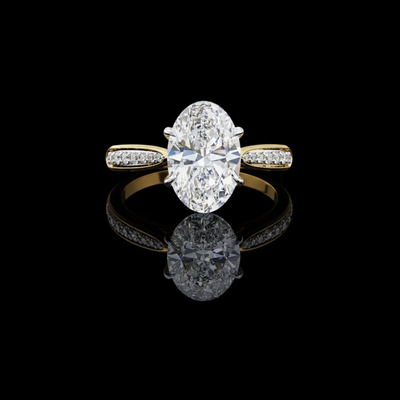
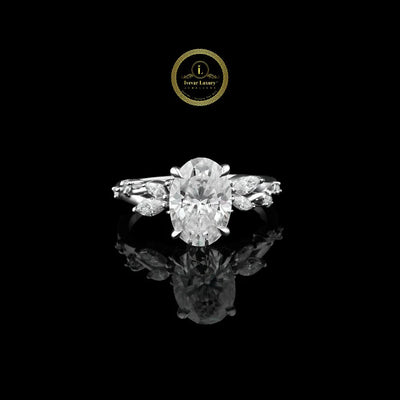
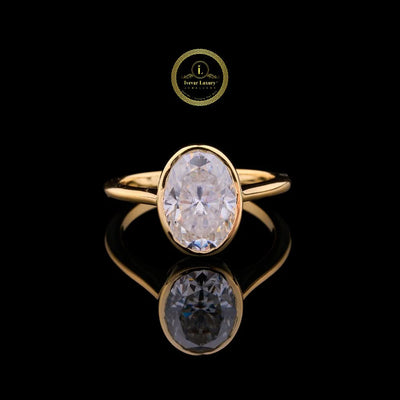
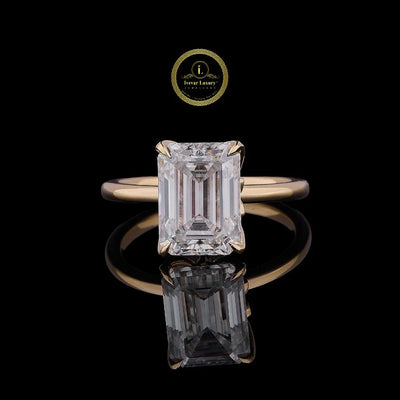
Shop the styles in this guide








Lab Grown Diamond or Moissanite?
A lab grown diamond is a real diamond grown in a lab. It is chemically, physically and optically the same as a mined diamond and scores 10 on the Mohs hardness scale. Lab diamonds are grown by CVD or HPHT; both methods make real diamonds.
Moissanite is a different gem (silicon carbide) with more colorful fire and a lower price. It scores 9.25 on the Mohs scale, so it is still very durable for daily wear. Its refractive index is about 2.65, compared with about 2.42 for diamond, which is why it shows more rainbow flashes. It is not a diamond, and we always label it as moissanite.
| Feature | Lab grown diamond | Moissanite |
|---|---|---|
| What it is | Real diamond | Silicon carbide, a different gem |
| Hardness (Mohs) | 10 | 9.25 |
| Sparkle | White brilliance with fire | Stronger rainbow fire |
| Certificate | IGI or GIA report | Not graded on the diamond scale |
| Cost | Less than mined diamond | Less than lab grown diamond |
Choose a lab grown diamond if you want a real diamond with a grading report. Choose moissanite if you want the most sparkle and size for the least money and love its colorful fire. Compare styles in our moissanite solitaire rings.
Choosing the Metal
Karat
10K gold is the hardest-wearing and the most affordable, with a slightly paler color. 14K gives a richer color with good durability and is the most popular choice. 18K has the deepest color but is softer, so it shows wear sooner.
Color
White gold makes a colorless stone look its whitest. Yellow gold feels warm and classic and is forgiving of slightly warmer stone colors. Rose gold is soft and romantic. Many buyers choose a yellow or rose band with white gold prongs to keep the stone looking bright.
Band width
A slim band of around 1.8 to 2 mm makes a 1 carat center look larger and more delicate. A wider band of 2.5 mm or more feels sturdier and suits larger fingers or bolder styles. If you plan to wear a wedding band next to it, choose widths that look balanced together.
Common Mistakes to Avoid
- Chasing carat over cut: a large, poorly cut stone looks dull and smaller than a well-cut one of lower weight.
- Overpaying for invisible grades: D color and Flawless clarity cost more, but G to H and VS look the same to the eye once set.
- Ignoring the profile: a very high setting catches on clothes and hair; check the side view before you buy.
- Forgetting the wedding band: some curved or low settings need a contoured band. Plan both rings together.
- Skipping the certificate: for a lab grown diamond, a report from IGI or GIA confirms what you are paying for.
- Calling moissanite a diamond: moissanite is a separate gem with its own strengths. Buy it because you love it, not as a diamond.
Pairing a Wedding Band
A 1 carat solitaire pairs easily with most bands. A plain band in the same metal gives a clean, classic stack. A pavé or half-eternity band adds sparkle and makes the set look fuller. A curved or notched band hugs a low setting or a halo so the two rings sit flush.
When you choose, match the metal color and karat if possible. Different karats wear at different rates, and rings rubbing together all day can wear the softer one faster. Browse our lab grown wedding bands to see options that sit well beside a 1 carat solitaire.
Tips Before You Buy
- Measure the finger correctly: measure at the end of the day, when fingers are slightly larger, and avoid measuring when your hands are cold.
- Think about daily life: if you work with your hands, choose a lower profile, six prongs or a bezel.
- Plan for the wedding band: check that a band can sit flush, or choose a matching set.
- Ask for the certificate: and match the report details to the stone.
- Know the policies: Ivevar offers free worldwide shipping and 30-day easy returns, so you can see the ring on your hand before you commit.
- Go custom if needed: Ivevar makes custom jewelry and offers virtual appointments if you want a specific shape, setting or metal.
Caring for a 1 carat ring
Clean it weekly: soak it for 15 minutes in warm water with a drop of mild dish soap, brush gently under the stone with a soft toothbrush, then rinse and dry with a lint-free cloth. Take it off for the gym, gardening and cleaning with harsh chemicals such as bleach. Have the prongs checked once a year, and sooner if the ring starts catching on fabric, which is often the first sign of a lifted prong.
Store the ring on its own in a soft pouch or a separate box compartment. Diamond is the hardest gem, so it can scratch other jewelry, and two diamonds can scratch each other. Remember that hardness means resistance to scratching, not to impact: a hard knock on the edge can still chip a diamond, so a protective setting and a little care go a long way.
Shop at Ivevar


Ready to choose? Browse our full range of lab grown diamond engagement rings to see 1 carat options in every shape, or start with the solitaires above. Every ring can be made in 10K, 14K or 18K gold.
Frequently Asked Questions
How much does a 1 carat engagement ring cost at Ivevar?
It depends mostly on the metal and the stone. A 1 carat lab grown diamond costs far less than a mined diamond of the same quality, moissanite costs less again, and 10K gold costs less than 14K or 18K. Check each product page for the current price.
How wide is a 1 carat round diamond?
About 6.4 to 6.5 mm across when well cut.
Is 1 carat big enough for an engagement ring?
Yes. It is one of the most popular sizes and looks balanced on most hands. A halo or elongated shape can make it look larger.
What is the best shape for a 1 carat ring?
Round gives the most sparkle. Oval and pear look larger for the same weight. Choose the shape you love most; every shape works well at 1 carat.
Is a 1 carat lab grown diamond a real diamond?
Yes. It has the same chemical, physical and optical properties as a mined diamond. Only its origin is different.
What color and clarity should I pick for 1 carat?
G to H color and VS1 to VS2 clarity look white and clean to the eye for most people. Spend the savings on a better cut.
Is moissanite a type of diamond?
No. Moissanite is silicon carbide, a different gem. It is very hard (9.25 on the Mohs scale) and has more colorful fire than diamond.
Which setting is most secure for a 1 carat stone?
A bezel is the most protective. Among prong settings, six prongs hold the stone more securely than four.
Should I buy a 0.9 carat instead of 1 carat?
It can save money, because prices tend to step up at full carat weights. A 0.90 to 0.99 carat stone looks almost identical on the hand. The saving is largest with mined diamonds and smaller with lab grown ones.
Can I see a 1 carat ring before I commit?
Ivevar offers free worldwide shipping and 30-day easy returns, so you can see and try the ring at home. You can also book a virtual appointment to see stones and settings on video.


