Engagement Rings
 Anniversary Rings
 Solitaire Rings
 Halo Rings
 Toi Moi Rings
 Three Stone Rings
 Nature Inspired Rings
 Rose Cut Rings
 Fancy Color Rings
 Antique Cut Rings
 Wedding Rings
 Wedding Band Rings
 Exclusive Lab Grown Diamond Rings
 All Lab Grown Diamond Ring
 Engagement Rings
 Three Stone Rings
 Fancy Color Rings
 Antique Cut Rings
 Daily Wear Rings
 Wedding Band Rings
 Exclusive Moissanite Rings
 Earrings
 Bracelet
 Pendant
 Necklace
 Men's Ring
 Bridal Sets
 Rings
Rings
 Earrings
 Tennis chain
 Cuban Chains
 Custom Pendant
 Custom Ring
 Custom Teeth Grillz
 Round
Round
 Oval
Oval
 Cushion
 Marquise
 Pear
Pear
 Emerald
 Heart
Heart
 Princess
 Rose Cut
 Radiant
 Antique Cut
 Brooch
 Cufflink
 Keychain
 Unique Products
 +91 9265051773
 Virtual Appointment
 log in



$10,000 Engagement Ring: Lab Grown vs Natural — What Your Budget Buys
by Ankit Koshiya on Sep 29, 2026

Short answer: $10,000 is a luxury budget that buys a showstopping ring either way. Lab grown gets you a 2.5 to 4-carat diamond with elite specs in a designer-level setting — maximum visual drama. Natural gets you a 1 to 1.5-carat GIA-graded diamond with excellent cut — timeless prestige and better value retention. Choose lab grown for size, natural for origin.
- ✓ Lab grown at $10k: 2.5–4 carats — D–F color, VVS clarity, showpiece settings.
- ✓ Natural at $10k: 1–1.5 carats — Excellent cut, G–H, VS1–VS2, GIA graded.
- ✓ Same physics, different origin — no test or eye can tell them apart.
- ✓ Resale differs — natural retains more value; lab grown prices keep falling.
- ✓ Custom design unlocks — $10k funds fully bespoke CAD-created rings.
What $10,000 Means in 2026
Ten thousand dollars is more than double the national average engagement ring spend — you are shopping in the top tier of the market, where jewelers bring out their finest work. At this level, the question is no longer "what can I afford?" but "what do I value?" Every mainstream option is available: large stones, platinum, hand-engraving, fully custom design. The budget stops being a constraint and starts being a choice between two philosophies of luxury.
That choice is lab grown versus natural. They are physically identical — same carbon, same hardness, same brilliance — but the market prices them worlds apart. At $10,000 the gap between the two paths is at its most dramatic, which makes this the budget where the decision matters most. Let us walk both paths honestly.
Path 1: Lab Grown — Maximum Diamond
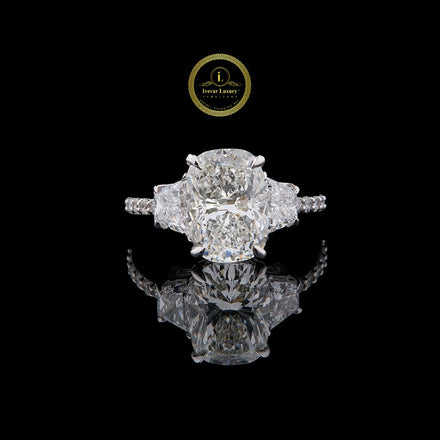
With lab grown, $10,000 buys a stone that stops rooms. Expect 2.5 to 4 carats with genuinely elite specifications — D–F color, VVS1–VVS2 clarity, Excellent cut, IGI certified — set in whatever mounting you can dream up. A 3-carat oval lab grown diamond of this quality, in a hand-engraved 18k gold setting with a hidden halo, is one of the most spectacular rings money can buy at any price. Nobody viewing it will think anything except "extraordinary."
This path also unlocks true bespoke design. At $10,000, commissioning a fully custom CAD-designed ring — sketched to your story, rendered in 3D, cast and hand-finished — is comfortably affordable with a lab grown center stone. Couples who want a one-of-one piece rather than a catalog design get the most creative freedom per dollar on this path. The trade-off to accept with open eyes: lab grown wholesale prices have fallen steadily as production scaled, so treat this ring as a forever piece, not an asset.

Path 2: Natural — Prestige and Permanence
With natural, $10,000 buys roughly a 1 to 1.5-carat GIA-graded diamond — and at this budget, you can demand superb specs: Excellent cut, G–H color, VS1–VS2 clarity. A 1.3-carat round brilliant with those grades in a platinum solitaire is the connoisseur's ring: not the biggest stone in the room, but arguably the finest-made. Natural diamonds carry the romance of billion-year origin and, historically, retain resale value far better than lab grown stones.
The discipline on this path: never sacrifice cut for carat. A 1.5-carat natural stone with mediocre cut looks smaller and duller than a 1.2-carat stone with Excellent cut — and at $10,000 there is no reason to compromise. Buy GIA-graded (the gold standard for natural), verify fluorescence is negligible-to-none, and keep the setting refined: platinum or 18k gold, classic proportions. Understated perfection is the whole aesthetic here.

Head-to-Head: What Changes, What Doesn't
Physically, nothing changes between the paths. A lab grown and natural diamond of the same cut, color, clarity and carat are indistinguishable — to the eye, the loupe, and the diamond tester. Both score 10 on the Mohs scale; both will look identical in fifty years. The differences are economic and emotional: price per carat, value retention, and what origin means to you. Be honest about which of those you actually care about, because $10,000 is too much to spend performing someone else's values.
One practical note: at this budget, buy from a jeweler with serious craftsmanship credentials regardless of path. Large stones magnify setting flaws — a poorly seated 3-carat diamond is a liability, not a luxury. Ask who makes the mounting, whether it is cast or hand-forged, and what the warranty covers. Then insure the finished ring immediately; at $10,000, a standalone jewelry policy is essential.
| Factor | $10,000 lab grown | $10,000 natural |
|---|---|---|
| Center stone | 2.5–4 ct, D–F, VVS | 1–1.5 ct, G–H, VS1–VS2 |
| Visual impact | Dramatic, showstopping size | Refined, connoisseur-grade |
| Setting options | Fully bespoke CAD design affordable | Classic platinum/18k designs |
| Value retention | Weak — prices still falling | Stronger — historically stable |
| Best for | Maximum beauty per dollar | Origin prestige & legacy |
The Third Option: Splitting the Budget
Some couples split the difference: a 2-carat lab grown diamond in an 18k gold setting with hand-finishing, landing around $7,000–$8,000, and the remainder saved or put toward the wedding. This is often the wisest use of a $10,000 budget — a ring with genuine presence, premium metal and craftsmanship, and no financial stretch. Remember that the ring is one line item in a marriage budget; arriving at the wedding unstressed is worth more than an extra half-carat.
Whichever path you take, the fundamentals do not change: independent certification (IGI for lab grown, GIA for natural), a jeweler whose workshop you trust, a 30-day return window, and insurance from day one. At $10,000 you are buying a small treasure — buy it like one.
Shop Our Best Sellers


Swipe to see more → | View all best sellers
Frequently Asked Questions
What does a $10,000 engagement ring look like?
With lab grown: a 2.5 to 4-carat diamond with elite specs in a designer setting — dramatic and showstopping. With natural: a 1 to 1.5-carat GIA-graded diamond of superb quality — refined and prestigious. Both are top-tier rings.
Is lab grown or natural better at $10,000?
Neither is objectively better — they are physically identical. Lab grown maximizes size and design freedom; natural offers origin prestige and stronger value retention. Choose based on what you value, not what impresses others.
Can anyone tell a lab grown diamond from natural?
No. Not by eye, loupe, or standard diamond tester. Only advanced laboratory equipment detecting growth signatures — plus the laser inscription and grading report — can identify origin.
Do expensive engagement rings hold value?
Natural diamonds retain value better than lab grown, whose wholesale prices have fallen steadily. But no engagement ring is an investment — retail markup means resale is always below purchase price. Buy for a lifetime of wear, not appreciation.
Should I get a custom-designed ring at $10,000?
It is the ideal budget for it, especially with a lab grown center stone. A bespoke CAD-designed ring — sketched, 3D-rendered and hand-finished to your story — delivers a one-of-one piece no catalog can match.
Platinum or gold at this budget?
Both are appropriate. Platinum is the most durable, naturally white and prestigious; 18k gold offers warmer tones and costs less, freeing budget for the stone. For a $10,000 natural-diamond ring, platinum is the classic pairing.
How should I insure a $10,000 ring?
With a standalone jewelry insurance policy or a scheduled rider, from the day you take possession. Expect roughly 1–2% of appraised value per year for coverage against loss, theft, damage and mysterious disappearance.
Sources
- Gemological Institute of America (GIA)
- International Gemological Institute (IGI)
- The Knot — Luxury Ring Data
- Brides — High-End Ring Guides
- American Gem Society

Aumsri Pradhan is the founder of Ivevar Luxury, a Surat-based fine jewelry brand that designs and handcrafts lab grown diamond and moissanite jewelry in its own workshop. She leads the brand's design and customer experience, from engagement rings and bridal sets to custom pieces made to each client's story. Through the Ivevar blog, she shares practical guidance on lab grown diamonds, moissanite, diamond grading and ring design to help buyers choose with confidence.