Engagement Rings
 Anniversary Rings
 Solitaire Rings
 Halo Rings
 Toi Moi Rings
 Three Stone Rings
 Nature Inspired Rings
 Rose Cut Rings
 Fancy Color Rings
 Antique Cut Rings
 Wedding Rings
 Wedding Band Rings
 Exclusive Lab Grown Diamond Rings
 All Lab Grown Diamond Ring
 Engagement Rings
 Three Stone Rings
 Fancy Color Rings
 Antique Cut Rings
 Daily Wear Rings
 Wedding Band Rings
 Exclusive Moissanite Rings
 Earrings
 Bracelet
 Pendant
 Necklace
 Men's Ring
 Bridal Sets
 Rings
Rings
 Earrings
 Tennis chain
 Cuban Chains
 Custom Pendant
 Custom Ring
 Custom Teeth Grillz
 Round
Round
 Oval
Oval
 Cushion
 Marquise
 Pear
Pear
 Emerald
 Heart
Heart
 Princess
 Rose Cut
 Radiant
 Antique Cut
 Brooch
 Cufflink
 Keychain
 Unique Products
 +91 9265051773
 Virtual Appointment
 log in




Cathedral vs Classic Solitaire Settings: What's the Difference?
by Ankit Koshiya on Sep 29, 2026

Short answer: A cathedral setting lifts the center stone high on sweeping arches of metal that rise from the band, giving height, drama, and a detailed side profile. A classic solitaire sets the stone low on a simple, unadorned band for a clean, timeless look. Cathedrals look more elaborate and shield the stone's sides; classic solitaires snag less, sit lower, and usually cost less.
- ✓ Cathedral = raised stone on arches. — Slopes of metal sweep up from the band to cradle the diamond high above the finger.
- ✓ Classic solitaire = stone set low and simple. — A plain band with minimal metal; the diamond does all the talking.
- ✓ Cathedrals look grander and more detailed. — The height and side profile give presence, especially with step cuts like emerald and Asscher.
- ✓ Classic solitaires are lower-maintenance. — Less metal to snag or scratch, easier to clean, and typically the more affordable setting.
- ✓ Both suit every diamond shape. — Round, oval, emerald, cushion, and pear all work — in lab grown diamond or moissanite.
What Is a Cathedral Setting?
A cathedral setting gets its name from the architecture it resembles: two slopes of metal rise from the band like the arches of a cathedral nave, meeting beneath the center stone to hold it high above the finger. The band's shoulders literally become part of the design, curving upward in a graceful slope that frames the diamond from the sides.
The effect is height and presence. Because the stone sits elevated, a cathedral setting shows off the diamond's full profile — the pavilion and girdle visible from the side — and the raised position catches light dramatically. The arches also add real structure: they brace the head of the ring, making the setting sturdy despite its height. It is the setting for someone who wants their ring to have architecture, not just a stone on a band.

What Is a Classic Solitaire Setting?
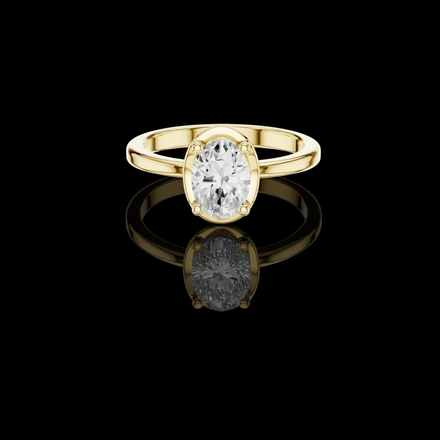
The classic solitaire is the purist's ring: a single diamond held by four or six prongs on a plain, unadorned band, sitting low and close to the finger. There are no arches, no slopes, no side detailing — the band stays flat and simple, and every eye goes straight to the stone.
That simplicity is the whole point. A classic solitaire maximizes the diamond itself: nothing competes with it, light floods in from every angle, and the low profile makes it the most comfortable, snag-free prong setting you can wear. It is also the most timeless choice in jewelry — the silhouette that has defined "engagement ring" for generations, and the one least likely to ever look dated.

Cathedral vs Classic Solitaire: Side by Side
The core difference is elevation. A cathedral lifts the diamond into the air on its arches; a classic solitaire keeps it grounded on the band. Everything else — looks, practicality, price — flows from that one decision.
| Feature | Cathedral Setting | Classic Solitaire |
|---|---|---|
| Stone height | Raised high on metal arches | Set low, close to the finger |
| Side profile | Detailed and architectural; pavilion visible | Minimal; clean straight band |
| Overall look | Grander, more elaborate, vintage-leaning | Understated, modern-classic, timeless |
| Snag risk | Higher — raised head can catch on fabrics | Lower — sits close to the hand |
| Wedding band fit | Straight bands usually sit flush against the arches | Straight bands sit flush; easiest pairing of all |
| Best diamond shapes | Emerald, oval, round — height flatters elongated cuts | Every shape; round and princess are the icons |
| Typical cost | More metal and labor — moderately higher | Simplest mounting — usually the most affordable |
Which One Suits Your Lifestyle?
Choose the cathedral if you love presence. The raised stone reads larger and more dramatic, the arches give the ring a crafted, almost vintage feel, and the height makes the diamond visible across a room. It pairs beautifully with wedding bands, since the arches create a natural cradle that straight bands nestle against. The trade-off is practical: a high-set stone catches on things more easily and takes harder knocks, so it suits someone who will baby their ring a little.
Choose the classic solitaire if you prize ease. Nothing wears more comfortably day in and day out — it slides under gloves, never snags a sweater, and asks for almost no maintenance beyond the occasional prong check. It is also the smarter pick if your partner works with their hands or leads an active life. And because the setting is so simple, more of your budget goes into the diamond itself rather than the mounting.
There is no wrong answer here, only a style answer. Some buyers even split the difference with a low cathedral — arches with a modest lift — getting the architectural look without the full height. If you are torn, try both on: the right setting usually announces itself the moment it is on the finger.
Price, Maintenance, and Diamond Choices
On price, the classic solitaire almost always wins — it is the simplest mounting a jeweler makes, using the least metal and labor. A cathedral costs moderately more for its extra metalwork, though the difference is small relative to the diamond itself. Either way, choosing a lab grown diamond or moissanite over a mined stone frees up far more budget than the setting choice ever will, letting you go bigger on the stone in either style.
Maintenance is straightforward for both: prong checks once or twice a year, regular cleaning, and insurance. Cathedrals deserve a little extra attention at the arches, where the metal meets the head, since that junction takes stress. Whichever you choose, both settings showcase the center stone honestly — so invest in cut quality first, because a well-cut diamond is what makes either silhouette sing.
Shop Our Best Sellers


Swipe to see more → | View all best sellers
Frequently Asked Questions
What is the difference between a cathedral and a solitaire setting?
A cathedral setting raises the center diamond high on arched metal shoulders that sweep up from the band, creating height and a detailed side profile. A classic solitaire sets the diamond low on a plain, unadorned band with minimal metal for a clean, understated look.
Is a cathedral setting more expensive than a classic solitaire?
Moderately, yes. The cathedral's arches require more metal and more bench labor than a simple solitaire mounting. The difference is usually a few hundred dollars at most — small compared with the cost of the diamond itself.
Do cathedral settings snag more than low solitaires?
They can. The raised head of a cathedral sits higher above the finger, so it is more likely to catch on fabrics or take a knock than a low-set classic solitaire. If your partner is very hands-on, the lower profile is the more practical pick.
Which setting makes the diamond look bigger?
The cathedral, generally. Elevating the stone and framing it with arches gives it more presence and makes the diamond visible from more angles. A classic solitaire can look equally substantial with a larger stone, since none of the budget goes into elaborate metalwork.
Can a wedding band sit flush with a cathedral setting?
Usually, yes. The cathedral's arches create a natural cradle that most straight wedding bands nestle against cleanly. A classic solitaire pairs flush with virtually any straight band, making it the easiest setting to match.
Are cathedral settings good for emerald cut diamonds?
Excellent. The height and open side profile of a cathedral beautifully showcase the long lines and hall-of-mirrors facets of emerald, Asscher, and other step cuts. It is one of the most flattering settings for elongated shapes.
Which setting is more timeless — cathedral or classic solitaire?
The classic solitaire is the most timeless silhouette in engagement rings and will never look dated. The cathedral is also a long-established classic with vintage roots, but its more elaborate profile reads as a bolder style statement.
Sources
- Gemological Institute of America (GIA)
- Brides — Engagement Ring Setting Guides
- The Knot — Ring Settings & Trends

Aumsri Pradhan is the founder of Ivevar Luxury, a Surat-based fine jewelry brand that designs and handcrafts lab grown diamond and moissanite jewelry in its own workshop. She leads the brand's design and customer experience, from engagement rings and bridal sets to custom pieces made to each client's story. Through the Ivevar blog, she shares practical guidance on lab grown diamonds, moissanite, diamond grading and ring design to help buyers choose with confidence.