

 Engagement Rings
 Anniversary Rings
 Solitaire Rings
 Halo Rings
 Toi Moi Rings
 Three Stone Rings
 Nature Inspired Rings
 Rose Cut Rings
 Fancy Color Rings
 Antique Cut Rings
 Wedding Rings
 Wedding Band Rings
 Exclusive Lab Grown Diamond Rings
 All Lab Grown Diamond Ring
 Engagement Rings
 Three Stone Rings
 Fancy Color Rings
 Antique Cut Rings
 Daily Wear Rings
 Wedding Band Rings
 Exclusive Moissanite Rings
 Earrings
 Bracelet
 Pendant
 Necklace
 Men's Ring
 Bridal Sets
 Rings
 Earrings
 Tennis chain
 Cuban Chains
 Custom Pendant
 Custom Ring
 Custom Teeth Grillz
 Round
 Oval
 Cushion
 Marquise
 Pear
 Emerald
 Heart
 Princess
 Rose Cut
 Radiant
 Antique Cut
 Brooch
 Cufflink
 Keychain
 Unique Products
 +91-9265051773
 Virtual Appointment
 log in




Short answer: Choose a round engagement ring if you want the most sparkle and a timeless look. Choose an oval if you want the biggest look for your budget and a shape that makes fingers look longer and slimmer. Ovals usually cost less per carat than rounds, while rounds hide color and inclusions a little better.
Oval and round are two of the most loved engagement ring shapes in the world, and they are often the final two on a shortlist. They have a lot in common: both are brilliant cuts, both have soft outlines with no sharp corners, and both suit almost every setting style. The differences are in sparkle, visible size, finger effect, price and the small details you need to check before you buy.
This guide compares the two side by side, explains what to look for in each shape, and helps you decide which one fits your hand, your style and your budget.
Oval vs Round at a Glance
| Round | Oval | |
|---|---|---|
| Sparkle | Maximum brilliance | Very bright, slightly softer |
| Visible size | Standard | Looks larger for the same carat |
| Price per carat | Higher | Usually lower |
| Effect on finger | Classic, balanced | Elongates the finger |
| Bow tie | None | Possible; choose a faint one |
| Hides color | Very well | Well; tips can show a little warmth |
| Cut grade on report | Usually given | Often not; judge by eye |
| Style | Timeless, traditional | Modern, elegant |
Sparkle: why round leads, and how close oval gets
The round brilliant has been refined over more than a century to return as much light as possible. Its 57 or 58 facets are arranged symmetrically around a circle, so light entering the stone is reflected back through the top evenly from every direction. The result is the brightest, most even sparkle of any diamond shape.
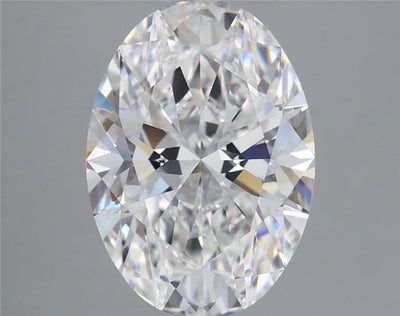
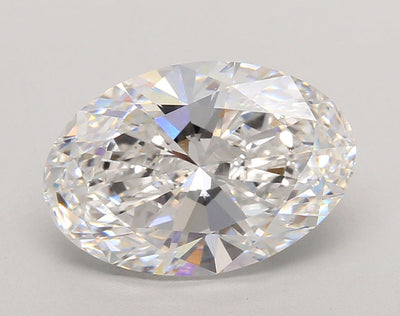
An oval is essentially a stretched round brilliant. It uses a similar facet pattern, so it is still very bright, with lively flashes of white light and colour. Because the outline is longer in one direction, though, light behaves slightly differently along the length of the stone. That is what creates the "bow tie" in some ovals, which we cover below.
In everyday life, a well-cut oval sparkles beautifully, and most people will never notice that a round is technically brighter. If sparkle is your top priority, round is the safe winner. If you want a strong sparkle plus more visible size, a well-cut oval gets you very close.
Size Comparison: Oval vs Round
Carat is a measure of weight, not size. Because an oval spreads its weight across a longer outline, it shows more surface area from the top than a round of the same carat weight.
| Carat | Round (diameter) | Oval (approx. 1.40 ratio) |
|---|---|---|
| 1 ct | about 6.5 mm | about 7.7 x 5.5 mm |
| 1.5 ct | about 7.4 mm | about 8.8 x 6.3 mm |
| 2 ct | about 8.1 mm | about 9.7 x 6.9 mm |
Measurements are approximate and vary with how each stone is cut. The key point: a 1 carat oval is noticeably longer than a 1 carat round is wide, so on the finger it reads as a bigger stone. Many buyers find that a 1.5 carat oval gives the presence they hoped a 2 carat round would.
The length-to-width ratio changes this too. A slimmer oval (around 1.50) looks longer; a fuller oval (around 1.30) looks wider and closer to a round. See our diamond size chart for more shapes and sizes.
Who Should Choose a Round Engagement Ring?
- Sparkle first: you want the most sparkle possible.
- Timeless taste: you love a classic look that never feels dated.
- Easy matching: you want a stone that easily fits almost any setting and wedding band.
- Simple buying: you prefer not to think about ratios or bow ties.
- Clear grading: you like having a formal cut grade on the certificate to guide you.
Who Should Choose an Oval Engagement Ring?
- Size for budget: you want the stone to look as large as possible for your budget.
- Slimming effect: you like a lengthening effect on shorter fingers.
- Something different: you want something a little more distinctive than a round.
- Design freedom: you like east-west, toi et moi or hidden halo designs.
- Vintage softness: you love a romantic, slightly vintage outline that still feels modern.
 Shown: Cathedral Style Oval Cut Lab Diamond Solitaire Engagement Ring
How each shape looks on different hands
The shape you pick changes how your whole hand looks, so it is worth thinking about your fingers as well as the stone.
- Short or wide fingers: an oval set north-south (lengthwise along the finger) creates a long line that makes fingers look slimmer. A round can look great too, especially in a size that does not cover the full width of the finger.
- Long, slender fingers: both shapes work. A round gives a balanced look; a fuller oval (ratio around 1.30 to 1.40) avoids looking too narrow.
- Small hands: a round of modest size looks proportionate, while a slim oval adds presence without extra width.
- Larger hands: ovals of 1.5 carats and up hold their own beautifully; rounds may need a halo or a larger carat to feel balanced.
Tip: Print or draw both outlines at their real millimetre size, cut them out and lay them on your finger. It takes two minutes and tells you more than any photo, because you see the shape against your own hand.
The Bow Tie Effect in Ovals
Many ovals show a darker, bow-tie-shaped area across the middle of the stone. It happens because light does not reflect back evenly through the centre of an elongated brilliant cut. Almost every oval has some bow tie; what matters is how strong it is.
- Faint bow tie: adds contrast and depth, and is perfectly acceptable. Many people like it.
- Moderate bow tie: visible in most lighting. Acceptable if the rest of the stone is bright.
- Strong or dark bow tie: looks like a dark band across the stone. Avoid it.
Bow ties are not listed on grading reports, so you need to see real photos or video of the actual stone, ideally in both bright and soft light. Rounds do not have this issue at all, which is one reason they are the simpler choice.
Buying Tips for Each Shape
Round
Choose the top cut grade with Excellent polish and symmetry. G to H color and VS2 clarity usually look white and clean. Because rounds hide colour and small inclusions well, you can often go a little lower in colour (H or I in yellow gold) and still get a bright, white-looking stone.
Oval
Pick a length-to-width ratio you like (1.35 to 1.50 is popular), avoid dark bow ties, and check real photos or video. G color or better looks best in white metal because ovals can show slight color at the tips. Read our oval engagement ring buying guide for more.
Ovals also benefit from a balanced outline. Check that both ends are evenly curved and that the "shoulders" (the sides near each end) are not too flat or too bulging. VS2 or SI1 clarity is usually eye-clean in an oval, as its brilliant facets hide small inclusions well.
Colour in each shape
A round brilliant's facet pattern is very good at masking a faint body colour, so a round in G or H looks white face-up in white gold. An oval concentrates colour slightly at its two ends, where the stone is narrower and light travels a longer path. That is why G or better is a safe choice for an oval in white gold. In yellow or rose gold, the warm metal hides colour in both shapes, so H or I can look lovely.
Clarity in each shape
Both shapes are brilliant cuts, and their many small facets break up light in a way that hides small inclusions well. VS2 is a reliable eye-clean choice for both, and many SI1 stones are eye-clean too. Larger stones show more, so step up a clarity grade as carat weight rises, and always check that no inclusion sits right under the table where it is easiest to see.
Price and Budget: Where Your Money Goes
For the same carat weight, colour and clarity, an oval usually costs less than a round. There are two simple reasons. First, cutting a round brilliant from a rough crystal wastes more material than cutting an oval, so each round carat costs more to produce. Second, rounds are in constant demand, which keeps their prices firm.
That difference gives you a choice. With the same budget you can:
- Go bigger with an oval: choose a larger carat weight and enjoy the extra face-up size on top of it.
- Go better with an oval: keep the same carat and spend the difference on a higher colour grade, a better setting or a matching band.
- Stay round and prioritise cut: choose a slightly smaller round with a top cut grade, which will out-sparkle a larger but poorly cut stone.
Lab grown diamonds and moissanite both cost far less than mined diamonds of similar size, so whichever shape you choose, these stones let you reach a larger size or a higher grade than you might expect. Set a total budget for the ring first, then decide how to split it between the stone, the setting and the metal.
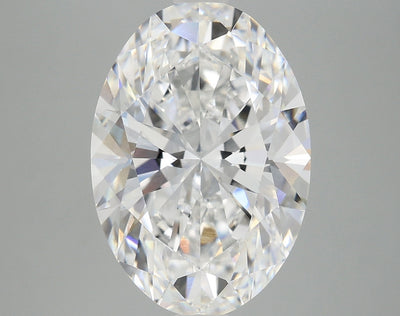
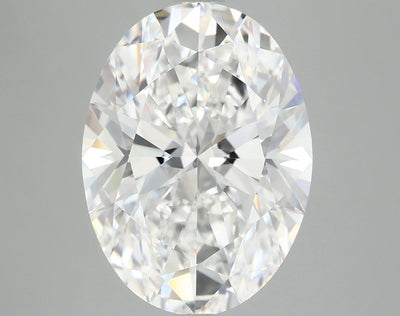
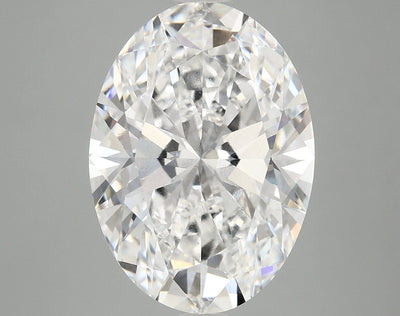
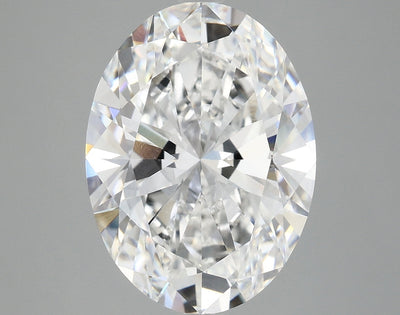
Shop the styles in this guide
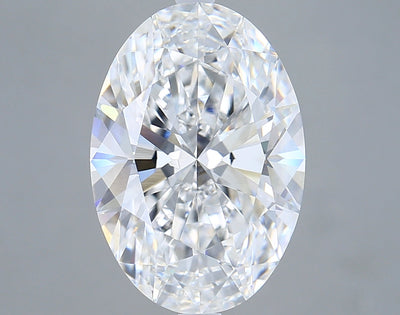

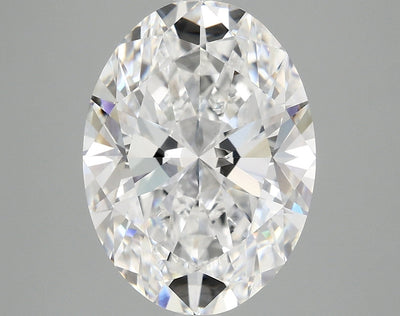

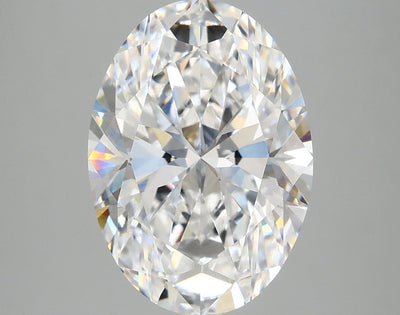
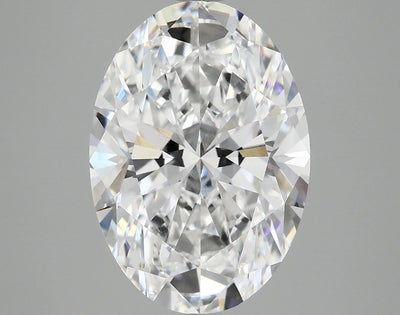




Questions to Ask Before You Buy
- Can I see a real video? Essential for ovals to judge the bow tie and outline; helpful for rounds to see true sparkle.
- What are the exact measurements? Millimetres tell you how big the stone will look; carat alone does not.
- Is there a grading report? For lab grown diamonds, ask for an IGI or GIA report and check that the measurements match.
- What is the length-to-width ratio? For ovals, confirm it falls in the range you like.
- How high does the setting sit? Higher settings show more stone; lower settings snag less and pair more easily with a band.
- What is the return policy? Know your options before you order, especially when buying online.
Lab Grown Diamond or Moissanite?
Both shapes are available as lab grown diamonds and as moissanite, and the choice of stone matters as much as the shape.
| Lab grown diamond | Moissanite | |
|---|---|---|
| What it is | Real diamond, same as mined | Silicon carbide, a different gem |
| Hardness (Mohs) | 10 | 9.25 |
| Refractive index | About 2.42 | About 2.65, more rainbow flashes |
| Grading | IGI or GIA reports, 4Cs | Usually graded by colour and clarity only |
Lab grown diamonds are chemically, physically and optically the same as mined diamonds, grown using the CVD or HPHT methods. Moissanite is not a diamond, but its brilliance and durability make it a popular engagement stone. Moissanite's extra fire can be especially striking in a round, while some buyers prefer a lab diamond oval for its softer, whiter sparkle. Compare lab diamond ovals, lab diamond rounds and moissanite ovals.
Best Settings for Oval and Round Stones
Solitaire
A single stone on a plain or pavé band suits both shapes. Rounds look classic in four or six prongs; ovals usually look best in four or six prongs with the band tapering toward the stone.
Halo and hidden halo
A halo adds visible size and sparkle. Around a round, it creates a bright, circular look. Around an oval, it emphasises the length and makes the stone look even larger. A hidden halo sits under the stone and is seen only from the side.
East-west, three-stone and toi et moi
Ovals turned sideways (east-west) feel modern and sit low on the hand. Both shapes work in three-stone designs, and an oval paired with a pear or round in a toi et moi ring is a popular way to combine two shapes.
Matching a wedding band
Rounds sit easily next to most straight bands. Ovals sometimes leave a small gap against a straight band, especially with low settings; a slightly curved or contoured band can close it. Choose your setting height with your future band in mind.
Oval and Round Engagement Rings at Ivevar
We handcraft every engagement ring in our Surat workshop, send a CAD design for approval, and ship free worldwide, with 30-day easy returns. Choose lab grown diamonds, many with IGI certificates, or moissanite, set in 10K, 14K or 18K gold. If you want help deciding between shapes, book a virtual appointment and we will show you both side by side, or ask us to create a custom design. Browse lab grown diamond engagement rings and solitaire rings.
Shop Oval and Round Engagement Rings
 Cathedral Oval Solitaire RingShop Now
 Elongated Oval Slim Band RingShop Now
 Split Shank Oval SolitaireShop Now
 Round Cathedral Solitaire RingShop Now
 Six Prong Round Solitaire RingShop Now
 Round Pave Band Engagement RingShop Now
Swipe to see more → | View all engagement rings
Frequently Asked Questions
Is oval or round more popular?
Round has long been the most popular engagement ring shape, and oval is one of today's most requested alternatives.
Does an oval look bigger than a round?
Yes. At the same carat weight, an oval usually has a larger face-up area.
Which shape is more durable?
Both have no sharp corners, so both are durable for everyday wear.
Which shape suits short fingers?
Ovals set north-south help short fingers look longer.
Which shape sparkles more?
A well-cut round brilliant returns the most light of any shape. A well-cut oval is very close and still very bright, with slightly broader flashes.
What is the best length-to-width ratio for an oval?
There is no single best ratio. Between 1.35 and 1.50 is the most popular range; lower ratios look fuller, higher ratios look slimmer and longer. Pick the outline you find most beautiful.
Is an oval cheaper than a round?
Usually, per carat. More of the rough crystal is lost when cutting a round, and demand for rounds is high, so rounds tend to cost more for the same carat, colour and clarity.
Do oval and round stones need different care?
No. Both shapes have no sharp corners, so they are less likely to chip than pointed shapes. Clean either one with warm water, a drop of mild soap and a soft brush, and have the prongs checked once a year. Ovals in tall settings can catch on knits and hair, so a lower setting is worth considering if you have an active routine.
Can I switch shapes after ordering?
If your ring has not yet been made, talk to us as early as possible; once a custom ring is crafted, changing the centre stone means remaking the setting, because prongs are shaped to fit one outline.
Can I see the stone before my ring is made?
Yes. At Ivevar we can share photos or video of your stone and send a CAD design for approval before we craft the ring.
The Bottom Line
Round gives maximum sparkle and a classic look; oval gives more visible size and a modern, elongating shape. Try both on and choose the one that makes you smile. If you are still torn, look at your hand from a normal distance rather than up close: that is how you and everyone else will see the ring every day.
Related Guides
- Oval engagement rings: the complete buying guide
- Engagement ring settings explained
- How much should you spend on an engagement ring?

Author Bio
Aumsri Pradhan
Founder, Ivevar Luxury
Aumsri Pradhan is the founder of Ivevar Luxury, a Surat-based fine jewelry brand that designs and handcrafts lab grown diamond and moissanite jewelry in its own workshop. She leads the brand's design and customer experience, from engagement rings and bridal sets to custom pieces made to each client's story. Through the Ivevar blog, she shares practical guidance on lab grown diamonds, moissanite, diamond grading and ring design to help buyers choose with confidence.


