

 Engagement Rings
 Anniversary Rings
 Solitaire Rings
 Halo Rings
 Toi Moi Rings
 Three Stone Rings
 Nature Inspired Rings
 Rose Cut Rings
 Fancy Color Rings
 Antique Cut Rings
 Wedding Rings
 Wedding Band Rings
 Exclusive Lab Grown Diamond Rings
 All Lab Grown Diamond Ring
 Engagement Rings
 Three Stone Rings
 Fancy Color Rings
 Antique Cut Rings
 Daily Wear Rings
 Wedding Band Rings
 Exclusive Moissanite Rings
 Earrings
 Bracelet
 Pendant
 Necklace
 Men's Ring
 Bridal Sets
 Rings
 Earrings
 Tennis chain
 Cuban Chains
 Custom Pendant
 Custom Ring
 Custom Teeth Grillz
 Round
 Oval
 Cushion
 Marquise
 Pear
 Emerald
 Heart
 Princess
 Rose Cut
 Radiant
 Antique Cut
 Brooch
 Cufflink
 Keychain
 Unique Products
 +91-9265051773
 Virtual Appointment
 log in




Radiant Cut Engagement Rings: Brilliant Styles & Prices
by Aumsri Pradhan on Sep 29, 2026

Short answer: A radiant cut has the clean rectangular or square outline of an emerald cut with the lively sparkle of a brilliant cut. Its clipped corners make it durable, and it hides small inclusions well. Choose a ratio of about 1.00–1.05 for a square look or 1.25–1.35 for a classic rectangle.
The radiant is the shape for people who cannot decide between crisp lines and big sparkle. It gives you both. This guide covers what makes a radiant different, how to pick the right ratio, which settings suit it, what drives the price, and whether a lab grown diamond or moissanite radiant is the better fit for you.
What Is a Radiant Cut?
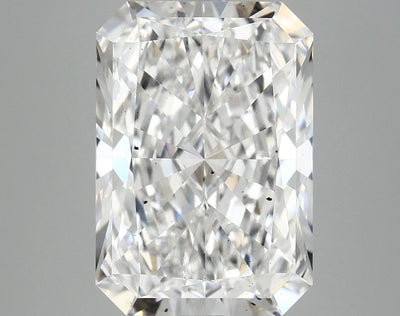
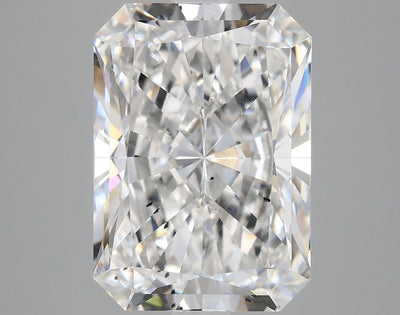
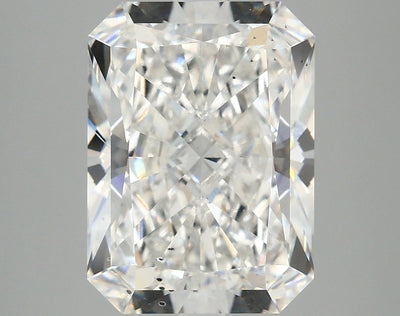
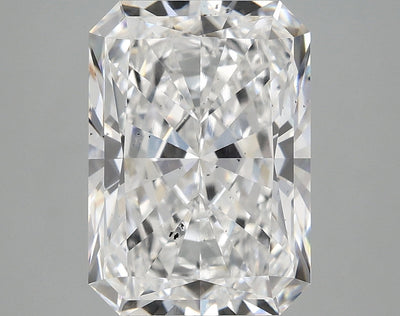
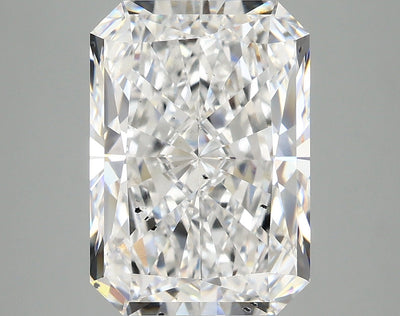
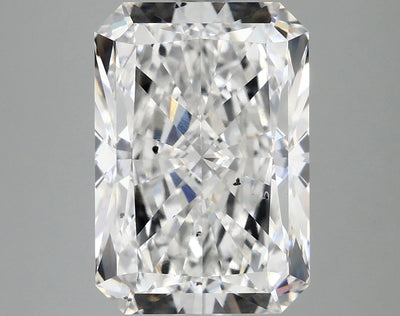
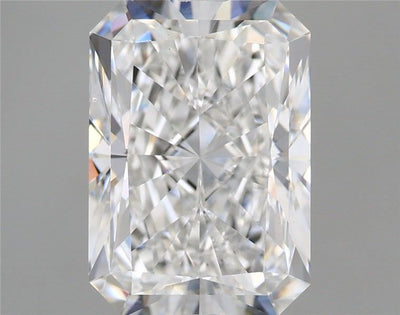
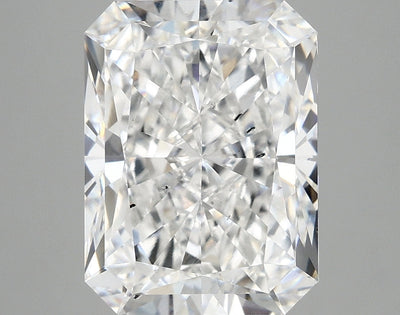
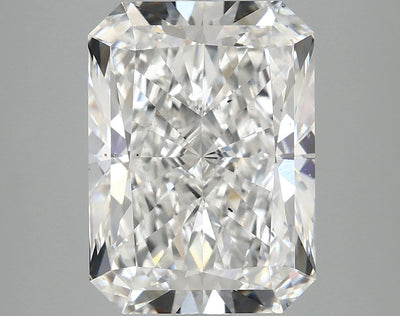
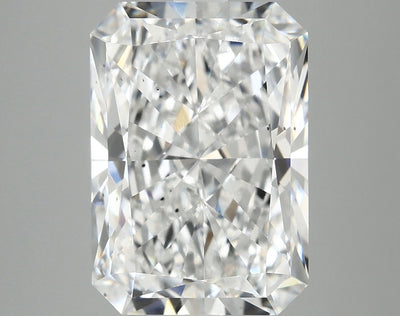
A radiant is a square or rectangular stone with trimmed (cut-off) corners and a full set of brilliant-style facets on the crown and pavilion. Most step cuts, like the emerald and Asscher, use long parallel facets that create broad flashes of light, sometimes called a "hall of mirrors" effect. The radiant takes that same tailored outline and fills it with dozens of smaller triangular and kite-shaped facets, which break light into lots of quick, bright sparkles.
The result looks a little like crushed ice when you tilt it: busy, bright and very lively. It sits between the calm elegance of an emerald and the round brilliant's fireworks, which is why it appeals to such a wide range of tastes.
The anatomy that matters
- Cropped corners: the four small angled edges that replace sharp points. They are the key to the radiant's durability.
- Brilliant pavilion: the faceting underneath, which does most of the work of returning light.
- Table: the flat top facet. A moderate table keeps the sparkle lively without looking glassy.
- Depth: radiants are often cut a little deeper than other fancy shapes, which affects how large they look face-up.
Why Choose a Radiant Cut
Radiant cuts use brilliant-style facets inside a step-cut outline, so they sparkle more than emerald or Asscher cuts. The cut corners protect the stone from chipping, which makes it practical for daily wear. Its shape pairs well with baguette, marquise or pear side stones.
There are a few more reasons buyers love this shape:
- Forgiving clarity: all those small facets scatter light and help hide minor inclusions, so you rarely need a top clarity grade.
- Flexible outline: you can choose anything from a near-perfect square to a long rectangle.
- Modern but timeless: straight lines feel architectural and fresh, while the sparkle keeps it romantic.
- Easy to pair: straight edges sit neatly next to a plain or pavé wedding band.
Choosing the Right Ratio
The length-to-width ratio decides whether your radiant reads as a square or a rectangle. Divide the length by the width to find it. Here is how the common ranges look:
| Ratio | Look | Good for |
|---|---|---|
| 1.00–1.05 | Square radiant | A bold, compact, modern look |
| 1.10–1.20 | Soft rectangle | A gentle balance between square and long |
| 1.25–1.35 | Classic elongated rectangle | Lengthening the finger and looking larger |
| 1.40 and above | Long, slim rectangle | A striking, dramatic statement |
Elongated radiants spread their weight over a longer surface, so they look bigger than a square one of the same carat weight. A square radiant, by contrast, looks compact and confident. Neither is better; it depends on the hand and on personal taste.
Tip: If you are buying as a surprise, a ratio around 1.25 to 1.30 is a safe middle ground. It reads clearly as a rectangle, flatters most fingers, and looks generous for its weight.
Radiant vs Other Popular Cuts
- Radiant vs emerald: both are rectangular, but the emerald uses long step facets for a calm, mirror-like look, while the radiant is cut for maximum sparkle. Radiants are also more forgiving of small inclusions.
- Radiant vs princess: both can be square, but the princess has sharp, pointed corners. The radiant's trimmed corners are less likely to chip and look softer on the hand.
- Radiant vs cushion: the cushion has rounded corners and a pillow-like outline. The radiant looks crisper and more geometric.
- Radiant vs oval: both look large for their weight when elongated. The oval is soft and curved; the radiant has straight lines and a modern feel.
| Shape | Sparkle style | Corner durability |
|---|---|---|
| Radiant | Bright, busy, "crushed ice" | High (cropped corners) |
| Emerald | Broad, calm flashes | High (cropped corners) |
| Princess | Bright, crisp | Lower (sharp points) |
| Cushion | Soft, chunky sparkle | High (rounded corners) |
| Oval | Bright, flowing | High (no corners) |
Best Settings for a Radiant Cut
Solitaire: a clean four-prong or claw setting shows off the outline. Browse our lab diamond solitaire rings for simple styles. Halo: a row of small stones around the center adds sparkle and makes it look larger; see our halo rings. Hidden halo: stones sit under the center stone, visible from the side only. Three stone: a radiant center with trapezoid, baguette or pear side stones looks balanced and elegant; explore our three stone rings.
More setting ideas
- Bezel: a thin rim of metal around the whole stone. Very secure and sleek, ideal for active hands.
- East-west: the rectangle set sideways across the finger for a modern, low-profile look.
- Pavé band: small stones along the shank add sparkle without hiding the center's outline.
- Marquise side stones: the pointed side stones contrast nicely with the radiant's straight edges.
Whatever you choose, make sure there is a prong or bezel covering each corner. Even cropped corners are the most exposed part of the stone.
How to Choose a Radiant Cut
- Pick the outline first. Decide between square and rectangular using the ratio table above.
- Look at the face-up size. Elongated radiants spread their weight over a longer surface, so they look bigger than a square one of the same carat weight. Compare millimetre measurements, not just carats.
- Watch the color. Radiants hold color a little more in their corners than round stones do, so if you want a very white look, choose a higher color grade or a white gold setting.
- Clarity can be moderate. The many facets help hide small inclusions, so a stone that looks clean to the eye does not need the top clarity grade.
- Check the depth. A radiant that is very deep carries hidden weight underneath and can look smaller than its carat weight suggests.
- Look for even sparkle. In a video, the light should spread across the whole stone. Avoid stones with a dark patch in the middle.
Common mistakes to avoid
- Judging size by carat alone. Two radiants of the same weight can look quite different face-up because of depth. Always compare length and width in millimetres.
- Paying for clarity you cannot see. With radiant faceting, eye-clean is enough for most buyers. Put the savings toward size or a better setting.
- Ignoring the corners. Make sure each corner sits under a prong or bezel, even though the corners are cropped.
- Buying from a single photo. Radiants vary in how evenly they sparkle. A short video shows dark patches or a weak center much better than a still image.
- Choosing a ratio she will not like. If she has shown you rings she admires, note whether they are square or long. That is the best clue you will get.
A little care at the buying stage means a ring that looks right on her hand for decades, not just in the listing.
What Affects the Price?
Carat weight, color, clarity and cut quality all play a part, as do the length-to-width ratio and the setting. A halo, hidden halo or pavé band adds more small stones and more work. The metal you choose, such as 925 silver or 10K to 18K gold, also changes the final cost.
| Price factor | How it affects cost |
|---|---|
| Stone type | Moissanite usually costs less than a lab grown diamond of similar size |
| Carat weight | Prices climb faster as you cross whole and half carat marks |
| Color and clarity | Top grades cost more; eye-clean and near-colorless give the best value |
| Setting design | Halos, pavé and side stones add stones and labor |
| Metal | Silver is the most affordable; 18K gold is the richest and highest priced |
To see current prices, browse our lab diamond radiant and moissanite radiant collections. You can filter by metal and style to find what fits your budget.
Ways to get more for your budget
- Stay just under a round number: a stone slightly below a whole or half carat looks nearly identical but costs less.
- Choose an elongated ratio: it looks larger for the same weight.
- Put the money in the center stone: a simple solitaire or thin pavé band leaves more budget for the stone itself.
Shop the styles in this guide
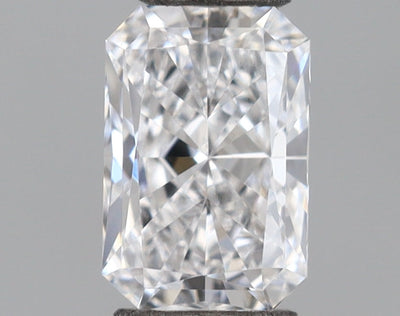
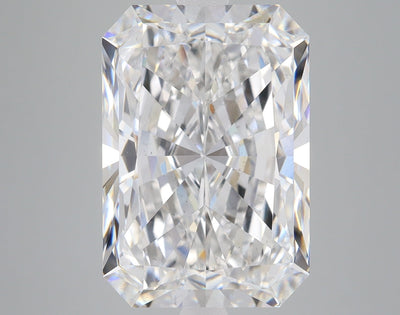


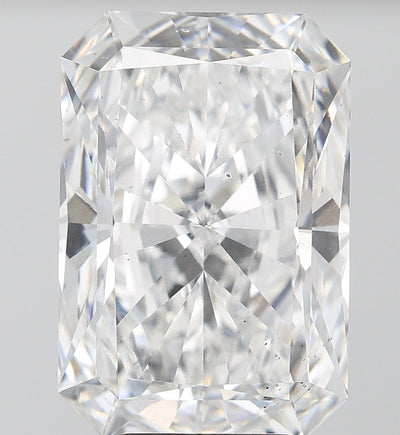

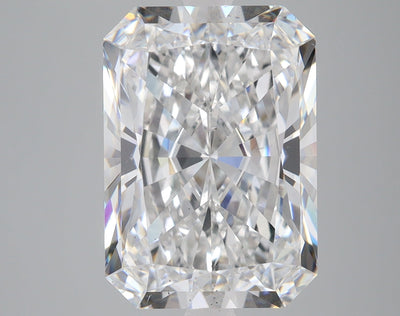




Lab Grown Diamond or Moissanite Radiant?
A lab grown diamond radiant is a real diamond, grown by the CVD or HPHT method and rated 10 on the Mohs scale. It is chemically, physically and optically the same as a mined diamond, and many of our stones come with IGI certificates. A moissanite radiant rates 9.25, is very durable, and shows extra rainbow fire, which the radiant's brilliant facets bring out strongly. Both are excellent for daily wear.
Moissanite is not a diamond, and we always label it as moissanite. Its refractive index of about 2.65 is higher than diamond's 2.42, which is why it throws more colorful flashes. Some people love that extra color; others prefer the whiter, classic brilliance of diamond.
| Question | Lab grown diamond | Moissanite |
|---|---|---|
| Is it a diamond? | Yes | No, it is silicon carbide |
| Hardness (Mohs) | 10 | 9.25 |
| Look in a radiant cut | Crisp white sparkle | Strong rainbow fire |
| Best if she wants | "A real diamond" | Maximum sparkle for the budget |
Choosing the metal
White gold gives an icy, modern frame that makes a near-colorless radiant look even whiter. Yellow gold feels warm and vintage, and it is forgiving if the stone has a hint of warmth. Rose gold adds a soft, romantic tone. For everyday rings, 14K gold balances durability and color well; 18K is richer and a little softer, and 10K is the hardest and most budget-friendly. We also make many designs in 925 sterling silver. Whichever metal you pick, ask for the prongs in a matching or white metal if you want the stone to look as white as possible.
Who Suits a Radiant Cut?
The radiant is one of the most adaptable shapes, but a few wearers get the most from it:
- Short or wide fingers: an elongated rectangle draws the eye along the finger and makes the hand look slimmer.
- Long, slender fingers: a square or soft-rectangle radiant adds width and balance.
- Active lifestyles: the cropped corners and a low or bezel setting make it a practical everyday ring.
- Fans of Art Deco style: straight lines and geometric side stones echo the period's look.
- Sparkle lovers who want something different: it shines as brightly as many round stones but looks far less common.
If you are unsure, look at her current jewelry. Someone who wears clean, geometric pieces will probably love a radiant. Someone who wears soft, curved shapes may lean toward an oval or cushion instead.
Pairing a Wedding Band
Because a radiant has straight sides, it sits beautifully next to a straight band. A few pairing ideas:
- Plain band in the same metal: the simplest, most timeless option, and it keeps the focus on the center stone.
- Pavé or eternity band: adds a line of sparkle that matches the radiant's lively look.
- Baguette band: rectangular step-cut stones echo the radiant's outline for a sleek, tailored set.
- Contoured band: useful if the engagement ring has a low halo or side stones that would otherwise stop a straight band sitting flush.
Check the setting height before you buy. If the band needs to slide under the center stone, the engagement ring needs enough clearance. Our lab grown wedding bands include many styles designed to sit neatly beside a fancy-shape center.
Radiant Cuts Beyond the Engagement Ring
The same qualities that make a radiant a great center stone work across other jewelry too. Because the shape is bright and compact, it reads well even in small sizes.
- Stud earrings: square radiants look bold and modern, and the cropped corners sit comfortably in four-prong or bezel studs.
- Pendants: an elongated radiant on a fine chain makes a clean, geometric solitaire necklace that pairs with almost anything.
- Tennis bracelets: a line of radiants creates a continuous, crisp edge of sparkle with no gaps between rounded stones.
- Anniversary and eternity bands: small radiants set side by side give a sleek, tailored look that complements a radiant engagement ring.
If you are building a matching set over time, choosing radiants for each piece gives the collection a consistent, intentional look. Our custom jewelry service can help match the stone type, color and metal across pieces so they sit together naturally.
Caring for a Radiant Cut Ring
The radiant's many facets collect lotion and soap quickly. Soak the ring in warm water with mild dish soap, brush gently under the stone, and rinse. Have the prongs at the corners checked once a year.
Tip: Take your ring off before applying hand cream or sunscreen. A thin film on the pavilion is the main reason a radiant suddenly looks dull.
Shop at Ivevar
Explore our lab diamond radiant and moissanite radiant collections. Every order includes free worldwide shipping and 30-day easy returns, and our custom jewelry team can build a radiant ring to your exact ratio and metal. A few favorites:


Frequently Asked Questions
Is a radiant cut more sparkly than an emerald cut?
Yes. Radiant cuts use brilliant faceting, so they sparkle more than step-cut emeralds.
Are radiant cuts durable?
Yes. The clipped corners make them less likely to chip than sharp-cornered princess cuts.
Do radiant cuts look big?
Elongated radiants look larger than a round of the same weight; square radiants look similar in size.
What metal suits a radiant cut?
White gold gives an icy, modern look, yellow gold feels warm and vintage, and rose gold adds a soft, romantic tone. Choose the metal your partner wears most.
What is the most popular radiant ratio?
The classic rectangle, around 1.25 to 1.35, is the most widely chosen. Square radiants near 1.00 are a bolder, more compact alternative.
Do I need a high clarity grade for a radiant?
Usually not. The brilliant faceting hides small inclusions well, so an eye-clean stone looks just as good on the hand as a much higher grade.
Is a radiant cut good for an everyday ring?
Yes. The cropped corners resist chipping, and both lab grown diamond and moissanite are hard enough for daily wear. A bezel or low prong setting adds extra protection for busy hands.
Does a radiant look bigger than a princess cut?
An elongated radiant usually looks larger than a square princess of the same weight. A square radiant and a princess look fairly similar in size, but the radiant's corners are softer and more durable.
Can I book help choosing a radiant?
Yes. You can book a virtual appointment with our team to compare stones, settings and metals before you order.


