Engagement Rings
 Anniversary Rings
 Solitaire Rings
 Halo Rings
 Toi Moi Rings
 Three Stone Rings
 Nature Inspired Rings
 Rose Cut Rings
 Fancy Color Rings
 Antique Cut Rings
 Wedding Rings
 Wedding Band Rings
 Exclusive Lab Grown Diamond Rings
 All Lab Grown Diamond Ring
 Engagement Rings
 Three Stone Rings
 Fancy Color Rings
 Antique Cut Rings
 Daily Wear Rings
 Wedding Band Rings
 Exclusive Moissanite Rings
 Earrings
 Bracelet
 Pendant
 Necklace
 Men's Ring
 Bridal Sets
 Rings
Rings
 Earrings
 Tennis chain
 Cuban Chains
 Custom Pendant
 Custom Ring
 Custom Teeth Grillz
 Round
Round
 Oval
Oval
 Cushion
 Marquise
 Pear
Pear
 Emerald
 Heart
Heart
 Princess
 Rose Cut
 Radiant
 Antique Cut
 Brooch
 Cufflink
 Keychain
 Unique Products
 +91 9265051773
 Virtual Appointment
 log in



Two-Tone Wedding Bands: A Guide to Mixing Gold Colors
by Ankit Koshiya on Sep 29, 2026

Short answer: Two-tone wedding bands combine two gold colors — typically yellow with white, or rose with yellow — in one ring, giving you the versatility to match any jewelry you own. They are built to last (the metals are fused, not plated), suit couples who can't agree on one color, and pair beautifully with mixed-metal stacks. The only real rule: keep the design balanced so neither tone overwhelms the other.
- ✓ Two-tone means versatility. One ring that matches both your yellow-gold and white-metal jewelry.
- ✓ The metals are fused solid. Real two-tone bands are not plated — the colors cannot wear off.
- ✓ Great for undecided couples. Each partner's band can lead with a different tone.
- ✓ Balance the design. Roughly equal visual weight keeps the ring harmonious, not busy.
- ✓ White gold sections need replating. The white portions wear like any white gold — plan for upkeep.
What "Two-Tone" Actually Means
A true two-tone wedding band is made from two solid gold alloys joined together — yellow gold beside white gold, rose beside yellow, sometimes all three (tricolor). The metals are soldered, fused, or inlaid as solid sections: a yellow center with white edges, a white band with a yellow inlay stripe, a braided or woven pattern. Because both colors are solid metal through and through, they can never "wear off" the way plating can. A two-tone band looks the same in year twenty as day one, apart from normal polishing.
Be wary of rings marketed as two-tone that are actually plated — a yellow band with white rhodium plating on sections, for instance. Plating wears through with daily use, leaving a patchy ring. Ask directly: "are both colors solid metal?" A reputable jeweler answers instantly and the price reflects it — solid two-tone construction costs more than plating, and is worth it.
The Classic Combinations
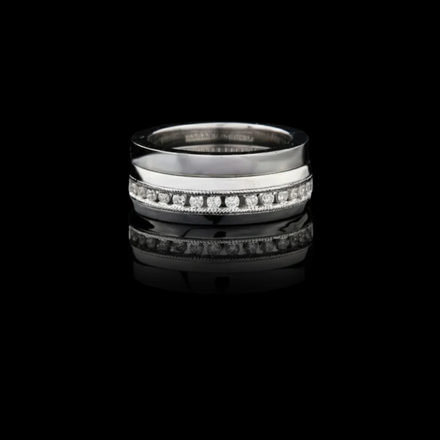
Yellow and white gold is the original two-tone pairing and still the most popular. It bridges the classic yellow-gold wedding tradition with modern white-metal tastes — ideal when one partner loves yellow gold and the other wears platinum or white gold daily. Rose and yellow gold is the romantic pairing: warm on warm, vintage-feeling, gorgeous on warm skin tones. Rose and white is the most contemporary — soft pink against crisp white, striking in braided or twisted designs.
Tricolor bands — yellow, white, and rose in one ring, with interlocking rolling rings as the classic example — are the maximalist choice. They work best in simple forms (rolling bands, plain tri-color stripes) where the three colors get equal billing. In busy designs, three tones can turn chaotic; restraint is the tricolor's best friend.

Why Couples Choose Two-Tone
The most common reason is simple: they couldn't agree. She loves the warmth of yellow gold; he wears a white-gold watch daily and wants his ring to match. A two-tone band — or a pair where hers leads yellow and his leads white — resolves the standoff elegantly, and many couples report liking the compromise more than either original preference.
The second reason is wardrobe versatility. If your jewelry box mixes metals — a yellow gold necklace, white gold earrings, a two-tone watch — a two-tone band harmonizes with all of it. No more feeling like your ring clashes with your other pieces. And the third reason is fashion: mixed metals are a defining jewelry trend of the mid-2020s, and a two-tone band puts you in it without committing your whole collection.
Design Rules for Getting It Right
Balance the visual weight. The most successful two-tone bands give each color roughly equal presence — a centered stripe, alternating sections, a symmetric braid. Designs where one tone is a whisper-thin accent can look like an afterthought; designs where tones fight at unequal sizes look busy. Mind the boundaries. Crisp, clean lines between the metals read as intentional and luxurious; wavy or uneven joins read as craftsy.
Consider the engagement ring. A two-tone band beside a single-tone engagement ring works when the band picks up the engagement ring's metal as one of its tones — the shared color ties the pair together. A two-tone band beside an already two-tone engagement ring risks overload; in that case, let the band go simpler. Texture helps. Brushed centers with polished edges (or vice versa) in two tones create depth that single-tone rings can't match.
Care: The White Gold Caveat
Two-tone bands need the same care as their component metals — which means the white gold sections need what white gold always needs: rhodium replating every 12–18 months to stay bright white. The yellow and rose sections just need occasional polishing. When replating, the jeweler masks the yellow/rose sections so only the white gets dipped; a good jeweler does this routinely, but confirm yours is comfortable with two-tone work before you buy.
Resizing two-tone bands is slightly more complex than single-tone — the jeweler must match the metal colors at the join — but entirely routine for an experienced bench. As with any patterned band, extreme size changes can distort the design, so get the size right the first time.

| Combination | Mood | Best for | Watch out for |
|---|---|---|---|
| Yellow + white | Classic bridge | Couples split on color; mixed jewelry boxes | White sections need replating |
| Rose + yellow | Warm, romantic | Vintage lovers, warm skin tones | Tones can blur together at small scale |
| Rose + white | Modern contrast | Contemporary brides, braided designs | White sections need replating |
| Tricolor | Maximalist icon | Statement wearers, rolling-ring fans | Keep the form simple to avoid chaos |
Shop Our Best Sellers


Swipe to see more → | View all best sellers
Frequently Asked Questions
What is a two-tone wedding band?
A wedding band made from two solid gold colors — such as yellow and white gold — fused together in one ring. Both colors are solid metal throughout, so they never wear off like plating.
Are two-tone rings just plated?
Quality two-tone bands are solid fused metal, not plated. Always ask the jeweler to confirm both colors are solid — plated "two-tone" rings wear through to patchy metal with daily use.
Do two-tone wedding bands cost more?
Solid two-tone construction costs somewhat more than a single-tone band of the same weight, reflecting the extra labor of joining metals. The premium is modest — roughly 10–25% — not a doubling.
Which two-tone combination is most popular?
Yellow and white gold remains the classic, bridging traditional and modern tastes. Rose and yellow is the romantic favorite; rose and white the most contemporary. Tricolor adds all three.
Can I wear a two-tone band with a single-tone engagement ring?
Yes — it works best when the band includes your engagement ring's metal as one of its tones, tying the pair together. Avoid pairing a two-tone band with an already two-tone engagement ring.
Does the white gold in a two-tone band need replating?
Yes, the white gold sections wear like any white gold and need rhodium replating every 12–18 months. The jeweler masks the yellow/rose sections during the process.
Can two-tone bands be resized?
Yes, by an experienced jeweler who matches the metal colors at the join. Extreme size changes can distort patterned designs, so get the size right initially.
Sources

Aumsri Pradhan is the founder of Ivevar Luxury, a Surat-based fine jewelry brand that designs and handcrafts lab grown diamond and moissanite jewelry in its own workshop. She leads the brand's design and customer experience, from engagement rings and bridal sets to custom pieces made to each client's story. Through the Ivevar blog, she shares practical guidance on lab grown diamonds, moissanite, diamond grading and ring design to help buyers choose with confidence.