

 Engagement Rings
 Anniversary Rings
 Solitaire Rings
 Halo Rings
 Toi Moi Rings
 Three Stone Rings
 Nature Inspired Rings
 Rose Cut Rings
 Fancy Color Rings
 Antique Cut Rings
 Wedding Rings
 Wedding Band Rings
 Exclusive Lab Grown Diamond Rings
 All Lab Grown Diamond Ring
 Engagement Rings
 Three Stone Rings
 Fancy Color Rings
 Antique Cut Rings
 Daily Wear Rings
 Wedding Band Rings
 Exclusive Moissanite Rings
 Earrings
 Bracelet
 Pendant
 Necklace
 Men's Ring
 Bridal Sets
 Rings
 Earrings
 Tennis chain
 Cuban Chains
 Custom Pendant
 Custom Ring
 Custom Teeth Grillz
 Round
 Oval
 Cushion
 Marquise
 Pear
 Emerald
 Heart
 Princess
 Rose Cut
 Radiant
 Antique Cut
 Brooch
 Cufflink
 Keychain
 Unique Products
 +91-9265051773
 Virtual Appointment
 log in




Short answer: No, they are not the same. An engagement ring is given at the proposal and usually has a prominent center stone. A wedding ring (or wedding band) is exchanged during the wedding ceremony and is usually a simpler band, often worn by both partners. Many people wear both together on the same finger, with the wedding band closest to the heart, and plan them as a matching pair.
Engagement rings and wedding bands are both steeped in symbolism and tradition, but they do not mean the same thing. For centuries these rings have represented love and commitment, yet each one marks a different moment: the promise to marry, and the marriage itself.
This guide explains the differences in meaning, design and tradition, how each ring developed, how customs vary around the world, and the practical questions couples ask when buying them, from budgets and metals to stacking and fit.
Engagement Rings vs. Wedding Bands: A Closer Look
| Aspect | Engagement Rings | Wedding Bands |
|---|---|---|
| Symbolism | Represents the proposal and intent to marry | Symbolizes the marriage and lifelong commitment |
| Design | Often features a prominent center stone, typically a diamond | Simpler, often a plain band or set with small diamonds |
| Occasion | Given during the proposal | Exchanged during the wedding ceremony |
| Who wears it | Traditionally one partner | Usually both partners |
| Tradition | Worn on the ring finger of the left hand in many countries | Also worn on the ring finger, often alongside the engagement ring |
| Everyday wear | Raised stone can catch on things | Low profile and easy to wear daily |
The table gives a quick view of how the two rings differ. In short, the engagement ring is about the promise, and the wedding band is about the marriage. One is usually more decorative, the other more practical, and together they tell the full story.
What Is an Engagement Ring?
An engagement ring is the ring given when one partner proposes to the other. It signals that the couple intend to marry, and it is usually worn from the proposal onwards.
Most engagement rings are built around a center stone, which is the focal point of the design. That stone is often a diamond, but lab grown diamonds, moissanite and colored gemstones are all popular choices. The rest of the ring, called the setting, holds the stone and shapes the overall look. Common settings include:
- Solitaire: A single center stone on a plain band. Classic and easy to pair with any wedding band.
- Halo: A ring of small stones around the center stone that adds sparkle and makes it look larger.
- Three stone: A center stone with a smaller stone on each side, often said to represent past, present and future.
- Pavé or side stones: Small diamonds set along the band for extra sparkle.
- Toi et moi: Two stones set side by side, representing two people.
You can explore these styles in our lab grown diamond engagement rings.
What Is a Wedding Band?
A wedding band is the ring exchanged during the wedding ceremony itself. In many traditions both partners receive one, so the bands are often bought as a pair. Wedding bands are usually simpler than engagement rings, designed to be worn every day for the rest of your life.
Popular wedding band styles include:
- Plain metal band: Timeless and comfortable, available in different widths and finishes such as polished, brushed or hammered.
- Diamond band: A row of small diamonds across the top for a touch of sparkle.
- Eternity band: Diamonds set all the way around (full eternity) or across the top half (half eternity). See our lab diamond eternity rings.
- Curved or contoured band: Shaped to sit snugly against an engagement ring with a low or wide center stone.
- Men's bands: Often wider, with plain, textured or subtly set designs.
The Origins and Evolution of Wedding and Engagement Rings

The tradition of giving rings to mark a marriage dates back to ancient times. The Romans wore rings on the fourth finger of the left hand, and a long-standing belief held that a vein in this finger, the "vena amoris" or vein of love, ran directly to the heart. Anatomy does not support this, but the custom of the left-hand ring finger has lasted.
The diamond engagement ring as we know it is often traced to 1477, when Archduke Maximilian of Austria gave Mary of Burgundy a diamond ring on their betrothal. The gesture became fashionable among European nobility, and diamond engagement rings gradually spread from royalty to the wider public as diamonds became more available.
Wedding bands have an even older history, often traced to ancient Egypt, where rings were linked with eternal love. The circle, with no beginning and no end, represented infinity, and the opening in the center was seen as a gateway to the future. Over the centuries, wedding bands have changed in style, but their meaning as a universal symbol of marriage has stayed the same.
The idea of both partners wearing a wedding band is more recent than the tradition of the bride wearing one. Today, matching or coordinated bands for both partners are common in many parts of the world.
Cultural Variances: Rings Around the World

The customs around engagement rings and wedding bands vary significantly across cultures.
- Western countries: In the US, the UK and many other countries, the engagement ring is worn on the left ring finger before the wedding, and the wedding band joins it on the same finger after the ceremony.
- Northern and Eastern Europe: In many countries, including Germany, Norway, Poland and Russia, the right hand is preferred for wearing these rings, especially the wedding band.
- Switching hands: In some traditions, a ring is worn on one hand during the engagement and moved to the other hand at the wedding.
- India: Many Indian families hold a ring ceremony (often called a sagai or engagement ceremony) where the couple exchange rings in front of family. Other wedding symbols, such as the mangalsutra and toe rings, also carry deep meaning, and practices differ between regions and communities.
Understanding these differences helps you choose rings that suit your own traditions, or blend two families' customs in a way that feels right for you both.
Choosing Between Wedding Bands and Engagement Rings: A Personalized Approach

When it comes to choosing an engagement ring and a wedding band, personal preference plays the biggest role. Engagement rings are usually more elaborate, built around a center gemstone, while wedding bands are more understated. Some couples choose matching wedding bands as a symbol of their union, while others prefer rings that reflect their individual styles.
Personalization options are wide: you can choose the metal, the gemstone and its cut, the band width and an engraving. This turns your rings into one-of-a-kind pieces that tell your story. Here are the practical decisions to work through.
Metal
Choosing the same metal for both rings gives a seamless look, but mixing metals is popular too. Ivevar crafts rings in 10K, 14K and 18K gold in yellow, white and rose. Higher karat gold has a richer color, while 10K and 14K are slightly harder and stand up well to daily wear.
Stone
Lab grown diamonds are real diamonds, chemically, physically and optically the same as mined diamonds, and they score 10 on the Mohs scale. They are graded by labs such as IGI and GIA, and many Ivevar lab diamonds come with an IGI certificate. Moissanite is a different gemstone (9.25 on the Mohs scale) with more colorful sparkle and a lower cost. Both are excellent for rings worn every day.
Fit and profile
If you plan to wear both rings together, check how they sit side by side. A raised or low-set center stone can leave a gap or stop a straight band from sitting flush. A curved band or a setting designed to stack solves this.
Width and comfort
Wedding bands come in many widths. Narrow bands look delicate beside an engagement ring, while wider bands suit being worn alone and are a common choice for men. A comfort-fit band has a slightly rounded inside edge that slides over the knuckle more easily, which helps if you plan to wear it every day.
Engraving
An engraving inside the band is a private detail only you two know about. Popular choices include your wedding date, initials, a short phrase or coordinates of a meaningful place. Keep it short so the letters stay clear and readable, and confirm the spelling carefully before the ring is made.
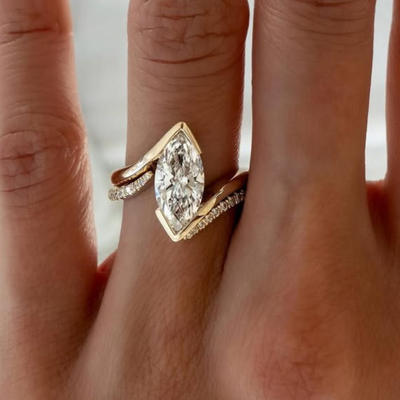
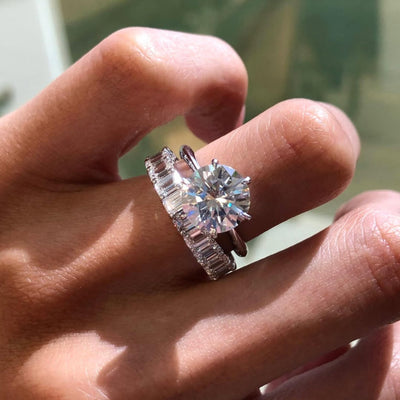
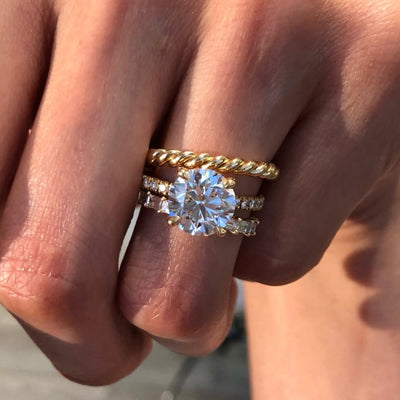
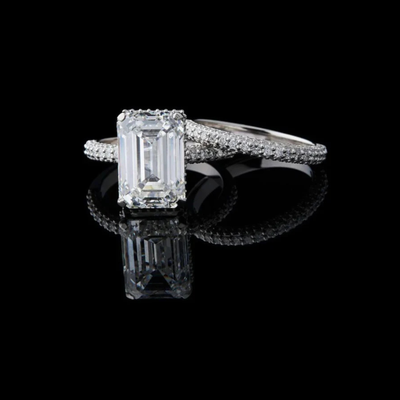
Shop the styles in this guide





How to Wear Your Engagement Ring and Wedding Band Together
Most people who wear both rings stack them on the same finger. The most common order is:
- Wedding band first: The wedding band goes on first, closest to the hand, which many people see as keeping it closest to the heart.
- Engagement ring on top: The engagement ring sits above it, toward the fingertip.
On the wedding day, some brides move their engagement ring to the right hand for the ceremony so the band can be placed directly on the left ring finger, then move it back afterwards.
Other options include wearing the engagement ring on the right hand after the wedding, keeping it for special occasions, or adding an eternity or anniversary band later to build a stack over time.
Tip: Try both rings on together before you finalize sizes. Two rings on one finger can feel tighter than one, and some people find they need a slightly larger size for comfort.
Bridal Sets vs Buying Separately
| Option | Advantages | Things to consider |
|---|---|---|
| Bridal set | Rings designed to fit perfectly together; one consistent look | Less flexibility if you want to change one ring later |
| Separate rings | Freedom to choose each ring on its own merits | Check that the band sits flush with the engagement ring |
| Custom pair | Fully personal design that fits exactly | Allow time for design and crafting |
If you want a perfectly matched pair, look at our lab diamond bridal sets. If you already have an engagement ring, bring its photo and measurements to a virtual appointment and we can help you find or design a band that fits it.
Can the Engaged Couple Switch Their Ring After the Engagement?

Yes. There is no single rule, and couples handle it in different ways.
One ring for both: Some couples choose a single ring that serves as both the engagement ring and the wedding band. This simplifies things and reduces cost, though some people feel it loses the symbolism of two rings marking two stages.
Stacking both: Others stack the engagement ring and wedding band on the same finger, creating a layered look that honors both the engagement and the marriage.
Upgrading later: Some couples start with a simpler engagement ring and upgrade the stone or setting for a later anniversary, keeping the original as a separate piece.
Everyday swap: Many people wear only the wedding band for work, sport or travel and keep the engagement ring for special occasions. This is especially practical if the engagement ring has a tall setting.
Modern Ring Styles: Reflecting Contemporary Weddings and Engagements

Trends in engagement rings and wedding bands continue to move toward personal, distinctive designs. More couples are exploring alternative gemstones, unusual cuts, colored stones and new settings to create rings as individual as their relationship. Classic diamond solitaires remain a favorite, but there is growing interest in rings that reflect the wearer's personality.
- Fancy shapes: Oval, pear, marquise and emerald cuts give a distinctive look.
- Nature-inspired designs: Vines, leaves and floral motifs, like the Dutch marquise ring shown above.
- Lab grown diamonds and moissanite: Popular for allowing a larger or higher-quality stone within the same budget.
- Mixed metals and stacks: Combining yellow, white and rose gold, or adding bands over the years.
- Custom wedding bands: Designed to complement the engagement ring or stand out as individual pieces.
Budgeting for Both Rings
Because the engagement ring is bought first, it is easy to spend most of the budget on it and forget the wedding bands. A few simple ideas help:
- Plan both at once: Decide on a total budget for the engagement ring and both bands before you start shopping.
- Prioritize the center stone: Most of the engagement ring's cost is in the center stone. Lab grown diamonds and moissanite stretch the budget further.
- Keep bands simple: A plain or lightly set band can look elegant and cost less than a full eternity band.
- Think long term: Choose durable metals and secure settings for rings you will wear every day for decades.
In Summary: Understanding the Symbolism
While they may look similar at first glance, engagement rings and wedding bands have distinct meanings and roles. The engagement ring marks the promise, and the wedding band marks the marriage. Understanding the difference helps you choose rings that suit your love story, your style and your everyday life.
A Final Thought
Choosing your rings is part of the journey you share. Whether you choose a single band, a matched bridal set or a stack that grows over the years, your rings will reflect your bond.
Shop at Ivevar: Explore our lab grown diamond engagement rings and lab grown wedding bands, or book a virtual appointment to design a custom pair. Every order includes worldwide delivery, free shipping and 30-day easy returns.
Frequently Asked Questions (FAQs)
Can I wear my wedding band and engagement ring together?
Yes. Many people wear them on the same finger, usually with the wedding band closest to the hand. Others alternate between the two or wear the engagement ring on the other hand.
Is a diamond engagement ring always the best choice?
Not necessarily. Many couples choose lab grown diamonds, moissanite or colored gemstones such as sapphires for a more personal touch or a different budget.
How long should my engagement ring and wedding band last?
With proper care, they can last a lifetime. Clean them regularly and have a jeweler check the prongs and settings about once a year. Our jewelry care guide has simple tips.
Which ring comes first, the engagement ring or the wedding band?
The engagement ring comes first, at the proposal. The wedding band is exchanged later, during the wedding ceremony.
Do both partners get an engagement ring?
Traditionally only one partner receives an engagement ring, but some couples now exchange engagement rings with each other. Wedding bands are usually worn by both partners.
Should the engagement ring and wedding band match?
They do not have to. Matching metals give a seamless look, while contrasting styles can look modern and personal. The key is that they sit comfortably together if you plan to stack them.
Can a wedding band be used as an engagement ring?
Yes. Some couples choose a diamond band or eternity ring for the proposal and wear it alone, or add another band at the wedding.
When should we buy our wedding bands?
It is wise to start a few months before the wedding, especially for custom designs, so there is time for crafting, delivery and any adjustments.


