Engagement Rings
 Anniversary Rings
 Solitaire Rings
 Halo Rings
 Toi Moi Rings
 Three Stone Rings
 Nature Inspired Rings
 Rose Cut Rings
 Fancy Color Rings
 Antique Cut Rings
 Wedding Rings
 Wedding Band Rings
 Exclusive Lab Grown Diamond Rings
 All Lab Grown Diamond Ring
 Engagement Rings
 Three Stone Rings
 Fancy Color Rings
 Antique Cut Rings
 Daily Wear Rings
 Wedding Band Rings
 Exclusive Moissanite Rings
 Earrings
 Bracelet
 Pendant
 Necklace
 Men's Ring
 Bridal Sets
 Rings
Rings
 Earrings
 Tennis chain
 Cuban Chains
 Custom Pendant
 Custom Ring
 Custom Teeth Grillz
 Round
Round
 Oval
Oval
 Cushion
 Marquise
 Pear
Pear
 Emerald
 Heart
Heart
 Princess
 Rose Cut
 Radiant
 Antique Cut
 Brooch
 Cufflink
 Keychain
 Unique Products
 +91 9265051773
 Virtual Appointment
 log in




Short answer: Solid gold wins on durability, tarnish resistance, and resale value — but 925 sterling silver wins on price. For a daily chain you keep for decades, solid gold is the long-term play. For getting the look now — thick Cuban link, heavy shine, iced-out finish — 925 sterling silver delivers nearly the same visual impact for a fraction of the cost.
- ✓ 925 sterling silver is 92.5% pure silver. Stamped "925," it is the jewelry industry standard for silver chains — affordable, bright, and strong enough for daily wear.
- ✓ Solid gold never tarnishes. 10K, 14K, and 18K gold hold their color forever; silver slowly oxidizes and needs regular polishing.
- ✓ Gold is denser and harder than silver. A solid gold Cuban link chain resists bending and denting better over years of wear.
- ✓ Silver costs roughly 1/50th of gold per gram. You can buy a thick, heavy 925 silver chain for what a thin gold chain costs.
- ✓ Only solid gold holds resale value. Gold can always be melted for its metal value; silver jewelry resells for a fraction of its purchase price.
What 925 Sterling Silver Actually Is
Sterling silver is not pure silver — and that is a good thing. Pure silver is too soft for a chain, so jewelers alloy it with 7.5% other metals, usually copper. The result is 925 sterling silver: stamped "925," bright white in color, and hard enough to hold the tight interlocking links of a Cuban chain without stretching.
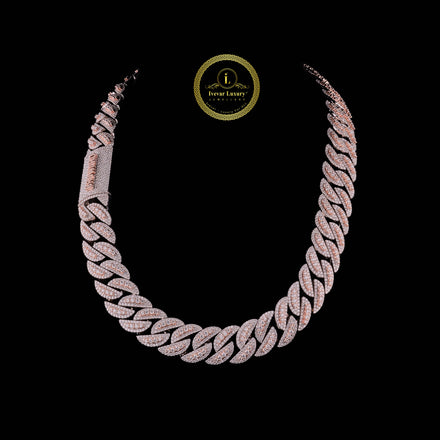
Silver is the workhorse of jewelry. It takes a brilliant polish, sets stones beautifully, and — most importantly for hip hop jewelry — lets you wear a thick, heavy, attention-grabbing chain for hundreds of dollars instead of thousands. A 20-inch, 12mm 925 silver Cuban link chain looks virtually identical to its gold counterpart from across the room. Up close, the difference is subtle: silver is a cooler, whiter metal, while gold carries warmth.
The trade-off is oxidation: silver reacts with sulfur in air and on skin, slowly developing a dark tarnish that polishes off completely. A quick wipe with a polishing cloth every week or two, plus dry storage in a pouch or anti-tarnish bag, keeps a silver chain blinding.
What Solid Gold Chains Are (and What They Aren't)
"Solid gold" chains are typically 10K, 14K, or 18K gold — gold alloyed with other metals for strength, since pure 24K gold is too soft for a chain. Higher karat means more gold content: 14K is 58.3% gold, 18K is 75%. For hip hop chains, 14K is the sweet spot — rich color, excellent durability, and a sane price.
One thing to be clear about: "gold plated" or "gold filled" is not solid gold. Gold plating is a microscopically thin layer that wears through with daily use, exposing the base metal. Gold-filled has a thicker bonded layer and lasts far longer, but it is still not solid gold. If a listing does not say "solid" and does not state a karat with a weight in grams, treat the gold claim with skepticism.
Solid gold's signature advantage is that it is forever: it does not tarnish, oxidize, or change color — ever. Sweat, saltwater, and daily life do not touch it. And because gold is nearly twice as dense as silver, links carry more mass and resist deformation better.

Durability in Daily Wear
Solid gold — especially 14K and 10K — is harder and heavier than sterling silver. In practice, gold Cuban links resist the micro-bending and surface wear that gradually softens a silver chain's crisp edges. A well-made solid gold chain can be a daily piece for decades and still look sharp.
Sterling silver is no fragile metal: a thick, solid-link silver Cuban is sturdy. But silver is softer, so with years of daily wear links can loosen slightly and edges round. It also darkens faster in humid climates or heavy sweat — polishable, but the maintenance is ongoing.
Price, Tarnish, and Maintenance
Silver trades at a tiny fraction of gold's price per gram, so a heavy 925 silver chain — thick links, serious weight, real presence — can cost a few hundred dollars. The same chain in solid 14K gold runs into the thousands. For many buyers this is not a close call: silver gets you the look, the weight, and the drip at a price that does not hurt.
The maintenance tax on silver is real but small: a two-minute wipe a couple of times a month, a warm soapy-water bath every month or two, dry storage in a sealed pouch. Total annual cost is practically nothing but a few minutes of your time. Gold's maintenance is essentially zero — rinse it when it gets grimy — and that convenience is part of what you pay for.

Resale Value: The Part Nobody Tells You
Jewelry is not an investment — but gold is close. Solid gold always has a melt value tied to the spot price of gold, which means a solid gold chain can be sold or traded any day, anywhere in the world, for a meaningful fraction of what you paid.
Silver jewelry resells poorly: the melt value of sterling silver is a small fraction of the finished piece's price, so a used silver chain typically sells for far less than purchase price. Buy silver to wear, not to hold value. If you plan to upgrade to gold later, treat the silver chain as a rental — its value to you is the look and the confidence, not the asset.
Which Should You Choose?
Choose 925 sterling silver for maximum presence per dollar — thick, heavy Cuban links for first chains, statement rotation pieces, and iced-out styles where the stones are the star. Choose solid gold for a daily driver for life: zero tarnish, zero fuss, and real resale value. Many collectors end with both — silver for bold rotation, gold for the chain that never comes off.
| Factor | 925 Sterling Silver | Solid Gold (14K) |
|---|---|---|
| Price | Roughly 1/50th of gold per gram — thick chains for hundreds | Same chain runs into the thousands |
| Tarnish | Oxidizes over time; needs regular polishing | Never tarnishes, ever |
| Durability | Softer; edges can round with heavy daily wear | Harder and denser; holds crisp edges for decades |
| Maintenance | Polish cloth weekly, soap bath monthly | Rinse when dirty — essentially zero |
| Resale value | Low — metal value is a fraction of purchase price | Strong — always worth its melt value |
| Best for | Bold statement pieces, rotation, first chains | Daily wear for life, heirloom pieces |
Shop Our Best Sellers


Swipe to see more → | View all best sellers
Frequently Asked Questions
Is 925 sterling silver real silver?
Yes. 925 sterling silver is 92.5% pure silver alloyed with other metals (usually copper) for strength. The "925" stamp is the industry guarantee of that purity and the standard for quality silver jewelry worldwide.
Does 925 sterling silver tarnish?
Yes, slowly. Silver reacts with sulfur in air and on skin, developing a dark oxidation layer. It is surface chemistry, not damage — regular polishing removes it completely and restores the shine.
Will a solid gold chain ever change color?
No. Solid 10K, 14K, and 18K gold do not tarnish or oxidize under normal wear. Sweat, saltwater, and perfume will not change their color, which is why gold is the zero-maintenance option.
Is a gold-plated chain the same as a solid gold chain?
No. Gold plating is a microscopically thin layer of gold over a base metal (often silver or brass) that wears through with daily use. Solid gold is gold alloy all the way through — there is nothing to wear off.
Which is better for an iced-out Cuban link chain, silver or gold?
Both set stones beautifully, so it comes down to budget and intent. Silver gives you a heavy, iced-out chain for a fraction of the cost — ideal when the stones are the star. Gold is the choice for a daily-worn heirloom with resale value.
Can you swim with a 925 silver chain?
Occasional contact with water is fine, but regular swimming — especially in chlorinated pools — accelerates tarnish. Rinse the chain with fresh water afterward, dry it fully, and store it dry. Solid gold handles water without any issue.
Does sterling silver hold any resale value?
Very little compared to gold. The melt value of sterling silver is a small fraction of a finished chain's retail price, so used silver jewelry typically resells for far less than you paid. Buy silver to wear and enjoy, not as a store of value.
Sources
- GIA — Gemological Institute of America
- IGI — International Gemological Institute
- JCK — Jewelry Industry News
- National Jeweler

Aumsri Pradhan is the founder of Ivevar Luxury, a Surat-based fine jewelry brand that designs and handcrafts lab grown diamond and moissanite jewelry in its own workshop. She leads the brand's design and customer experience, from engagement rings and bridal sets to custom pieces made to each client's story. Through the Ivevar blog, she shares practical guidance on lab grown diamonds, moissanite, diamond grading and ring design to help buyers choose with confidence.