Engagement Rings
 Anniversary Rings
 Solitaire Rings
 Halo Rings
 Toi Moi Rings
 Three Stone Rings
 Nature Inspired Rings
 Rose Cut Rings
 Fancy Color Rings
 Antique Cut Rings
 Wedding Rings
 Wedding Band Rings
 Exclusive Lab Grown Diamond Rings
 All Lab Grown Diamond Ring
 Engagement Rings
 Three Stone Rings
 Fancy Color Rings
 Antique Cut Rings
 Daily Wear Rings
 Wedding Band Rings
 Exclusive Moissanite Rings
 Earrings
 Bracelet
 Pendant
 Necklace
 Men's Ring
 Bridal Sets
 Rings
Rings
 Earrings
 Tennis chain
 Cuban Chains
 Custom Pendant
 Custom Ring
 Custom Teeth Grillz
 Round
Round
 Oval
Oval
 Cushion
 Marquise
 Pear
Pear
 Emerald
 Heart
Heart
 Princess
 Rose Cut
 Radiant
 Antique Cut
 Brooch
 Cufflink
 Keychain
 Unique Products
 +91 9265051773
 Virtual Appointment
 log in




Short answer: An iced out chain is a necklace whose links are paved edge to edge with diamonds or diamond alternatives like moissanite. The 2026 smart buy: a Cuban link or tennis chain in solid or vermeil gold with lab grown diamonds or moissanite — a five-figure look for a fraction of the price. Know your stones, know your metal, and buy from a maker who discloses both.
- ✓ Stone type decides the price. Lab grown diamonds and moissanite give real diamond looks and durability for far less than mined diamonds.
- ✓ Solid 14k gold is forever jewelry; gold vermeil over sterling silver is the value sweet spot. Avoid plated base metal.
- ✓ Cuban link is the classic hip hop silhouette; tennis chains give maximum sparkle per inch of neck.
- ✓ Hand-set stones stay put; glued stones fall out. Always ask how the stones are set before you buy.
- ✓ Get the details in writing: stone type, metal and karat, total weight, and a real warranty.
What "Iced Out" Actually Means
The phrase comes from 1980s–90s hip hop, when artists wore chains so densely set with diamonds they looked dripping with ice. "Iced out" means the chain's surface is covered — paved — with stones set edge to edge: diamonds, not metal. A true iced out chain is not a few stones on a pendant; the links themselves carry the sparkle from clasp to clasp.
Today most iced out chains use lab grown diamonds or moissanite instead of mined diamonds — identical looks at a tenth of the price. The craftsmanship bar has not changed: stones should be individually hand-set in real metal with secure pavé or prong settings, not glued on. That single difference separates a decades-long piece from one that sheds stones within a year.
Chain Styles: Pick Your Silhouette
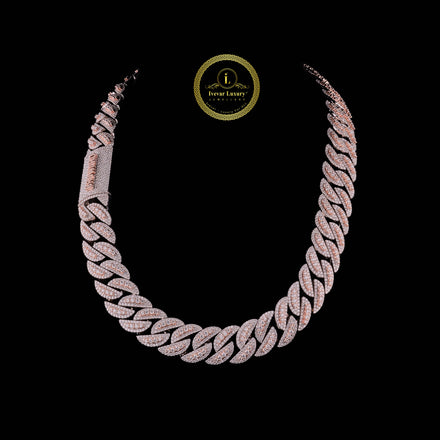
The Cuban link — also called the Miami Cuban — is the undisputed king. Its flat, interlocking oval links lay smoothly and catch light from every angle, which is why it became the default hip hop chain. Widths run from a subtle 3mm to a 20mm-plus statement, and the silhouette works for everyday pieces and stage-ready showstoppers alike.
Tennis chains offer a single continuous row of stones for an unbroken river of sparkle. Rope and Franco chains offer rich texture with fewer stones and a lower price point, while curb links are the Cuban's slimmer cousin. A wide Cuban screams confidence; a tennis chain whispers luxury. Most buyers start with one bold chain and build a layered look from there.

Diamonds vs Moissanite vs CZ: The Stone Decision
Your stones decide two things: how the chain looks up close, and how much you pay. Lab grown diamonds are chemically real diamonds — same carbon, same hardness of 10, same crisp white sparkle — at 80–90% less than mined diamonds. They are the choice for a genuine diamond piece you plan to keep forever and hand down.
Moissanite is the value champion of hip hop jewelry. Nearly as hard as diamond at 9.25 on the Mohs scale, it throws even more rainbow fire than diamond and costs a fraction of lab grown stones. Cubic zirconia is the budget option, but it is soft, scratches easily, and dulls within a year or two of daily wear. Skip CZ for a daily-wear chain; it is a fun entry point for occasional wear.

Metals: Solid Gold, Vermeil, or Silver
Metal is the skeleton of your chain, and it decides weight, durability, and price. Solid 14k or 18k gold is the heirloom option: it holds stones securely, never fades or tarnishes, and carries genuine resale value. Expect to pay for it — gold is heavy, and an iced out chain carries a lot of it. If the budget stretches there, solid gold is always the right call.
Gold vermeil — thick real gold over solid sterling silver — is the smart middle ground. It looks and feels like gold, holds stones well, and costs a fraction of solid gold. The bottom rung is plated base metal — often brass or copper under a thin gold wash. It photographs well but tarnishes, can irritate skin, and cannot be repaired like real precious metal. For a piece you love, never go below vermeil.
Pricing in 2026: What to Expect
Entry-level iced out chains start around a few hundred dollars for vermeil with moissanite or cubic zirconia stones — genuine hip hop style at an accessible price. Mid-range lab diamond pieces in solid 14k gold run roughly $1,500 to $6,000 depending on width, length, and total stone weight. Fully iced, wide, solid-gold showpieces climb past $10,000 into custom territory.
The biggest price lever is the stone-to-gold ratio. A slim 4mm tennis chain in vermeil with moissanite can look breathtaking for under $500, while a 14mm solid gold Cuban fully paved with lab diamonds is a serious investment. Buy the best metal you can afford and choose stones to fit the budget — the metal is the foundation, and it is the one part you can never upgrade later.
Red Flags: What to Avoid
If a seller will not name the stone, it is probably cubic zirconia being sold at a diamond price. Vague words like "diamond-like" or "simulated" without a real stone name are warning signs. Demand specifics: stone type, total stone weight, metal and karat, hand-set or glued. A trustworthy jeweler answers all four without blinking.
Watch for hollow, feather-light chains at suspiciously low prices — thin metal means bent links and lost stones. Skip sellers with no warranty, no returns, and no workshop of their own. And remember the oldest rule in jewelry: if a fully iced "diamond" chain costs less than a nice dinner, the stones are plastic or glass, and no discount code fixes that.
| Stone | Sparkle | Hardness | Cost impact | Best for |
|---|---|---|---|---|
| Lab grown diamond | Classic white fire | 10 | High — adds thousands | Heirloom pieces |
| Moissanite | Extra rainbow fire | 9.25 | Moderate — hundreds to low thousands | Daily wear, maximum value |
| Cubic zirconia | Glassy, dulls over time | 8.5 | Low — often under $300 | Occasional wear |
Buying With Confidence
Start with your budget, then work backward: metal first, stones second, size third. Read the product page like a contract — every specification should be listed, not hidden behind a "contact us" button. Check reviews with real customer photos and a stated warranty and repair policy — a genuine service bench, not just a mailbox.
Think in outfits, not single pieces. Layered is best: a short tennis chain with a longer Cuban, a pendant on one and plain links on the other, matched with a bracelet in the same metal. Build the set piece by piece from one maker, and the collection looks intentional, expensive, and entirely yours.
Shop Our Best Sellers


Swipe to see more → | View all best sellers
Frequently Asked Questions
What does "iced out" mean in jewelry?
"Iced out" means a piece fully paved with diamonds or diamond alternatives — metal covered edge to edge so it looks dripping with ice. The term comes from 1980s–90s hip hop culture.
Are iced out chains made with real diamonds?
They can be, but most use lab grown diamonds or moissanite instead of mined diamonds — the same icy look for a fraction of the price, and lab diamonds are chemically genuine.
How much does an iced out chain cost in 2026?
Vermeil with moissanite starts around a few hundred dollars. Solid 14k gold with lab grown diamonds runs $1,500 to $6,000; wide, fully iced custom showpieces climb past $10,000.
Moissanite or lab grown diamond for an iced out chain?
Moissanite offers more rainbow fire at a lower price and is extremely durable, making it the value champion for daily wear. Lab grown diamonds are genuine diamonds with classic white sparkle — choose them for heirloom pieces.
Is gold vermeil good for iced out chains?
Yes. Gold vermeil is thick real gold over solid sterling silver — the look and feel of gold for far less than solid gold, and the best middle ground for most buyers.
How do I clean an iced out chain?
Soak in warm water with mild dish soap, brush gently between stones with a soft toothbrush, rinse, and pat dry. Avoid harsh chemicals and abrasive cloths.
Can I shower or swim with my iced out chain?
Best not to. Chlorine, salt water, and hard tap water dull stones and weaken settings over time — take the chain off before swimming or showering and it will keep its fire for years.
Sources
- GIA — Gemological Institute of America
- IGI — International Gemological Institute
- JCK — Jewelry Industry News
- National Jeweler

Aumsri Pradhan is the founder of Ivevar Luxury, a Surat-based fine jewelry brand that designs and handcrafts lab grown diamond and moissanite jewelry in its own workshop. She leads the brand's design and customer experience, from engagement rings and bridal sets to custom pieces made to each client's story. Through the Ivevar blog, she shares practical guidance on lab grown diamonds, moissanite, diamond grading and ring design to help buyers choose with confidence.