

 Engagement Rings
 Anniversary Rings
 Solitaire Rings
 Halo Rings
 Toi Moi Rings
 Three Stone Rings
 Nature Inspired Rings
 Rose Cut Rings
 Fancy Color Rings
 Antique Cut Rings
 Wedding Rings
 Wedding Band Rings
 Exclusive Lab Grown Diamond Rings
 All Lab Grown Diamond Ring
 Engagement Rings
 Three Stone Rings
 Fancy Color Rings
 Antique Cut Rings
 Daily Wear Rings
 Wedding Band Rings
 Exclusive Moissanite Rings
 Earrings
 Bracelet
 Pendant
 Necklace
 Men's Ring
 Bridal Sets
 Rings
 Earrings
 Tennis chain
 Cuban Chains
 Custom Pendant
 Custom Ring
 Custom Teeth Grillz
 Round
 Oval
 Cushion
 Marquise
 Pear
 Emerald
 Heart
 Princess
 Rose Cut
 Radiant
 Antique Cut
 Brooch
 Cufflink
 Keychain
 Unique Products
 +91-9265051773
 Virtual Appointment
 log in




Short answer: Solitaire studs feature a single diamond per earring for a clean, timeless look that suits every occasion. Halo studs surround the center diamond with a ring of small stones, which makes each earring look noticeably larger and adds extra sparkle for a similar budget. Choose solitaires for everyday minimalism and flexibility; choose halos if you want maximum presence from a smaller center stone.
Both styles are classic, but they create very different effects on the ear. This guide compares them side by side, explains how each is built, and covers size, shape, settings, backs, metal and care, so you can pick the pair you will actually reach for every day.
Solitaire vs Halo Studs at a Glance
| Feature | Solitaire studs | Halo studs |
|---|---|---|
| Look | Clean, minimal, timeless | Glamorous, sparkly |
| Visible size | True to stone size | Looks noticeably larger |
| Value | Budget goes into the center stones | Smaller centers with a big look |
| Everyday wear | Excellent | Very good |
| Formal wear | Elegant | Excellent |
| Comfort | Very light and low | Slightly larger footprint |
| Cleaning | Easy | More small stones to clean |
In short, a solitaire puts the spotlight on one diamond, while a halo builds a frame of light around it. Neither is better; they simply suit different tastes, budgets and wardrobes.
How Each Style Is Built
Solitaire studs
A solitaire stud is a single diamond held in a small setting on a post. Everything you see from the front is the center stone and a few small prongs or a thin rim of metal. Because there is nothing else to look at, the cut, color and matching of the two stones matter more than in any other earring style.
Halo studs
A halo stud places a ring of small diamonds, usually round brilliants in pavé or tiny prongs, around the center stone. The halo sits slightly below or level with the center, so the eye reads the whole earring as one larger bright shape. Some designs use a double halo (two rows) for even more presence, and some use a hidden halo on the side of the setting that only shows from certain angles.
Halo vs cluster
A halo still has a clear center stone. A cluster has no single main stone; instead, several similar stones are grouped to form a shape such as a flower. If you want the look of one large diamond, a halo is closer; if you want a decorative shape, a cluster fits better.
Side profile and height
From the side, a solitaire is usually a small, neat setting, while a halo is wider and can sit slightly higher because of the extra metal around the center. A higher setting lets in more light but sticks out further from the lobe. If you wear your hair up, talk on the phone a lot or sleep in your studs, a lower profile is more comfortable in either style.
Why Choose Solitaire Studs?
- Go with everything: from jeans to evening wear, they never look out of place.
- Better center stones: your budget buys bigger or better center diamonds rather than accent stones.
- Easy care: fewer stones mean faster cleaning and fewer settings to check.
- Stacking friendly: perfect for layering with huggies and climbers.
- Timeless: the design has stayed classic for generations and is unlikely to date.
Setting styles for solitaires
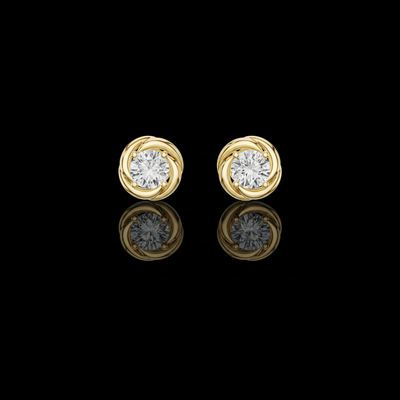
Four-prong settings show more of the diamond and look slightly larger; six-prong settings add security and a rounder outline; bezel settings are sleek and secure; basket settings sit close to the ear. Martini settings use a cone-shaped basket so the stone sits low and faces forward rather than tilting down.
Tip: Look at solitaire studs from the side as well as the front. A low setting that sits close to the lobe faces forward better and is less likely to catch on hair or scarves.
Why Choose Halo Studs?
- Bigger look: they can look up to about double the size of the center stones.
- Extra sparkle: many small facets catch the light from every angle.
- Wow factor: great for weddings, galas and gifts.
- Flatter colors: a white gold halo can make the center stone look whiter, while a yellow or rose gold halo adds warmth.
- Shape options: halos frame cushion, oval, pear, radiant and emerald cuts beautifully.
The main trade-off is that halo studs are a little wider on the lobe and have more small stones to keep clean. They also make a stronger statement, so if you prefer understated jewelry you may find solitaires easier to wear daily.
 Shown: Classic & Timeless Luxury Cushion Cut Halo Diamond Stud Lab Grown Earrings
Choosing the Right Size
For solitaires, a total carat weight of about 0.50 to 1.00 ct (both earrings together) is a popular everyday size, and 1.50 to 2.00 ct makes a noticeable statement. For halos, a smaller center can create a similar look. See our stud earrings size guide for millimeter details.
Size also depends on your earlobe and personal style. A petite lobe can be overwhelmed by very large studs, while a larger lobe can carry more. If you are unsure, consider how much of the lobe you want covered and choose a size that leaves a little lobe visible around the stud.
| Look you want | Solitaire option | Halo option |
|---|---|---|
| Subtle everyday sparkle | Smaller pair, around 0.50 ct total | Small center with a fine halo |
| Noticeable but polished | Around 1.00 ct total | Medium center with a single halo |
| Statement studs | 1.50 ct total and up | Larger center or a double halo |
These are general starting points, not rules. Two pairs with the same carat weight can look different depending on the cut, shape and setting height.
Thinking in millimeters
Carat weight measures weight, not size, so it helps to think about the diameter you will see on the ear. A halo adds width around the center stone, so a halo stud with a modest center can measure about the same across as a much heavier solitaire. When comparing pairs, ask for the total width of each earring, not just the carat weight of the center.
Shapes for Solitaire and Halo Studs
Round brilliant is the classic choice for both styles: it has the most sparkle, is easiest to match and suits every face. Beyond round, each shape changes the mood of the earring.
- Cushion: soft square corners, a romantic, slightly vintage feel, and very popular in halos.
- Oval: elongated and flattering, and it looks larger than a round of the same carat weight.
- Princess: crisp and modern; set with V-prongs to protect the corners.
- Radiant: square or rectangular with brilliant sparkle and trimmed corners.
- Emerald: long step facets for a clean, mirror-like flash rather than fiery sparkle.
- Pear: unusual for studs but graceful; usually worn point down.
With fancy shapes, check that both earrings are cut to the same proportions, so the outlines match when you look in the mirror.
Diamond Quality for Studs
Studs are seen from a distance, so you can be practical about grades. Focus on what you can actually see.
- Cut: the most important factor for sparkle in both styles. Prioritize it, especially for solitaires.
- Color: near-colorless grades in the G to J range usually look white on the ear. Halos in white gold help the center look even whiter.
- Clarity: choose eye-clean stones. Small inclusions are very hard to see on the ear.
- Matching: the two center stones should be close in size, color and brightness.
Why matching matters more in studs
Unlike a ring, studs are seen as a pair, one on each side of the face. If one stone is slightly warmer in color or a little smaller, it can show in photos and in the mirror. Good jewelers choose the two stones together, comparing size, color, brightness and cut proportions. In halo studs, the small stones should also match each other so the frame looks even all the way around.
Lab grown diamonds and moissanite
Lab grown diamonds are chemically, physically and optically the same as mined diamonds. They are produced by CVD or HPHT methods and graded by labs such as IGI and GIA, and many of our stones come with IGI certificates. Because they cost less than mined diamonds of the same size and quality, lab grown diamonds let you move up in size or quality for either style.
Moissanite is a separate gemstone, not a diamond. It rates 9.25 on the Mohs hardness scale (diamond is 10) and has a refractive index of about 2.65 (diamond is about 2.42), so it shows more colorful, rainbow-like flashes. It is a good option for larger solitaire studs on a tighter budget. Compare styles in our moissanite earrings collection.
Shop the styles in this guide
Metal and Backs
Choosing your metal
White gold gives a bright, modern finish and suits icy, colorless diamonds. Yellow gold looks warm and classic, and rose gold feels soft and romantic. In a halo design, the metal shows more because of the extra settings, so the color choice has a bigger effect on the overall look. We make studs in 10K, 14K and 18K gold; 14K is a popular balance of rich color and durability for earrings you wear every day.
Choosing your backs
Push backs are quick and easy and work well for lighter studs. Screw backs thread onto the post and are the most secure choice for larger or more valuable pairs. If a halo stud tilts forward, larger disc-shaped backs give extra support behind the lobe and help it face forward.
Buying Tips
- Match the stones: match the two center stones closely in color, clarity and size.
- Secure backs: choose screw backs for larger or more valuable studs.
- Consider the shape: round is classic; cushion, oval and radiant feel distinctive.
- Stretch your budget: lab grown diamonds give you bigger studs for the same budget.
- Check the halo: in halo studs, the small stones should be evenly spaced with no gaps or uneven heights.
- Think about lifestyle: if you wear studs to sleep or to the gym, a low bezel solitaire is the most practical.
Common mistakes to avoid
- Buying on carat alone: a well-cut smaller stone often looks brighter and larger than a poorly cut heavier one.
- Going too large for daily wear: very big studs can feel heavy and droop forward; save those for occasions.
- Ignoring the backs: loose push backs are a common way to lose a stud, so check the grip regularly.
- Overpaying for invisible clarity: top clarity grades are hard to tell apart on the ear, so spend on cut and size instead.
Wearing, Gifting and Care
Which suits which occasion
Solitaire studs work in every setting, from interviews to weddings, which makes them the safer gift if you are not sure of someone's taste. Halo studs shine at celebrations and pair well with formal outfits, open necklines and updos. Many people own both: solitaires for daily wear and halos for evenings.
Pairing with rings
You do not need to match your earrings to your engagement ring. A halo ring with solitaire studs looks balanced and understated, and halo studs with a solitaire ring add a little extra sparkle. If you like a coordinated look, match the metal color and stone shape rather than the exact style. Browse our lab grown halo rings if you want a matching ring.
Second and third piercings
If you have more than one piercing, you can combine both styles. Wear halo studs in the first hole for impact and small solitaires in the second, graduating down in size. This gives a balanced ear without looking crowded, and it lets one pair of halos do the work of a statement earring.
Keeping them bright
Soak studs in warm water with a little mild dish soap, brush gently with a soft toothbrush, rinse and pat dry. Halo studs need extra attention behind the small stones, where lotion and skin oils build up. Check prongs and backs every few months, and store each pair separately so diamonds do not scratch other jewelry.
Tip: Put your studs on after hairspray, perfume and makeup. These products leave a film on diamonds that dulls sparkle, especially on the many small stones in a halo.
Stud Earrings at Ivevar
We match every pair of stones and hand-set our studs in our Surat workshop. Every pair ships free worldwide, and you can book a virtual appointment to compare sizes, shapes and metals, or ask us about a custom design. For hygiene reasons, pierced earrings can only be returned if they are faulty; see our refund policy. Browse stud earrings and lab grown diamond earrings, or see our full earrings collection.
Shop Solitaire and Halo Studs
 Cushion Halo StudsShop Now
 Radiant Halo EarringsShop Now
 Oval Lab Diamond EarringsShop Now
 Crown Basket Round StudsShop Now
 Cushion Four Prong StudsShop Now
 Brilliant Round StudsShop Now
Swipe to see more → | View all stud earrings
Frequently Asked Questions
Do halo studs look bigger?
Yes. A halo makes each earring look noticeably larger than the center stone alone.
Which is better for everyday wear?
Solitaire studs are the most versatile, but many people wear halos daily too.
What size solitaire studs should I buy?
Around 0.50 to 1.00 ct total weight is a popular everyday choice.
Are screw backs necessary?
They are recommended for larger or valuable studs to prevent loss.
Can I wear halo studs with a solitaire engagement ring?
Yes. Mixing styles looks natural and balanced.
Are halo studs harder to clean?
A little. The small stones trap more dirt, so give them a gentle brush behind the halo during each clean.
Which is the better gift?
Solitaire studs are the safest gift because they suit every style. Halo studs are a great choice for someone who loves sparkle.
Do lab grown diamond studs look different from mined diamond studs?
No. Lab grown diamonds are the same material as mined diamonds and look identical on the ear.
Can I add a halo to my solitaire studs later?
Some designs use a separate halo jacket that slides onto the post behind a stud. Ask before buying whether a jacket will fit your setting style and stone size.
Do moissanite studs come in halo styles?
Yes. Moissanite works in both solitaire and halo designs, and its strong sparkle suits halos well.
The Bottom Line
Choose solitaire studs for timeless simplicity and halo studs for extra size and sparkle. Either way, matched stones and secure backs make all the difference.
If you are still undecided, think about how often you will wear them. For a pair you put on every morning and forget about, a solitaire in a low, secure setting is hard to beat. For a pair that makes an entrance at weddings, parties and celebrations, a halo gives more sparkle for the budget. And if the answer is both, a pair of each covers every occasion.
Related Guides

Author Bio
Aumsri Pradhan
Founder, Ivevar Luxury
Aumsri Pradhan is the founder of Ivevar Luxury, a Surat-based fine jewelry brand that designs and handcrafts lab grown diamond and moissanite jewelry in its own workshop. She leads the brand's design and customer experience, from engagement rings and bridal sets to custom pieces made to each client's story. Through the Ivevar blog, she shares practical guidance on lab grown diamonds, moissanite, diamond grading and ring design to help buyers choose with confidence.


