

 Engagement Rings
 Anniversary Rings
 Solitaire Rings
 Halo Rings
 Toi Moi Rings
 Three Stone Rings
 Nature Inspired Rings
 Rose Cut Rings
 Fancy Color Rings
 Antique Cut Rings
 Wedding Rings
 Wedding Band Rings
 Exclusive Lab Grown Diamond Rings
 All Lab Grown Diamond Ring
 Engagement Rings
 Three Stone Rings
 Fancy Color Rings
 Antique Cut Rings
 Daily Wear Rings
 Wedding Band Rings
 Exclusive Moissanite Rings
 Earrings
 Bracelet
 Pendant
 Necklace
 Men's Ring
 Bridal Sets
 Rings
 Earrings
 Tennis chain
 Cuban Chains
 Custom Pendant
 Custom Ring
 Custom Teeth Grillz
 Round
 Oval
 Cushion
 Marquise
 Pear
 Emerald
 Heart
 Princess
 Rose Cut
 Radiant
 Antique Cut
 Brooch
 Cufflink
 Keychain
 Unique Products
 +91-9265051773
 Virtual Appointment
 log in




Short answer: A bangle is a rigid, round bracelet that slips over the hand or opens on a hinge. A cuff is a rigid bracelet with an opening at the back, so it slides on from the side of the wrist. A link or chain bracelet is flexible and closes with a clasp. Bangles and cuffs hold their shape and stack neatly; link bracelets drape softly and adjust easily. Choose a hinged bangle for easy everyday wear, a cuff for bold style, and a link bracelet for comfort and movement.
Bracelet shopping gets much easier once you know the three main families. Each one is built differently, sits on the wrist differently and needs a different kind of sizing. This guide explains how bangles, cuffs and link bracelets work, how to measure for each, how they behave with diamonds set into them, and which one suits your wrist, your routine and your style.
Bangle vs Cuff vs Link at a Glance
| Feature | Bangle | Cuff | Link or chain |
|---|---|---|---|
| Structure | Rigid circle or oval | Rigid with a back opening | Flexible |
| How it goes on | Over the hand, or hinged | Slides on sideways | Clasp |
| Fit | Must match hand or wrist size | Slightly adjustable | Easily adjustable |
| Look | Clean, classic | Bold, modern | Soft, fluid |
| Stacking | Excellent | Good as a statement | Great mixed with bangles |
The short version: rigid bracelets (bangles and cuffs) give you structure and a crisp outline, while flexible bracelets (links and chains) give you comfort and movement. Most people end up owning at least one of each because they do different jobs.
Bangles
A bangle is a solid ring of metal worn around the wrist. Because it has no give, the way it opens decides how well it fits.
Slip-on bangles
Slip-on bangles have no clasp at all. They must pass over the widest part of your hand, which is usually the knuckles with your thumb tucked in. That means they always sit a little loose on the wrist and slide up and down your forearm as you move. Many people love that relaxed, swinging look, and slip-ons are the simplest design with no hinge or clasp to wear out.
Hinged bangles
Hinged bangles open on a small hinge and close with a clasp, often a tongue-and-box clasp with a safety catch. Since you never have to squeeze them over your hand, they can be sized much closer to your actual wrist. The result is a bangle that stays in place, sits flatter and keeps its diamonds facing up. For diamond bangles, hinged styles are usually the most practical choice.
How diamonds are set in bangles
Diamond bangles often use channel settings, where stones sit in a row between two metal walls, or prong settings along the top half. Channel settings protect the edges of the stones and feel smooth against sleeves. Prong settings let in more light and look brighter, but the prongs can catch on knitwear. Some bangles carry diamonds only across the top so the underside stays plain and comfortable on a desk.
Cuffs
A cuff is a rigid bracelet with a gap at the back. You put it on by sliding the narrowest part of your wrist through the opening from the side, then rotating it into place.
Why people choose cuffs
- Easy on, easy off: there is no clasp to fasten with one hand.
- Bold presence: the open design reads as modern and confident, even in a slim width.
- Some adjustability: a cuff can be gently eased open or closed by a jeweler for a better fit.
- Design freedom: the open ends are a natural place for a feature stone, a floral motif or two facing diamonds.
Cuff care tips
Avoid opening and closing a cuff wider than necessary every day. Repeated bending at the same point can tire the metal over time, especially in thin designs. Slide it on from the side instead of pulling the ends apart. If the fit feels too loose or too tight, ask a jeweler to adjust it rather than forcing it yourself, because diamond settings near the bend can be stressed.
Link and Chain Bracelets
Link bracelets are made of connected pieces that move with your wrist. They close with a clasp, such as a lobster clasp, box clasp or sliding bolo closure, and they are the most comfortable style for long wear.
Common link styles
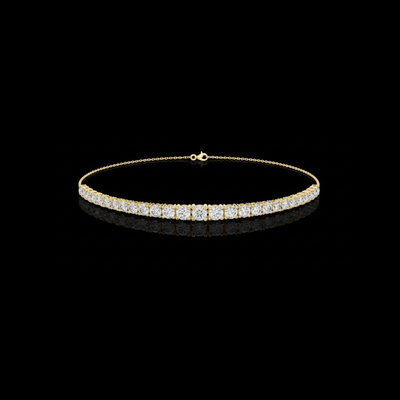
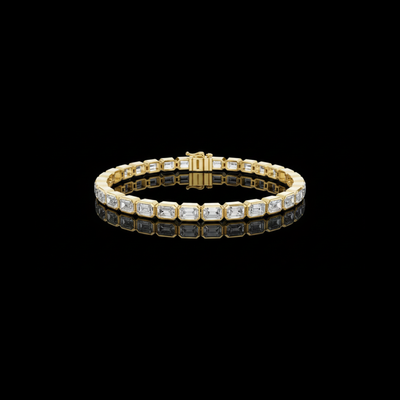
- Tennis bracelet: a continuous line of individually set diamonds, each in its own small link.
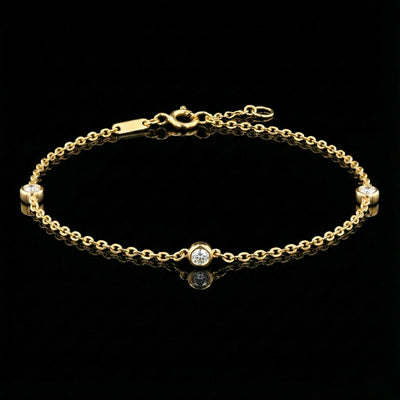
- Station bracelet: a fine chain with diamonds spaced along it at intervals.
- Interlocking and double-chain links: two strands or shapes that hook together for a modern, layered look.
- Geometric links: squares, circles or marquise shapes that add pattern and texture.
- Bolo bracelets: a chain with a sliding bead or stopper, so one bracelet fits many wrist sizes.
Because links are flexible, a link bracelet drapes around the round shape of your wrist instead of forming a fixed circle. It also tends to settle with the heavier part at the bottom, which is worth remembering if you want a pendant or feature stone to stay on top. A small safety chain or a balanced design helps keep the bracelet facing the right way.
 Shown: Slim Round Lab Diamond Hinged Bangle Bracelet for Women
How Each Type Feels in Daily Life
Looks matter, but daily comfort is what decides whether a bracelet gets worn or stays in the box. Here is how the three types compare when you are typing, carrying bags or getting dressed.
| Situation | Bangle | Cuff | Link |
|---|---|---|---|
| Typing at a desk | Hinged styles sit still; slip-ons can tap the desk | Comfortable if the back sits off the wrist bone | Most comfortable, but clasp can rub |
| Long sleeves and jackets | Slim bangles slide under easily | Wide cuffs may catch | Lies flat under fitted cuffs |
| Putting on alone | Slip-ons easy; hinged takes practice | Easiest of all | Lobster clasp can be fiddly; bolos are easy |
| Sleeping or exercise | Remove | Remove | Remove |
No fine bracelet should be worn for sport, swimming or heavy work. Even a diamond, which scores 10 on the Mohs hardness scale, can chip if it takes a sharp knock at the wrong angle, and gold settings can bend under impact.
How to Size Each Type
Sizing is where most bracelet returns come from, so it is worth five minutes with a soft tape measure or a strip of paper and a ruler.
- Slip-on bangle: bring your thumb and little finger together as if putting on a bangle, then measure around the widest part of your hand. Choose a bangle with an inner circumference at or just above that number.
- Hinged bangle: measure your wrist just above the wrist bone and add about 0.5 to 1 inch for comfort.
- Cuff: check the inner circumference and the opening width. The opening must be wide enough to pass the narrow side of your wrist.
- Link bracelet: measure your wrist and add about 0.5 to 1 inch. Add closer to 0.5 inch for a snug fit and closer to 1 inch for a looser drape.
Tip: Measure at the end of the day, when hands and wrists are at their fullest, and measure both wrists. Most people wear bracelets on the non-dominant hand, and the two wrists are not always the same size.
Oval vs round bangles
Wrists are oval, not round. An oval bangle sits more naturally and rotates less than a perfectly round one of the same length. If a round bangle keeps spinning so the diamonds face down, an oval shape is often the fix.
Metals, Widths and Diamonds
Choosing a metal
Ivevar crafts bracelets in 10K, 14K and 18K gold, and some styles in 925 sterling silver. Lower karat gold contains more alloy, which makes it slightly harder and more scratch resistant, while 18K has a richer colour and is softer. For a bracelet that will meet desks and door handles every day, 14K is a popular balance. Rigid bangles and cuffs show scratches more than link bracelets because they have large smooth surfaces, so a brushed or textured finish can be a smart choice if you are hard on jewelry.
Choosing a width
- Under about 3 mm: delicate, easy to stack, works for small wrists and everyday wear.
- Around 3 to 6 mm: a balanced everyday width that still feels like a feature.
- Wider statement pieces: best worn alone or with one slim partner.
Lab grown diamonds or moissanite
Lab grown diamonds are chemically, physically and optically the same as mined diamonds, grown by CVD or HPHT methods. Many Ivevar stones come with IGI certificates. Moissanite is a different gemstone, silicon carbide, rated 9.25 on the Mohs scale. It has a higher refractive index (about 2.65 against diamond's 2.42), so it shows more rainbow-coloured fire. Both are durable enough for bracelets. Choose diamond if you want the classic white brilliance and the word "diamond"; choose moissanite bracelets if you love extra colour flashes.
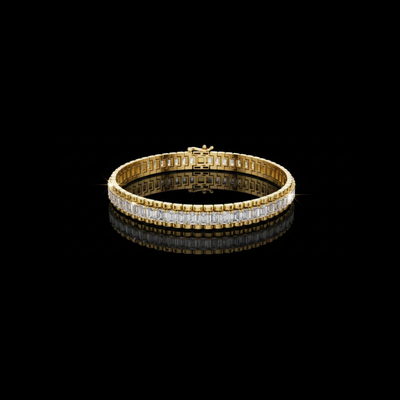
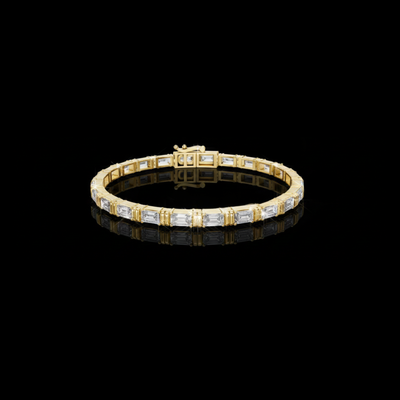
Shop the styles in this guide








Which Should You Choose?
- Everyday and office: a slim hinged bangle or a delicate link or station bracelet.
- Statement: a diamond cuff or a wide bangle, worn alone.
- Stacking: two slim bangles plus one link bracelet for contrast.
- Comfort first: a flexible link or chain bracelet.
- Hard-to-size wrists: an adjustable bolo or a cuff.
- Gifting without knowing her size: an adjustable bolo or link bracelet with a little extra length.
Matching the type to your wrist
Small, slim wrists tend to suit fine bangles and narrow links; a wide cuff can overwhelm them. Larger wrists can carry wider bangles and bolder cuffs, and they often find hinged styles more comfortable than slip-ons, which can be hard to fit over the hand. If your hand is much wider than your wrist, skip slip-on bangles altogether, because any slip-on that passes your knuckles will feel loose.
Mixing bangles, cuffs and links
The three types work best together. Rigid pieces create clean lines; flexible pieces fill the gaps and soften the stack. A simple formula is one rigid anchor, one flexible piece and one personal accent. Keep stones and metals from rubbing against each other every day by leaving a plain metal piece between two diamond pieces, and rotate what you wear. For more ideas, see our guide on how to stack bracelets, linked below.
Tip: If you want to wear a bracelet with a watch, put the watch on the opposite wrist or place a plain gold or soft bead piece between the watch and any diamond bracelet. Diamonds can scratch watch cases and crystals.
Caring for Each Type
- Bangles: check the hinge and clasp every few months; a loose clasp is the most common reason a hinged bangle falls off.
- Cuffs: avoid prying the opening wider; store flat so they do not get bent.
- Link bracelets: lay them flat or hang them so links do not tangle; inspect the clasp and the links nearest to it, which take the most strain.
- All types: clean with warm water, mild soap and a soft brush, then dry with a lint-free cloth. Store each piece in its own pouch.
Diamonds attract grease, so lotion, soap and sunscreen quickly dull their sparkle. A gentle clean every week or two keeps bangles and links bright.
Clasps and closures explained
The closure matters as much as the design, because a bracelet is only as secure as the part that holds it shut.
- Box clasp with safety catch: a tongue clicks into a box, and a side catch or figure-eight latch adds a second lock. Common on tennis bracelets and hinged bangles, and the most secure choice for diamonds.
- Lobster clasp: a spring-loaded hook that clips onto a ring. Simple and reliable on chains, though it can be fiddly to close one-handed.
- Sliding bolo: a bead or stopper slides along the chain to tighten the fit. Very easy to use and adjusts to almost any wrist.
- Hinge with push clasp: found on hinged bangles; check that it clicks firmly and does not spring open with a light tug.
Common Buying Mistakes to Avoid
- Guessing the size: rigid bracelets cannot stretch, so a bangle that is a little too small will not go on at all. Measure first.
- Choosing a slip-on for a wide hand: it will fit the knuckles and then hang loosely on the wrist.
- Ignoring the underside: run a finger along the inside. Rough edges or raised settings will rub every day.
- Buying for one outfit: pick a width and metal that suits most of what you wear, not just one occasion.
- Skipping the safety catch: on any diamond line bracelet, a second lock is worth having.
Bracelets at Ivevar
We handcraft lab grown diamond bangles, cuffs and link bracelets in our Surat workshop, in 10K, 14K and 18K gold. Every piece ships free worldwide and comes with 30-day easy returns. If you want a custom width, metal or stone layout, our team can help through a virtual appointment. Browse lab grown diamond bracelets, explore all bracelets, or find a ready-made present in our gift bracelets.
Shop Bangles, Cuffs and Link Bracelets
 Slim Hinged Diamond BangleShop Now
 Channel Set Hinged BangleShop Now
 Open Cuff Diamond BraceletShop Now
 Floral Open Cuff BangleShop Now
 Interlocking Link BraceletShop Now
 Geometric Double Chain BraceletShop Now
Swipe to see more → | View all bracelets
Frequently Asked Questions
What is the difference between a bangle and a cuff?
A bangle is a closed circle, either slip-on or hinged. A cuff has an open back and slides on from the side of the wrist.
Are hinged bangles easier to wear?
Yes. They open fully, so they fit closer to the wrist, stay in place better and keep diamonds facing up.
Which bracelet is most comfortable?
Flexible link and chain bracelets, because they move with the wrist and have no rigid edges.
Can I stack bangles and link bracelets?
Yes. Mixing rigid and flexible pieces creates great texture. Put a plain metal piece between diamond pieces to reduce rubbing.
How do I measure for a bangle?
Measure around your hand's widest point for slip-ons, or your wrist plus about 0.5 to 1 inch for hinged styles.
Can a cuff be adjusted?
Slightly. A jeweler can ease it open or closed. Avoid bending it repeatedly yourself, especially near diamond settings.
Why does my bangle keep spinning?
It is probably too loose or perfectly round. A closer hinged fit or an oval shape keeps the diamonds on top.
Which type is best as a gift if I do not know her size?
An adjustable bolo or a link bracelet is the safest choice. Rigid bangles need a more accurate size.
The Bottom Line
Choose a bangle for classic structure, a cuff for bold style, or a link bracelet for comfort. Measure carefully for the type you choose, pick a metal that suits your routine, and mix rigid and flexible pieces for a stack that feels personal.
Related Guides

Author Bio
Aumsri Pradhan
Founder, Ivevar Luxury
Aumsri Pradhan is the founder of Ivevar Luxury, a Surat-based fine jewelry brand that designs and handcrafts lab grown diamond and moissanite jewelry in its own workshop. She leads the brand's design and customer experience, from engagement rings and bridal sets to custom pieces made to each client's story. Through the Ivevar blog, she shares practical guidance on lab grown diamonds, moissanite, diamond grading and ring design to help buyers choose with confidence.


