Engagement Rings
 Anniversary Rings
 Solitaire Rings
 Halo Rings
 Toi Moi Rings
 Three Stone Rings
 Nature Inspired Rings
 Rose Cut Rings
 Fancy Color Rings
 Antique Cut Rings
 Wedding Rings
 Wedding Band Rings
 Exclusive Lab Grown Diamond Rings
 All Lab Grown Diamond Ring
 Engagement Rings
 Three Stone Rings
 Fancy Color Rings
 Antique Cut Rings
 Daily Wear Rings
 Wedding Band Rings
 Exclusive Moissanite Rings
 Earrings
 Bracelet
 Pendant
 Necklace
 Men's Ring
 Bridal Sets
 Rings
Rings
 Earrings
 Tennis chain
 Cuban Chains
 Custom Pendant
 Custom Ring
 Custom Teeth Grillz
 Round
Round
 Oval
Oval
 Cushion
 Marquise
 Pear
Pear
 Emerald
 Heart
Heart
 Princess
 Rose Cut
 Radiant
 Antique Cut
 Brooch
 Cufflink
 Keychain
 Unique Products
 +91 9265051773
 Virtual Appointment
 log in




Short answer: Most diamond eternity bands carry 1 to 3 total carats, with 2 carats the sweet spot for presence and practicality. Total carat weight depends on stone size, stone count, and your ring size — a size 7 band of 3mm stones holds roughly 1.5 carats, while 2mm stones hold about half that. Bigger stones mean more sparkle per stone but a chunkier, pricier, more fragile ring; smaller stones mean smoother, tougher, subtler bands.
- ✓ Two carats is the sweet spot. Noticeable presence without excessive bulk, cost, or fragility.
- ✓ Stone size drives the look. 2mm stones read delicate; 3mm classic; 4mm+ bold and blingy.
- ✓ Ring size changes carat weight. Larger sizes hold more stones, so the same design weighs more.
- ✓ Smaller stones wear tougher. Tiny melee stones sit lower and survive daily knocks better.
- ✓ Half-eternity halves the carats. Same look from the top at roughly half the price and weight.
How Eternity Band Carat Weight Works
An eternity band's total carat weight is simple arithmetic: stone size × stone count. But stone count depends on your ring size — a size 9 band fits more stones around than a size 5 — so the same design can vary by half a carat or more across sizes. Jewelers quote either a total carat weight for a specific size (usually size 6 or 7) or a per-stone size, and you should always ask which size a quoted weight refers to.
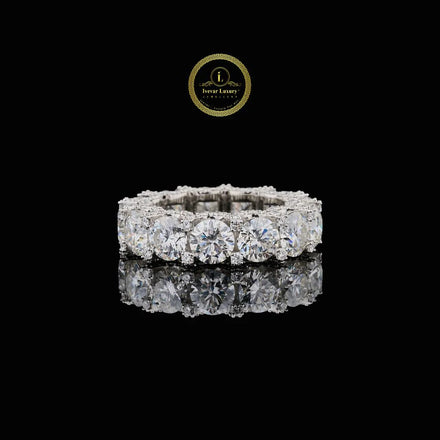
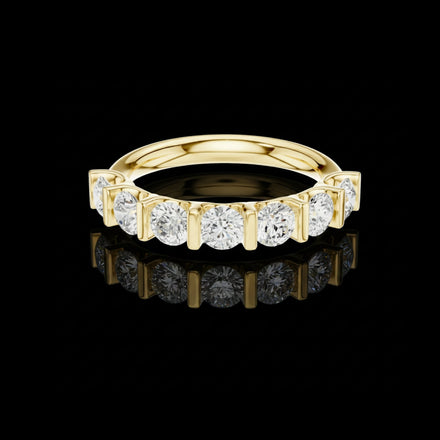
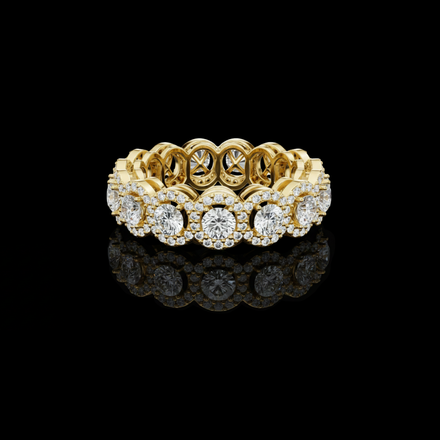
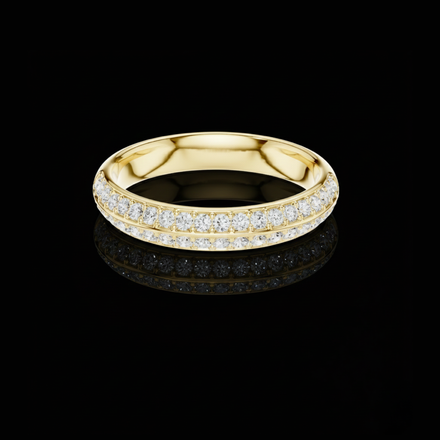
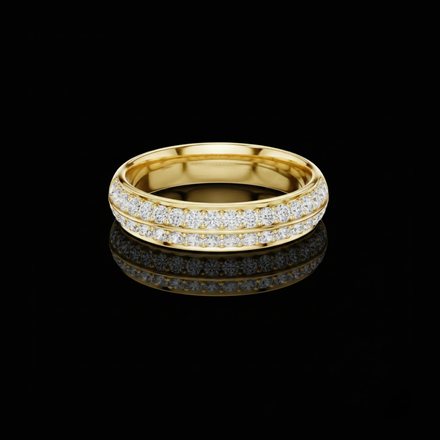
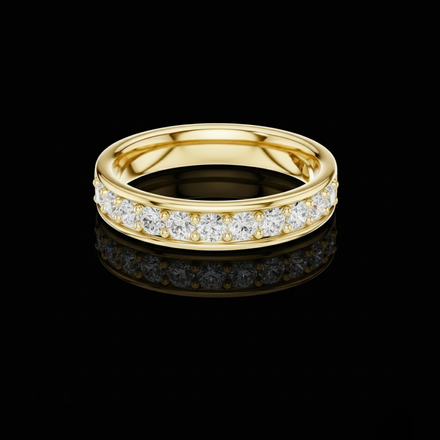
As a rough guide for full eternity bands in size 7: 2mm stones (about 0.03ct each) total roughly 0.7–1.0 carat; 2.5mm stones total roughly 1.2–1.5 carats; 3mm stones (about 0.10ct each) total roughly 1.8–2.2 carats; 3.5mm stones total roughly 2.5–3 carats; 4mm stones (about 0.25ct each) total 3.5–4+ carats. These are approximations — setting style and exact stone dimensions shift them — but they let you translate between the millimeter size you see in photos and the carat number on the price tag.
The Sweet Spots: 1, 2, or 3 Carats?
One carat and under — typically 2–2.5mm stones — is the delicate choice. The band reads as a fine line of sparkle, pairs effortlessly with any engagement ring, and is the toughest and most affordable eternity style. Ideal for petite fingers, active lifestyles, and brides who want shimmer without statement.
Two carats — usually 3mm stones — is the most popular eternity band in America, and the best all-rounder. The stones are individually visible, the band has real presence, and it still sits comfortably and pairs with most engagement rings. If you are unsure, start here.
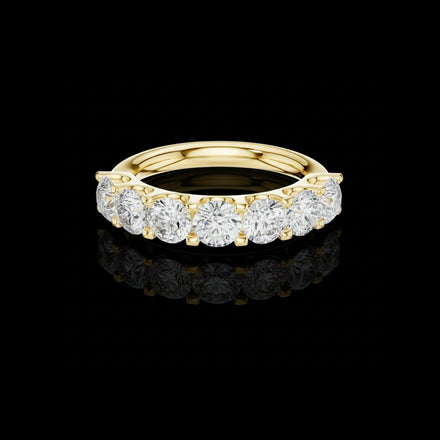
Three carats and up — 3.5–4mm+ stones — is unapologetic luxury. The band becomes a statement piece with serious finger coverage and serious cost. It is also taller, heavier, and more vulnerable to knocks; many owners of big eternity bands rotate them with a plain band for rough days. Choose this when the band is the star, not the supporting act.

Stone Size vs Finger Size: Getting the Proportion Right
Carat weight means nothing without proportion. On a petite size 5 finger, a 2-carat band of 3mm stones looks substantial; on a size 9 finger, the same 2 carats spreads thinner and reads more delicate — you might want 3mm stones just to achieve the same visual weight. General guidance: petite fingers (sizes 4–5.5) shine with 2–2.5mm stones; medium fingers (6–7.5) carry 2.5–3.5mm beautifully; larger fingers (8+) need 3mm+ stones for the band to hold its own.
Height matters too. Bigger stones sit taller above the finger, which affects how the band pairs with an engagement ring — a tall 4mm-stone band beside a low solitaire looks mismatched and can lever the engagement ring uncomfortably. Match the band's height to your engagement ring's shank for a pair that sits as one.
Lab-Grown Diamonds and Moissanite: Carats Without the Cost
Here is where modern stones change the math completely. A 2-carat natural diamond eternity band costs many thousands of dollars; the same 2 carats in lab-grown diamonds or moissanite costs a fraction — often under $1,000. Since eternity bands use many small stones, where lab-grown prices are most advantageous, they are the single best case for choosing lab-grown: identical optics, identical durability (for lab diamonds), at 70–90% less.
Moissanite deserves special mention for eternity bands: it is harder than most small-diamond alternatives, its extra fire reads beautifully in a continuous line of stones, and its price lets you jump a full stone size — 3.5mm moissanite presence for a 2.5mm diamond budget. For buyers who want maximum carat look per dollar, moissanite eternity bands are nearly unbeatable.

| Stone size | Approx. total carats (size 7, full) | Look | Best for |
|---|---|---|---|
| 2mm | 0.7–1.0 ct | Fine line of sparkle | Petite fingers, active wear |
| 2.5mm | 1.2–1.5 ct | Delicate but visible | Everyday elegance |
| 3mm | 1.8–2.2 ct | Classic presence | The popular sweet spot |
| 3.5mm | 2.5–3.0 ct | Bold and luminous | Statement wearers |
| 4mm+ | 3.5–4.0+ ct | Maximum bling | The band as the star |
Quality Still Counts at Small Sizes
With twenty or thirty small stones, cut quality matters more than with one big stone — poorly cut melee looks dull in aggregate, while well-cut small stones create the continuous river of light that makes eternity bands magical. Color and clarity can be modest (near-colorless, SI clarity is plenty at 2–3mm — inclusions are invisible at that size), but never compromise on cut.
Also ask about matching: in a well-made eternity band, all stones are matched for color and size so the band reads as one continuous line. Cheap bands mix parcels, and the eye catches the mismatched stones immediately. This is one place where paying for craftsmanship over rock-bottom price genuinely shows.
Shop Our Best Sellers


Swipe to see more → | View all best sellers
Frequently Asked Questions
How many carats is a typical eternity band?
Most fall between 1 and 3 total carats, with 2 carats the most popular choice. Total weight depends on stone size, stone count, and ring size — always ask which size a quoted carat weight refers to.
Is a 2 carat eternity band big?
It is the classic sweet spot — clearly present and sparkling, with individually visible stones, but still comfortable and practical for daily wear. On petite fingers it reads substantial; on larger fingers, elegant.
What size stones are in a 2 carat eternity band?
Usually around 3mm per stone (about 0.10ct each) in a size 7. Smaller 2.5mm stones reach 2 carats only on larger ring sizes with more stones; larger 3.5mm stones exceed 2 carats quickly.
Do bigger stones make a better eternity band?
Not necessarily. Bigger stones mean more presence but also more height, weight, cost, and vulnerability to knocks. Smaller stones sit lower, wear tougher, and create a smoother line of light.
How many carats are in a half-eternity band?
Roughly half the full-eternity equivalent — a 2-carat full eternity design becomes about 1 carat as a half-eternity. Same top view, roughly half the price, weight, and stone count.
Does ring size affect the carat weight?
Yes. Larger sizes hold more stones, so the identical design weighs more in total carats on a size 9 than a size 5 — sometimes by half a carat or more. Compare quotes at the same size.
Are lab-grown diamonds good for eternity bands?
They are the ideal case: identical optics to natural diamonds at 70–90% less, which matters enormously when buying twenty-plus stones. Moissanite is even more affordable and adds extra fire to the continuous line.
Sources

Aumsri Pradhan is the founder of Ivevar Luxury, a Surat-based fine jewelry brand that designs and handcrafts lab grown diamond and moissanite jewelry in its own workshop. She leads the brand's design and customer experience, from engagement rings and bridal sets to custom pieces made to each client's story. Through the Ivevar blog, she shares practical guidance on lab grown diamonds, moissanite, diamond grading and ring design to help buyers choose with confidence.