

 Engagement Rings
 Anniversary Rings
 Solitaire Rings
 Halo Rings
 Toi Moi Rings
 Three Stone Rings
 Nature Inspired Rings
 Rose Cut Rings
 Fancy Color Rings
 Antique Cut Rings
 Wedding Rings
 Wedding Band Rings
 Exclusive Lab Grown Diamond Rings
 All Lab Grown Diamond Ring
 Engagement Rings
 Three Stone Rings
 Fancy Color Rings
 Antique Cut Rings
 Daily Wear Rings
 Wedding Band Rings
 Exclusive Moissanite Rings
 Earrings
 Bracelet
 Pendant
 Necklace
 Men's Ring
 Bridal Sets
 Rings
 Earrings
 Tennis chain
 Cuban Chains
 Custom Pendant
 Custom Ring
 Custom Teeth Grillz
 Round
 Oval
 Cushion
 Marquise
 Pear
 Emerald
 Heart
 Princess
 Rose Cut
 Radiant
 Antique Cut
 Brooch
 Cufflink
 Keychain
 Unique Products
 +91-9265051773
 Virtual Appointment
 log in




Short answer: Matching his and hers wedding bands do not have to be identical. The easiest way to coordinate is to share one element, such as the same metal, the same finish, a similar stone shape or a matching engraving, while choosing widths and styles that suit each person. Many couples pair a slim diamond band for her with a 5 to 8 mm band for him in the same gold color.
Wedding bands are a daily reminder of your promise, and coordinating them can make that meaning even stronger. The trick is to make the two rings feel like a pair without forcing either person to wear something that does not suit their hand, their job or their taste.
This guide covers the main ways to match, the combinations that work best, how to choose metals and stones together, how to get widths right, engraving ideas, and a simple plan for ordering both bands so they arrive looking like they belong together.
Do His and Hers Wedding Bands Need to Match?
No. There is no rule that says wedding bands must match, and plenty of couples wear completely different rings. Matching is a choice, not a requirement, and it works best when it feels natural rather than forced.
That said, a coordinated pair has real appeal. When you hold hands or take photos, the rings read as a set. Many couples also like the idea that each ring carries a small piece of the other person's style.
Think of matching as a spectrum:
- Identical: the same design, only the width and size differ.
- Coordinated: different designs that share a metal, finish or stone style.
- Linked by detail: completely different rings joined by a hidden engraving or one shared stone.
- Independent: each partner chooses freely, with no attempt to match.
Most couples land somewhere in the middle. The rest of this guide helps you decide where you fit.
Ways to Match Wedding Bands
| Method | How it works | Best for |
|---|---|---|
| Same metal | Both bands in yellow, white or rose gold | Subtle coordination |
| Same finish | Both polished, brushed or hammered | A cohesive feel with different designs |
| Same stone style | Both channel set, or both with baguettes | Couples who both want diamonds |
| Matching engraving | A shared date, phrase or fingerprint inside | Private, sentimental matching |
| Fully matched set | Same design in different widths | A classic, unified look |
Same metal
Choosing one gold color for both rings is the simplest form of matching. It works even when the designs are very different, because the eye reads color first. A pavé band and a plain band in the same yellow gold still look like they belong together.
Same finish
Finish is the surface texture of the metal. A high polish is bright and reflective. A brushed or satin finish has fine lines that soften the shine. A hammered finish has small facets that catch light in an organic way. Sharing a finish is a quiet, grown-up way to coordinate. Keep in mind that brushed and hammered textures slowly soften with wear and can be refreshed by a jeweler.
Same stone style
If you both want stones, use the same setting style or stone shape. Two channel-set bands, two bezel-set bands or two bands with baguettes look intentionally paired even when one is much wider than the other.
Fully matched set
Some designs are made in a narrow version for her and a wider version for him. This gives the most obvious "set" look. Check that the narrow version still feels substantial enough, and that the wide version is not too heavy for daily wear.
Popular His and Hers Combinations
These pairings are easy wins. Each one shares at least one clear element while letting the rings suit different hands.
- Classic: her half eternity diamond band + his plain 6 mm band, both in 14K yellow gold.
- Modern: her baguette band + his flush-set diamond cigar band in white gold.
- Sparkle for both: her pavé band + his channel-set diamond band.
- Minimal: two plain bands with a shared inside engraving.
- Mixed metals: her rose gold band + his two-tone band with rose gold accents.
- Bezel pair: her bezel station band + his band with a single bezel-set stone, both with the same smooth, rounded edges.
- Textured pair: two brushed-finish bands, one slim and one wide, with a thin polished edge on each.
 Shown: Round Cut Lab Grown Diamond Men's Three Stone Diagonal Wedding Band
Choosing a Metal Together
Metal is the element most couples share, so it is worth getting right. You are choosing two things: the gold color and the gold purity (karat).
Gold color
Yellow gold is warm and traditional. White gold is cool and bright, and is usually plated with rhodium for extra whiteness, which wears over time and can be re-plated. Rose gold has a soft pink tone from the copper in the alloy. All three colors can be made at the same karat, so you can match purity even if you choose different colors.
Gold purity
| Karat | Gold content | Character |
|---|---|---|
| 10K | About 41.7% pure gold | Hardest and most scratch resistant; paler color |
| 14K | About 58.5% pure gold | Balanced durability and color; the most popular choice for bands |
| 18K | 75% pure gold | Richest color; softer, so it shows wear sooner |
For a matched pair, it helps to order both bands in the same karat and the same color. Different karats of yellow gold are slightly different shades, and the difference becomes obvious when two hands sit side by side.
Tip: If one of you works with your hands and the other does not, you can still share a color. Choose 14K for both, or choose 10K for the harder-working ring in the same color family and accept that the shade may differ very slightly.
Lab Grown Diamonds or Moissanite for Each Band?
If one or both bands will have stones, you will choose between lab grown diamond and moissanite. You do not have to choose the same stone for both rings, though doing so keeps the sparkle consistent.
| Feature | Lab grown diamond | Moissanite |
|---|---|---|
| What it is | Real diamond, chemically, physically and optically the same as mined diamond | Silicon carbide, a separate gemstone |
| Hardness (Mohs) | 10 | 9.25 |
| Sparkle | Bright, classic white sparkle | Higher refractive index (about 2.65 vs 2.42) and stronger rainbow flashes |
| Grading | Graded by labs such as IGI and GIA | Usually described by the seller |
Both stones are hard enough for daily wear in a wedding band. The choice is mostly about the look you prefer and your budget. If her engagement ring has a lab grown diamond, many couples choose lab grown diamonds for both bands so the whole set matches. Lab grown diamonds are created using CVD or HPHT growth, and many larger stones come with an IGI certificate.
If you like the stronger fire of moissanite, you can browse moissanite wedding bands and pair one with a matching men's design from our moissanite men's rings.
Tips for Choosing Together
Respect different lifestyles
If one partner works with their hands, choose a durable setting for that ring, even if the other ring is more delicate. Flush, bezel and channel settings protect stones better than raised prongs. A plain band is the toughest of all.
Pick widths that suit each hand
Her band usually looks best at 1.5 to 3 mm, his at 5 to 8 mm. See our wedding band width guide.
Coordinate with the engagement ring
Her band should sit nicely next to her engagement ring. Choose that first, then find his match. Check whether her band needs to be curved or notched to sit flush against the engagement ring setting.
Shop together
Trying bands on side by side makes it easier to see what feels like "us." If you are shopping online, look at photos of both rings at the same scale and ask for a virtual appointment to see them on camera.
Agree on the one thing you will share
Before you browse, decide which single element you want in common. It narrows your search and stops one partner from feeling pushed into a design they would not choose alone.
Getting Widths and Proportions Right
A matched pair looks best when each ring is in proportion to the hand that wears it. A 2 mm band can look lost on a large hand, and an 8 mm band can overwhelm a slim finger.
- Slim fingers: 1.5 to 2.5 mm for her, 4 to 5 mm for him.
- Average fingers: 2 to 3 mm for her, 5 to 6 mm for him.
- Larger hands: 3 mm or more for her, 6 to 8 mm for him.
Width also changes how a ring feels. Wider bands cover more skin and often feel better with a comfort fit, which has a rounded inside edge. If you choose a matched design in two widths, ask whether both widths can be made in the same fit and profile so the rings still look related.
Thickness matters too. A thin band in a wide width can bend over time. A sturdy band holds its shape better and protects any stones set into it.
Engraving Ideas for Matching Bands
Engraving is the most private way to match. Nobody else sees it, but you both know it is there. Most bands have room for a short line of text inside; wider bands fit more.
- Your wedding date: the classic choice, simple and timeless.
- Each other's initials: put her initials in his ring and his in hers.
- A split phrase: "Always" in one ring and "Forever" in the other.
- Coordinates: the latitude and longitude of where you met or got engaged.
- A shared joke or word: something that means nothing to anyone else.
- Fingerprints or handwriting: a custom engraving of each other's print or signature.
Tip: Keep engravings short. Fewer characters look cleaner and stay readable longer as the inside of the band wears. Confirm the exact spelling and date format before ordering, because engravings cannot simply be edited later.
Budgeting and Ordering
Budgeting for two bands
Buying two rings at once means planning a shared budget. A few practical points help:
- Width drives metal cost: a wide men's band uses much more gold than a slim women's band, so a plain men's band can cost as much as a diamond women's band.
- Stones add up: a full eternity band uses more stones than a half eternity band of the same width.
- Karat matters: 18K contains more gold than 14K or 10K, so it costs more for the same design.
- Lab grown and moissanite save money: both cost less than mined diamonds of similar size, which leaves room for better metal or more stones.
It is fine for the two rings to cost different amounts. What matters is that both of you are happy with what you wear every day.
A simple ordering plan
- Set the shared element: metal, finish, stones or engraving.
- Measure both ring sizes: use a sizer in the same width as each band, measured later in the day at room temperature.
- Choose her band first: make sure it sits well with her engagement ring.
- Choose his band second: match the shared element in a width that suits his hand.
- Confirm engraving text: check spelling, dates and character limits.
- Order together: one order makes it easier to match metal color exactly.
- Leave time: made-to-order bands need production and shipping time, so order well ahead of the wedding.
Common Mistakes to Avoid
A few avoidable errors cause most of the disappointment with matched bands:
- Matching at the expense of comfort: a design that suits one hand may feel bulky or flimsy on the other. Comfort wins over a perfect match.
- Ignoring the engagement ring: her band can look wrong, or rub against the setting, if it was chosen without the engagement ring on the same finger.
- Mixing white and yellow tones by accident: a white gold band next to a slightly warm yellow-tinted metal can look like a mismatch rather than a choice. If you mix, make it clearly deliberate.
- Choosing delicate stones for a hard-working hand: raised prongs on a gym-goer's or builder's ring will catch and loosen. Pick a flush, bezel or channel setting instead.
- Long engravings in narrow bands: too many characters in a slim band become tiny and hard to read.
- Leaving it too late: rushing means less choice and no time to adjust if a size is off.
Matching Bands at Ivevar
We design his and hers bands in our Surat workshop and can coordinate metals, finishes and stone settings across both rings, in 10K, 14K or 18K gold with lab grown diamonds or moissanite. For a fully personal pair, our custom jewelry service can create two bands around one shared idea, and a virtual appointment lets you see options together on camera. Every band ships worldwide with free shipping and 30-day easy returns.
Browse men's lab diamond rings and women's wedding bands, or explore lab grown eternity rings if she wants stones all the way around.
Shop His and Hers Wedding Bands
 Men's Three Stone DiagonalShop Now
 Men's Off Center Three StoneShop Now
 Men's Curved Accent RingShop Now
 Men's Geometric BandShop Now
 Men's Single Row Channel RingShop Now
 Geometric Bezel Round BandShop Now
Swipe to see more → | View all men's rings
Frequently Asked Questions
Do wedding bands have to match?
No. Many couples coordinate one detail, such as metal or finish, rather than matching exactly.
Should both bands be the same metal?
It is the simplest way to coordinate, but mixed metals can look great too, especially with a two-tone band that links both colors.
Can we buy matching bands at different times?
Yes, but matching metal color exactly is easier if you order together, because small alloy differences show when rings sit side by side.
Is it traditional for the man to wear a band?
In many countries, most grooms now wear a wedding band. It is a personal choice, and many couples treat it as an equal part of the ceremony.
Can matching bands be engraved?
Yes. Matching engravings are a popular, private way to connect the rings. Keep the text short so it stays crisp.
What width should his and hers bands be?
Women's bands are commonly 1.5 to 3 mm and men's bands 5 to 8 mm. Choose based on finger size and comfort.
Can one band have diamonds and the other be plain?
Yes. This is one of the most popular pairings. Share the metal or finish so they still look connected.
Is moissanite durable enough for a men's band?
Yes. Moissanite is 9.25 on the Mohs scale, second only to diamond, so it handles daily wear well in a secure setting.
The Bottom Line
Coordinate one element, such as metal, finish, stones or engraving, and let each band suit its wearer. Get the widths right, order together for a true color match, and add a private engraving if you want a detail only the two of you share. That balance creates a pair that feels unified yet personal.
Related Guides
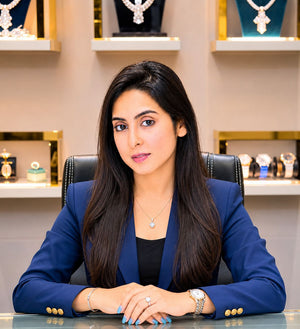
Author Bio
Aumsri Pradhan
Founder, Ivevar Luxury
Aumsri Pradhan is the founder of Ivevar Luxury, a Surat-based fine jewelry brand that designs and handcrafts lab grown diamond and moissanite jewelry in its own workshop. She leads the brand's design and customer experience, from engagement rings and bridal sets to custom pieces made to each client's story. Through the Ivevar blog, she shares practical guidance on lab grown diamonds, moissanite, diamond grading and ring design to help buyers choose with confidence.


