

 Engagement Rings
 Anniversary Rings
 Solitaire Rings
 Halo Rings
 Toi Moi Rings
 Three Stone Rings
 Nature Inspired Rings
 Rose Cut Rings
 Fancy Color Rings
 Antique Cut Rings
 Wedding Rings
 Wedding Band Rings
 Exclusive Lab Grown Diamond Rings
 All Lab Grown Diamond Ring
 Engagement Rings
 Three Stone Rings
 Fancy Color Rings
 Antique Cut Rings
 Daily Wear Rings
 Wedding Band Rings
 Exclusive Moissanite Rings
 Earrings
 Bracelet
 Pendant
 Necklace
 Men's Ring
 Bridal Sets
 Rings
 Earrings
 Tennis chain
 Cuban Chains
 Custom Pendant
 Custom Ring
 Custom Teeth Grillz
 Round
 Oval
 Cushion
 Marquise
 Pear
 Emerald
 Heart
 Princess
 Rose Cut
 Radiant
 Antique Cut
 Brooch
 Cufflink
 Keychain
 Unique Products
 +91-9265051773
 Virtual Appointment
 log in




Short answer: Both lab grown diamond and moissanite wedding bands are durable, beautiful and far more affordable than mined diamond bands. Lab grown diamonds are real diamonds (10 on the Mohs scale) with classic white brilliance. Moissanite is a different gemstone (about 9.25 on the Mohs scale) with more rainbow fire and an even lower price. Choose lab grown if you want a true diamond look; choose moissanite for maximum sparkle on a tighter budget.
Wedding bands often use many small stones, which makes the stone choice a big factor in price. A half eternity band might hold a dozen stones; a full eternity band can hold twenty or more. Multiply any difference in stone cost by that number and the choice between lab grown diamond and moissanite starts to matter a lot.
This guide explains how the two stones differ, how those differences show up in a band rather than a single large stone, which one suits your engagement ring, and how to buy either with confidence.
Lab Grown Diamond vs Moissanite Bands at a Glance
| Lab grown diamond | Moissanite | |
|---|---|---|
| What it is | Real diamond (carbon) | Silicon carbide gemstone |
| Hardness | 10 | About 9.25 |
| Refractive index | About 2.42 | About 2.65 |
| Sparkle | White brilliance with balanced fire | Strong rainbow fire |
| Look in small stones | Classic diamond look | Very sparkly; slight rainbow flashes |
| Price | Low compared with mined diamonds | Lower still |
| Diamond tester | Tests as diamond | Often identified as moissanite on multi-testers |
| Certification | Often graded by IGI or GIA | Usually sold with a seller's description or certificate of authenticity |
| Durability | Excellent | Excellent |
What Each Stone Actually Is
Before comparing them in a band, it helps to know what you are buying. The two stones are often sold side by side, but they are entirely different materials.
Lab grown diamond
A lab grown diamond is a real diamond. It is made of carbon arranged in the same crystal structure as a diamond from the ground, so it is chemically, physically and optically the same. The only difference is where it formed. Lab diamonds are grown using one of two methods:
- CVD (chemical vapor deposition): carbon from a gas is deposited layer by layer onto a thin diamond seed until a crystal grows.
- HPHT (high pressure, high temperature): carbon is exposed to intense heat and pressure, recreating the conditions deep inside the earth.
Once cut and polished, a lab diamond is graded on the same 4Cs as a mined diamond: cut, color, clarity and carat. Larger stones are often graded by labs such as IGI and GIA. In a wedding band, the stones are usually small, so they are typically sold as a matched set of a stated color and clarity range rather than with a certificate for each stone.
Moissanite
Moissanite is a gemstone made of silicon carbide. It was first found in tiny amounts in a meteor crater, but natural moissanite is extremely rare, so all moissanite used in jewelry is created in a lab. It is not a diamond and not a diamond imitation in the cheap sense; it is a distinct, very hard and very brilliant gem in its own right.
Moissanite has a higher refractive index than diamond (about 2.65 versus about 2.42) and stronger dispersion, which is the splitting of light into spectral colors. In plain terms, it bends light more and throws more rainbow flashes. That is why moissanite is often described as having more fire than diamond.
Modern moissanite is available in colorless and near-colorless grades that look bright white in a band. Older or lower grade moissanite could show a faint yellow or gray tint, which is why it pays to check the color description when you buy.
How the Differences Show in a Wedding Band
Comparisons between diamond and moissanite usually focus on a single large center stone. In a wedding band, the stones are much smaller, and that changes what you actually notice.
Sparkle and fire
The rainbow fire of moissanite is easiest to see in larger stones under direct light, such as sunlight or spotlights. In small pave or channel stones, the effect is softer. A moissanite band still looks very lively, with occasional colorful flashes, while a lab diamond band shows a crisper white sparkle. Most people cannot tell them apart across a table.
Color
Color matters more when stones are lined up next to each other, because any difference between neighbors is easy to spot. Whichever stone you choose, look for well-matched, near-colorless or colorless stones along the whole band.
Durability
Both stones are excellent for daily wear. Diamond is the hardest gem at 10 on the Mohs scale, and moissanite at about 9.25 is harder than sapphire and far harder than everyday materials like glass or steel. In a band, the setting style (channel, pave, prong or flush) has more effect on durability than the choice between these two stones.
Cleaning
Both stones attract skin oils and lotion, which dull their sparkle. A weekly soak in warm soapy water and a soft brush keeps either one bright. Neither stone becomes cloudy on its own over time.
When to Choose a Lab Grown Diamond Band
- Perfect match: your engagement ring has a diamond and you want a perfect match.
- Classic look: you prefer classic white sparkle over rainbow fire.
- Real diamond: having a "real diamond" matters to you.
- Certification: you want the option of graded stones, especially in larger sizes.
A lab grown diamond band is also a natural choice if you plan to add an anniversary band later and want every ring in your stack to be diamond. Browse our lab grown diamond wedding bands or full lab diamond eternity rings to see the range.
When to Choose a Moissanite Band
- Matching stone: your engagement ring is moissanite.
- Extra fire: you love extra fire and sparkle.
- Bigger look: you want a wide or full eternity band at the lowest price.
- Budget balance: you would rather spend more on the engagement ring, metal or a second band.
Moissanite also makes sense for statement bands with larger stones, such as an eternity band of oval or emerald cuts, where the cost of diamonds would add up quickly. See our moissanite eternity rings for examples.
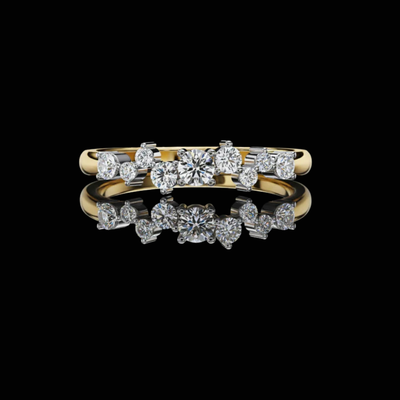
 Shown: Chevron Brilliant Round Moissanite Wedding Eternity Band
Band Styles and Settings for Each Stone
Both stones work in every common band style, but some designs show off each one's character better than others. Thinking about the style first can make the stone decision easier.
Pave and micro pave bands
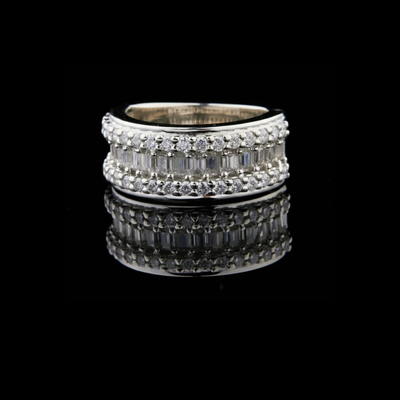
Pave bands use many tiny stones held by small beads of metal, creating a continuous line of sparkle. Because the stones are so small, the visual difference between diamond and moissanite is at its smallest here. This is a style where moissanite offers great value, and where a lab diamond band will be almost indistinguishable to most people.
Channel set bands
In a channel setting, stones sit side by side between two walls of metal, with no prongs. It is one of the most secure settings for daily wear and suits active lifestyles. Both stones look clean and bright in a channel.
Shared prong and eternity bands
Shared prong bands lift each stone slightly higher so more light reaches it. This is where moissanite's extra fire becomes more visible, especially with larger stones. If you love rainbow flashes, a prong-set moissanite eternity band shows them best. If you prefer a calm, white sparkle, choose lab diamond.
Fancy shape bands
Bands with ovals, emerald cuts, pears or marquise stones use more gem material per stone. Emerald cuts in particular, with their long, open facets, show the character of each stone more clearly. Lab diamond emerald cuts look cool and mirror-like, while moissanite emerald cuts show bolder flashes of color.
Men's bands
Men's bands often use a single row of channel or flush set stones in a wider metal band. The stones are protected by the metal, so either choice is very durable. Moissanite can be a smart option for wider bands with several rows, where stone weight adds up.
Long-Term Wear and Value
A wedding band is meant to be worn for decades, so it helps to think beyond the day you buy it.
- Wear: both stones will look the same in twenty years as they do today, as long as the setting is maintained and the band is cleaned.
- Repairs: if a small stone is ever lost, a jeweler can replace it with a matching stone of the same type. Keep a note of which stone and color range your band uses.
- Upgrades: many people add an anniversary or eternity band later. Choosing the same stone now makes it easier to build a matching stack.
- Resale: wedding bands are rarely bought as investments, and small stones of either type have limited resale value. Choose based on how the band looks and feels to you.
Shop the styles in this guide






Price: Where the Difference Adds Up
Both stones cost far less than mined diamonds of similar size and quality, and moissanite is usually lower still. In a band, the price gap grows with the total stone weight. A slim band with tiny pave stones holds very little gem material, so the difference between the two may be modest. A wide band, a full eternity band, or a band with larger stones holds much more, and that is where moissanite can save a meaningful amount.
| Band style | Stone content | Impact of stone choice on price |
|---|---|---|
| Plain band with a single small stone | Very low | Small |
| Slim pave half eternity | Low | Modest |
| Full pave eternity | Medium | Noticeable |
| Eternity band with larger stones | High | Large |
| Wide men's band with multiple rows | High | Large |
Metal is the other big cost driver. A heavy 18K gold band will cost more than a slim 10K gold one whichever stone you pick, so compare like with like when weighing your options.
Tip: Decide on the band style first, then compare the same design in both stones. That shows you the real price difference for the ring you actually want, instead of comparing two very different bands.
Can You Mix Them?
Yes. Many people pair a lab grown diamond engagement ring with a moissanite band, or the reverse. In small pave stones, the difference is subtle to most eyes, though moissanite may show a little more rainbow fire in bright light.
A practical approach is to put your budget where it shows most. Some couples choose a lab grown diamond for the engagement ring center stone and a moissanite eternity band to keep the total cost down. Others choose a moissanite center stone and spend more on a lab diamond band. Both approaches are valid; what matters is that you are happy with the look.
Matching your band to your engagement ring
The simplest rule is to match the stone in your engagement ring. A lab diamond engagement ring with a lab diamond band, or moissanite with moissanite, guarantees the same color and character across your stack.
That said, mixing is common and usually works well. If you mix, pay attention to color. A colorless moissanite band next to a near-colorless diamond, or the other way round, can look slightly different in tone. Choosing stones in a similar color range keeps the stack looking unified.
Also consider the cut. Round brilliant stones in a band blend easily with almost any engagement ring. If your center stone is an oval, emerald or pear, a band with the same cut can echo the shape, or you can choose round stones for contrast.
Buying Tips
- Color grade: ask for the stone color grade; near-colorless looks best next to white diamonds.
- Matching: check that stones are well matched along the band.
- Settings: choose secure settings for everyday wear, such as channel or well-made shared-prong pave.
- Clear labeling: make sure the seller clearly labels which stone you are buying.
- Fit: confirm your ring size carefully, especially for full eternity bands, which are harder to resize because stones go all the way around.
- Returns: buy from a seller with a clear return policy so you can see the band in person.
Be wary of listings that call moissanite a "moissanite" or that blur the line between the two. They are different gemstones, and a trustworthy seller will say exactly which one you are getting.
Lab Diamond and Moissanite Bands at Ivevar
We handcraft both lab grown diamond and moissanite bands in our Surat workshop and label every stone clearly. Many of our lab grown diamonds come with IGI certificates, and bands are available in 10K, 14K and 18K gold. Every band ships free worldwide, with 30-day easy returns. Browse lab grown diamond wedding bands and moissanite wedding bands, and read our lab grown diamond vs moissanite guide. If you would like a matching set, explore our moissanite bridal sets, or book a virtual appointment to design a custom band.
Shop Moissanite Wedding Bands
 Chevron Moissanite BandShop Now
 Geometric Baguette Round BandShop Now
 Baguette Round Eternity BandShop Now
 Emerald Channel Set BandShop Now
 Half Eternity Emerald BandShop Now
 Round Moissanite SolitaireShop Now
Swipe to see more → | View all moissanite bands
Frequently Asked Questions
Is moissanite good for a wedding band?
Yes. It is hard, durable and very sparkly, which makes it well suited to a ring worn every day.
Can people tell moissanite from diamond in a band?
Rarely by eye in small stones; moissanite may show more rainbow flashes in bright light.
Which is more affordable?
Moissanite is usually less expensive than lab grown diamond, and the gap grows with the total size of the stones in the band.
Will moissanite get cloudy?
No. Quality moissanite keeps its brilliance; clean it regularly like any jewelry.
Can I match a moissanite band to a diamond ring?
Yes, especially with near-colorless moissanite that is close in tone to the diamond.
Is a lab grown diamond band a real diamond?
Yes. Lab grown diamonds are chemically, physically and optically the same as mined diamonds. Only their origin is different.
Which is more durable for daily wear?
Diamond is harder, but both are excellent for everyday wear. The setting style matters more to how well a band holds up than the choice between the two stones.
Do small band stones come with certificates?
Small pave and channel stones are usually sold as a matched set with a stated quality range. Individual certificates are more common for larger stones.
The Bottom Line
Choose lab grown diamond for a true diamond look and moissanite for maximum sparkle at the lowest price. Both make durable, beautiful wedding bands. Match the stone to your engagement ring if you can, check the color and matching of the stones, and pick a secure setting that suits your lifestyle.
Related Guides
Author Bio
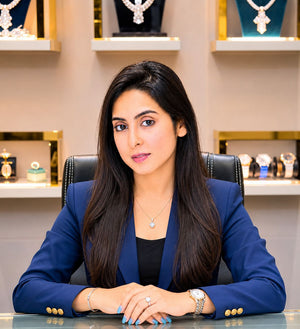
Aumsri Pradhan
Founder, Ivevar Luxury
Aumsri Pradhan is the founder of Ivevar Luxury, a Surat-based fine jewelry brand that designs and handcrafts lab grown diamond and moissanite jewelry in its own workshop. She leads the brand's design and customer experience, from engagement rings and bridal sets to custom pieces made to each client's story. Through the Ivevar blog, she shares practical guidance on lab grown diamonds, moissanite, diamond grading and ring design to help buyers choose with confidence.


