

 Engagement Rings
 Anniversary Rings
 Solitaire Rings
 Halo Rings
 Toi Moi Rings
 Three Stone Rings
 Nature Inspired Rings
 Rose Cut Rings
 Fancy Color Rings
 Antique Cut Rings
 Wedding Rings
 Wedding Band Rings
 Exclusive Lab Grown Diamond Rings
 All Lab Grown Diamond Ring
 Engagement Rings
 Three Stone Rings
 Fancy Color Rings
 Antique Cut Rings
 Daily Wear Rings
 Wedding Band Rings
 Exclusive Moissanite Rings
 Earrings
 Bracelet
 Pendant
 Necklace
 Men's Ring
 Bridal Sets
 Rings
 Earrings
 Tennis chain
 Cuban Chains
 Custom Pendant
 Custom Ring
 Custom Teeth Grillz
 Round
 Oval
 Cushion
 Marquise
 Pear
 Emerald
 Heart
 Princess
 Rose Cut
 Radiant
 Antique Cut
 Brooch
 Cufflink
 Keychain
 Unique Products
 +91-9265051773
 Virtual Appointment
 log in




Lab Grown Diamond Tennis Bracelet: Carat Weight and Size Guide
by Aumsri Pradhan on Sep 28, 2026
Quick answer: To size a lab grown diamond tennis bracelet, measure your wrist snugly and add about 0.5 to 1 inch for comfort. Most US women wear a 7 inch bracelet. For carat weight, 2 to 3 carats total gives a delicate everyday look, around 5 carats gives a classic statement, and 7 to 10 carats or more gives a bold, red-carpet sparkle.
A tennis bracelet is one of the most versatile pieces of fine jewelry you can own. Here is how to get the length, carat weight and setting right.
Shop the styles in this guide


How to Measure Your Wrist
- Wrap a soft tape measure, or a strip of paper, around your wrist just above the wrist bone.
- Keep it snug but not tight, and note the measurement in inches.
- Add 0.5 inch for a closer fit or about 1 inch for a looser, sliding fit.
| Wrist size | Close fit | Relaxed fit |
|---|---|---|
| 5.5 in | 6 in | 6.5 in |
| 6 in | 6.5 in | 7 in |
| 6.5 in | 7 in | 7.5 in |
| 7 in | 7.5 in | 8 in |
| 7.5 in (common for men) | 8 in | 8.5 in |
A tennis bracelet should move slightly but not slide far over your hand. If it is too loose, the clasp tends to rotate to the top of the wrist.
How Many Carats Should a Tennis Bracelet Be?
Total carat weight (ctw) depends on stone size and bracelet length. These are approximate figures for a 7 inch bracelet of round stones:
| Total carat weight | Approx. stone size | Look |
|---|---|---|
| 2 to 3 ctw | about 2 mm | Delicate, easy to stack |
| 4 to 6 ctw | about 2.7 to 3 mm | Classic tennis bracelet |
| 7 to 10 ctw | about 3.5 mm | Bold statement |
| 10+ ctw | 4 mm and up | Maximum sparkle |
Lab grown diamonds make higher carat weights far more affordable than mined diamonds, so many buyers choose a size up.
How bracelet length changes total carat weight
Because a tennis bracelet is one continuous line of stones, the total carat weight rises with every extra link. A 7.5 inch bracelet made with the same stones as a 7 inch one carries a few more diamonds, so its listed ctw is slightly higher. When you compare two bracelets, check that the carat figures refer to the same length, or you may be comparing a 6.5 inch piece with an 8 inch one.
The reverse is also true. If you order a shorter bracelet for a small wrist, the total weight drops a little even though each stone and the overall look stay the same. Stone size, not total weight, is what your eye actually notices on the wrist.
Stone size matters more than the total number
Two bracelets can both be described as 5 carats yet look very different. One may use slightly larger stones with a little more metal between them, while another packs smaller stones tightly together. Ask for the millimeter size of each stone and the number of stones, then picture the width on your wrist rather than relying on the total carat weight alone.
| Stone size | Bracelet width on the wrist | Best for |
|---|---|---|
| About 2 mm | A fine, thread-like line of light | Stacking with watches and other bracelets, small wrists, office wear |
| About 2.7 to 3 mm | Clearly visible but still refined | A first tennis bracelet you plan to wear daily |
| About 3.5 mm | Bold and noticeable across a room | Evening wear, larger wrists, wearing on its own |
| 4 mm and up | Wide and heavy, a true statement | Men's bracelets, hip hop styling, special occasions |
Quality Grades for Tennis Bracelet Diamonds
Tennis bracelets use dozens of small diamonds, so you judge them as a matched set rather than one by one. The goal is an even line where no single stone looks darker, cloudier or smaller than its neighbors.
- Color: Near colorless stones in the G to H range look bright white in white gold or silver. In yellow gold, slightly warmer stones blend in well because the metal already adds warmth.
- Clarity: Inclusions in 2 to 3 mm stones are very hard to see without magnification. A VS or SI range that looks clean to the eye is usually all you need for a bracelet.
- Cut: Cut drives sparkle. Well cut small stones flash far more than poorly cut larger ones, so ask about cut quality before chasing carat weight. Our guide to lab grown diamond cut grades explains what to look for.
- Matching: Look closely at photos or videos for any stone that sits lower, tilts or reads a different shade. Consistency is what makes a tennis bracelet look expensive.
Small stones in bracelets are rarely sold with an individual grading report for each diamond. When a report is offered, it usually covers the stones as a group with an approximate color and clarity range.
Lab Grown Diamond vs Mined Diamond vs Moissanite Tennis Bracelets
All three can make a beautiful tennis bracelet. The right one depends on how you weigh budget, sparkle style and the word "diamond."
| Feature | Lab grown diamond | Mined diamond | Moissanite |
|---|---|---|---|
| Material | Carbon, the same as mined diamond | Carbon | Silicon carbide |
| Hardness (Mohs) | 10 | 10 | 9.25 |
| Refractive index | About 2.42 | About 2.42 | About 2.65 |
| Look | Classic diamond white and fire | Classic diamond white and fire | Stronger rainbow flashes, especially in sunlight |
| Diamond tester | Reads as diamond | Reads as diamond | Can be told apart with the right tester |
| Cost for the same size | Much lower than mined | Highest | Usually the lowest |
A lab grown diamond is a real diamond, grown by the CVD or HPHT method instead of being mined. Telling it apart from a mined diamond takes specialized lab equipment. If you love extra fire and want the most size for your budget, a moissanite bracelet is worth a look. Our moissanite vs lab grown diamond vs diamond comparison covers the differences in more detail.
Choose the Right Setting and Stone Shape
Four prong
The classic choice. Four prongs show off the most diamond and give the brightest sparkle.
Bezel or channel
Metal surrounds each stone, which protects it from knocks. A great pick for active, everyday wear.
Emerald, oval and fancy shapes
Emerald cut tennis bracelets feel elegant and modern; oval and marquise designs add movement. Fancy shapes often use fewer, larger stones for the same carat weight.
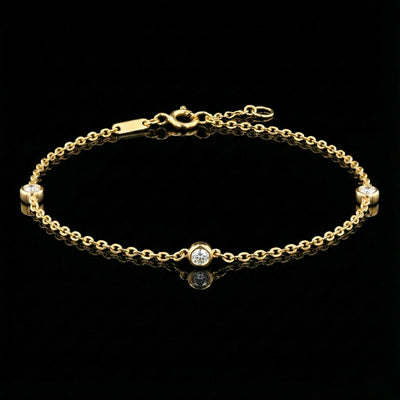
 Shown: Round Cut Brilliant Lab Grown Diamond Four Prong Tennis Bracelet
Check the Clasp
The clasp is the most important safety feature. Look for a box clasp with a secure click plus a safety latch or figure-eight catch. Test that it closes firmly, and have it checked by a jeweler once a year.
Metal Choice
- 14K gold: durable and popular in the US for everyday bracelets.
- 18K gold: richer color, slightly softer.
- 18K white gold: bright white finish that flatters colorless diamonds.
- Sterling silver: budget friendly, but needs more polishing.
Matching your metal to your skin and wardrobe
Gold karat changes both color and toughness. Lower karat gold has more alloy metals mixed in, which makes it harder and more scratch resistant, while higher karat gold is richer in color but softer.
| Metal | Strengths | Things to know |
|---|---|---|
| 10K gold | The hardest and most scratch resistant gold option | Paler yellow color than higher karats |
| 14K gold | A balanced mix of color and strength for daily wear | The most common choice for tennis bracelets |
| 18K gold | Deep, rich color that looks luxurious | Softer, so prongs and links can wear faster with heavy use |
| 925 sterling silver | The most budget friendly way to get a large look | Tarnishes over time and needs regular polishing |
White gold and silver make diamonds look icy and bright, yellow gold gives a warm vintage feel, and rose gold flatters warmer skin tones. If you wear a watch on the same wrist, matching the metals makes a stack look intentional.
Fit Tips for Different Wrists and Styles
Small or slim wrists
On a wrist under about 6 inches, a 2 to 3 mm stone size keeps the bracelet in proportion. Choose the close fit length so the bracelet does not slide down onto the hand when you reach for things.
Larger wrists and men's tennis bracelets
Men usually prefer 3.5 mm stones or larger and a length of 8 to 8.5 inches. A heavier bracelet hangs better with a little room, so the relaxed fit column in the sizing table above is a good starting point. For chunkier looks, browse our lab grown diamond tennis chains to pair a matching necklace.
Stacking with a watch
If you stack a tennis bracelet next to a watch, order the close fit length so it stays on its side of the watch. A loose tennis bracelet will slide under the watch case and the stones can rub against the metal.
Wearing it alone
A single bracelet worn on its own can be a touch looser, which lets it catch the light as your wrist moves. This is where a relaxed fit and a slightly larger stone size really shine.
Popular Tennis Bracelet Styles
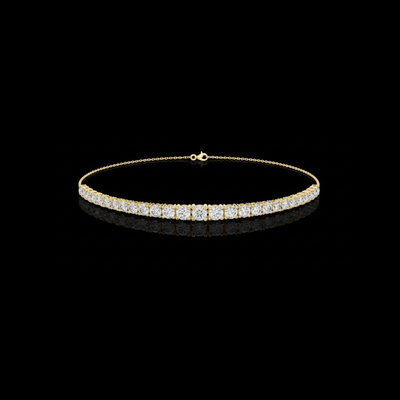
- Classic round four prong: The timeless option with the most light coming through each stone.
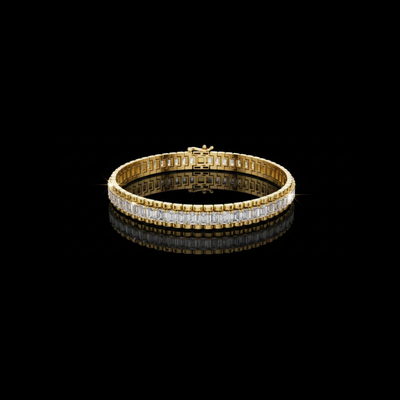
- Wide link: Stones set in broader links for a bolder, more modern line.
- Floral or infinity links: Clusters or shaped links that add pattern while keeping the flexible tennis feel.
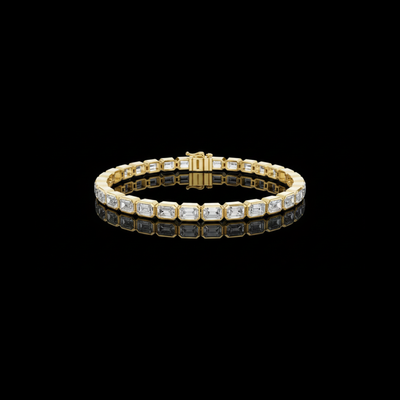
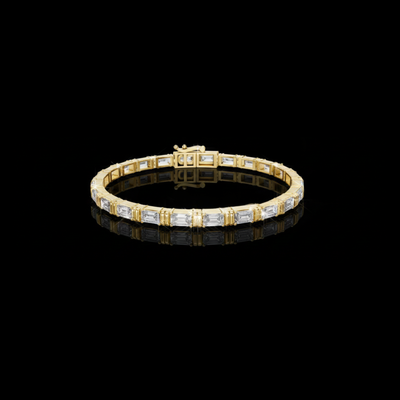
- Emerald cut: Step cut rectangles with a clean, mirrored flash rather than scattered sparkle.
- Marquise and mixed shapes: Pointed or alternating shapes that create movement along the wrist.
- Colored accents: A gemstone or colored stone between diamonds for a personal touch.
You can explore more designs in our lab diamond fine jewelry bracelet collection.
Shop the styles in this guide








What Affects the Cost of a Tennis Bracelet
Several factors move the price of a lab grown diamond tennis bracelet up or down, and knowing them helps you spend where it shows.
- Total carat weight: More and larger stones cost more, and the jump is steeper as single stones get bigger.
- Stone quality: Whiter, cleaner and better cut stones cost more, though very small stones show quality differences less.
- Metal type and weight: Gold costs more than sterling silver, higher karat gold costs more than lower karat, and wide links use more metal.
- Length: Every extra half inch adds stones and metal.
- Setting work: Each stone is set by hand, so complex link designs and fancy shapes take more labor.
Caring for Your Tennis Bracelet
Lab grown diamonds do not get cloudy, change color or lose their sparkle over time. When a bracelet looks dull, the cause is almost always lotion, soap film and skin oil collecting under the stones.
- Soak the bracelet for a few minutes in warm water with a drop of mild dish soap.
- Brush gently behind each stone with a soft toothbrush, where oil builds up.
- Rinse in a bowl of clean water rather than over an open drain.
- Pat dry with a lint free cloth and let it air dry fully before storing.
- Store it flat or in its own pouch so it does not tangle or scratch other jewelry.
Take the bracelet off for the gym, gardening, cleaning with chemicals and swimming in chlorinated pools. Snagging is the main risk to a tennis bracelet, and a bent prong can loosen a stone. See our jewelry care guide for more tips.
Common Sizing and Buying Mistakes
- Using your watch strap size: Watch straps sit differently on the wrist. Measure the wrist itself.
- Ordering too loose: A loose bracelet spins, hides the clasp on top and is more likely to catch on things.
- Judging by carat weight alone: Compare stone size in millimeters and the length the carat figure refers to.
- Ignoring the clasp: A bracelet without a secondary safety catch is easy to lose.
- Choosing very soft metal for heavy use: For daily wear on an active wrist, 10K or 14K gold holds up better than 18K.
Step-by-Step Tennis Bracelet Checklist
- Measure your wrist just above the wrist bone and write it down in inches.
- Decide between a close fit or relaxed fit and add 0.5 or 1 inch.
- Pick a stone size that suits your wrist and how you plan to wear it.
- Choose a stone shape and setting style, prong for sparkle or bezel for protection.
- Select your metal and color based on durability, skin tone and what you already wear.
- Confirm the clasp has a box lock plus a safety latch or figure-eight catch.
- Check that the carat weight shown matches the length you are ordering.
- Plan your care routine so the stones stay bright.
Buying a Tennis Bracelet as a Gift Without Knowing the Size
Surprise gifts are where most sizing problems start. You can usually get close without asking directly.
- Borrow a bracelet: Lay a bracelet they already wear flat and measure it end to end, including the clasp. That is their preferred finished length.
- Use a watch carefully: Measure the strap from the buckle hole they use to the end of the case. Treat this as a rough guide only, since watches sit higher on the arm.
- Go with the common size: If you have nothing to measure, 7 inches suits many women and 8 inches suits many men, as noted above.
- Lean slightly smaller for petite frames: A bracelet that is a little snug is easier to live with than one that slides over the hand.
Since a tennis bracelet is made to order, it pays to confirm the length before you place the order rather than after it arrives.
Who a Lab Grown Diamond Tennis Bracelet Suits
A tennis bracelet suits anyone who wants real diamond sparkle they can wear every day without thinking about it. It is a natural gift for milestones like graduations, anniversaries and promotions, and it pairs as easily with a T-shirt as with evening wear. If you are building a matching set, our lab grown diamond tennis necklace guide helps you choose a necklace in the same style.
Tennis Bracelets at Ivevar
We handcraft our tennis bracelets in our Surat workshop, setting each diamond by hand and testing every clasp. Bracelets can be made to your wrist length and ship free worldwide, with 30-day easy returns. Browse our lab grown diamond bracelets.
Shop Lab Grown Diamond Tennis Bracelets
 Round Four Prong Tennis BraceletShop Now
 Round Wide Link Tennis BraceletShop Now
 Floral Infinity Tennis BraceletShop Now
 Emerald Cut Tennis BraceletShop Now
 Emerald Cut Tennis BraceletsShop Now
 Marquise Clover Tennis BraceletShop Now
Swipe to see more → | View all bracelets
Frequently Asked Questions
What is the most common tennis bracelet size?
In the US, 7 inches is the most common women's size, and 8 inches is common for men.
How many carats is a good tennis bracelet?
Around 3 to 5 carats is a popular everyday choice. Go higher for a statement look.
Can a tennis bracelet be resized?
Yes, a jeweler can usually add or remove links. It is easier to order the right length from the start.
Can I wear a tennis bracelet every day?
Yes. Choose a secure clasp, remove it for heavy work, and have the clasp checked yearly.
What clasp is best for a tennis bracelet?
A box clasp with a tongue that clicks into place, backed up by one or two figure-eight safety catches, is the most secure choice for a bracelet you wear daily.
Is a lab grown diamond tennis bracelet a real diamond bracelet?
Yes. Lab grown diamonds are carbon crystals with the same hardness, chemistry and optical properties as mined diamonds, and standard thermal diamond testers read them as diamond.
What length should a men's tennis bracelet be?
Measure the wrist and add 0.5 to 1 inch, as for women's sizes. Many men end up in an 8 to 8.5 inch bracelet with stones of 3.5 mm or larger.
Why does my tennis bracelet look less sparkly than when I bought it?
Oil, lotion and soap residue collect behind the stones and block light. A gentle soak and soft brush cleaning brings the sparkle straight back.
The Bottom Line
Measure your wrist and add half to one inch, choose a carat weight that fits your style, and insist on a secure double-locking clasp. A lab grown diamond tennis bracelet gives you real diamond sparkle at a far more accessible price.
Related Guides
- Lab diamond classic bangles
- What does TW mean in jewelry?
- How to buy a lab grown diamond: a simple buying guide
Author Bio
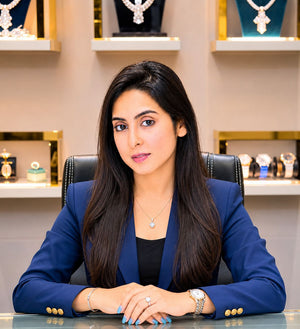
Aumsri Pradhan
Founder, Ivevar Luxury
Aumsri Pradhan is the founder of Ivevar Luxury, a Surat-based fine jewelry brand that designs and handcrafts lab grown diamond and moissanite jewelry in its own workshop. She leads the brand's design and customer experience, from engagement rings and bridal sets to custom pieces made to each client's story. Through the Ivevar blog, she shares practical guidance on lab grown diamonds, moissanite, diamond grading and ring design to help buyers choose with confidence.


