Engagement Rings
 Anniversary Rings
 Solitaire Rings
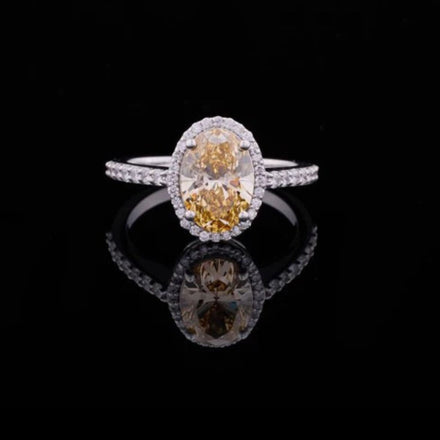
 Halo Rings
 Toi Moi Rings
 Three Stone Rings
 Nature Inspired Rings
 Rose Cut Rings
 Fancy Color Rings
 Antique Cut Rings
 Wedding Rings
 Wedding Band Rings
 Exclusive Lab Grown Diamond Rings
 All Lab Grown Diamond Ring
 Engagement Rings
 Three Stone Rings
 Fancy Color Rings
 Antique Cut Rings
 Daily Wear Rings
 Wedding Band Rings
 Exclusive Moissanite Rings
 Earrings
 Bracelet
 Pendant
 Necklace
 Men's Ring
 Bridal Sets
 Rings
Rings
 Earrings
 Tennis chain
 Cuban Chains
 Custom Pendant
 Custom Ring
 Custom Teeth Grillz
 Round
Round
 Oval
Oval
 Cushion
 Marquise
 Pear
Pear
 Emerald
 Heart
Heart
 Princess
 Rose Cut
 Radiant
 Antique Cut
 Brooch
 Cufflink
 Keychain
 Unique Products
 +91 9265051773
 Virtual Appointment
 log in



Lab Grown Diamond Halo Engagement Rings: Styles & Prices
by Ankit Koshiya on Sep 29, 2026

Short answer: Lab grown diamond halo engagement rings surround the center stone with a frame of smaller diamonds, making the center look noticeably larger — often like a stone about half a carat bigger — and adding serious sparkle. Prices typically run $800–$3,000 — far below mined halo rings — with classic, hidden, and floral halo styles to choose from. The diamonds are real diamonds, chemically identical to mined ones, and center stones come with independent grading reports.
- ✓ A halo makes the center diamond look up to 30% larger — the eye reads the center stone and its frame as one bigger diamond.
- ✓ Lab grown halo rings cost $800–$3,000 — roughly 60–80% less than the same design in mined diamonds.
- ✓ Three main styles: classic halo (frame at the top), hidden halo (frame under the center stone), and floral halo (petal-shaped frame).
- ✓ Oval and cushion centers pair beautifully with halos and give the most finger coverage per carat.
- ✓ Halo stones need the same care as any pave work — an annual prong check keeps the small diamonds secure.
What Is a Halo Engagement Ring?
A halo engagement ring sets a ring of small diamonds around the center stone, framing it in a continuous circle of light. The effect is dramatic: the halo adds visual weight to the center diamond, so a 1.00-carat center in a halo can read like a solitaire about half a carat larger. That is why halos are the most popular upgrade trick in ring design — you get the presence of a much larger diamond without paying for one.
With lab grown diamonds, the halo advantage compounds. Because lab grown center stones already cost a fraction of mined ones, a lab grown halo ring delivers the visual impact of a large mined solitaire at a price many buyers find astonishing. A halo that would cost $8,000–$15,000 with mined diamonds frequently lands at $1,500–$3,000 with lab grown stones — same sparkle, same real diamond material.
Halo Styles: Classic, Hidden, and Floral
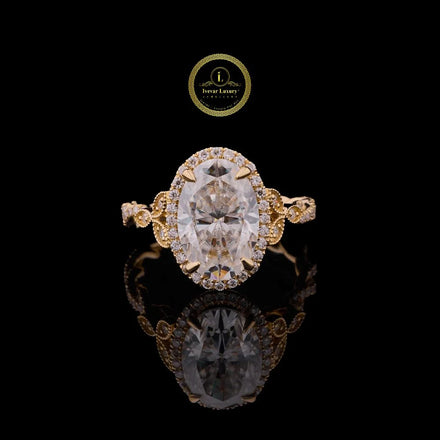
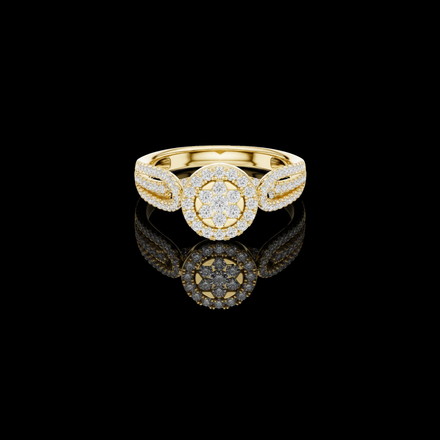
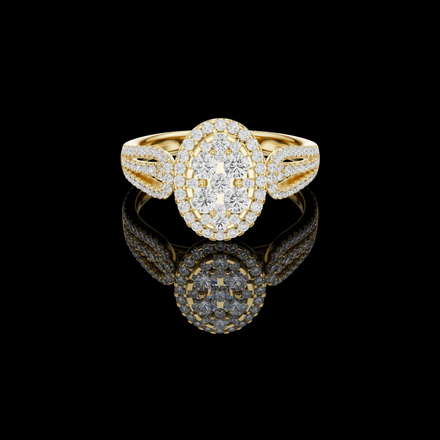
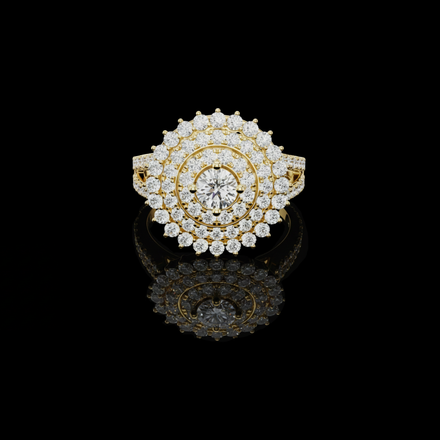
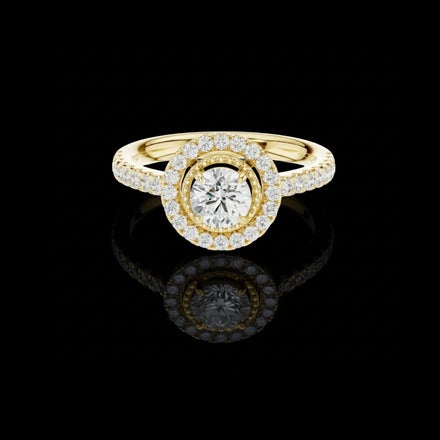
The classic halo is a single ring of pave diamonds sitting at the same level as the center stone's table, tracing its outline in a perfect frame. It works with every center shape — round, oval, cushion, emerald — and it is the best choice if maximum size illusion is the goal. Double halos add a second concentric frame for even more presence; they suit larger hands and bolder tastes.
The hidden halo takes a subtler approach: the diamond frame sits just below the center stone, invisible from the top but visible from the side. From above, the ring reads as a clean solitaire; from the side, it reveals a secret ring of fire. Hidden halos are the current favorite for buyers who want the sparkle without the look of trying — understated from the front, luxurious in profile. They pair especially well with oval and emerald centers on pave bands.
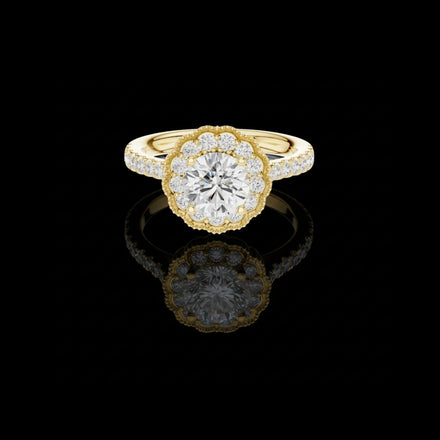
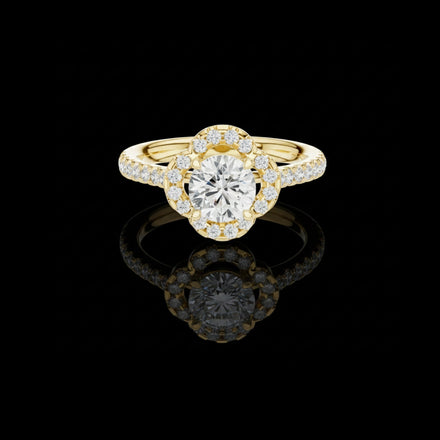
The floral halo shapes the frame into petals, turning the diamond surround into a flower. Sunburst and leaf-style halos blend the classic frame with nature-inspired detail, softening the geometry of a round or oval center. Floral halos photograph beautifully and feel romantic rather than architectural — a good match for vintage-leaning or feminine design tastes.

How Much Do Lab Grown Diamond Halo Rings Cost?
Price follows center-stone size first, then halo complexity. A halo ring with a 1.00-carat lab grown center typically costs $1,200–$2,000; stepping to a 1.50-carat center moves the range to $2,000–$3,000. Smaller halo designs — a 0.50-carat center in a delicate frame — can start around $800. The halo itself adds modest cost: the small melee diamonds are inexpensive, and most of the price difference between styles is craftsmanship.
Compare that to mined: a 1.50-carat mined halo ring from a traditional retailer often costs $10,000–$18,000, with the center stone alone accounting for most of it. The lab grown version uses the same design and the same metal — the price gap comes from how the diamonds were grown, not from any difference you can see or wear.

Choosing the Right Center Shape for a Halo
Oval centers are the halo's best friend: the elongated shape already covers more finger, and the halo extends that advantage into a dramatic finger-spanning presence. Cushion cuts pair similarly well, their soft corners echoing the halo's frame. Round centers in halos are the timeless classic — maximum brilliance framed in brilliance. Emerald centers with halos create a striking contrast: the step-cut's calm, hall-of-mirrors flash against the halo's scattered fire.
One caution: halos add width. On petite fingers, a large halo on a large center can overwhelm. If your ring size is under 5, consider a 1.00-carat center with a delicate single halo rather than a double halo on a 1.50-carat stone. And remember that halos sit slightly higher than plain solitaires — if you work with your hands, a lower-set halo or a bezel-halo hybrid protects the design better.
Certification for Lab Grown Halo Rings
Ask for an independent grading report on the center stone; the small halo diamonds are too small to certify individually. IGI grades most lab grown diamonds and lists full color, clarity and cut grades. GIA, since October 1, 2025, labels lab grown stones Premium or Standard rather than giving color and clarity grades. If you want to compare two center stones grade by grade, an IGI report makes that easiest.
Caring for a Halo Ring
A halo contains more small diamonds than a solitaire, which means more prongs to maintain — but the care routine is the same: monthly soap-and-water cleaning and an annual professional inspection. During the inspection, the jeweler checks the melee stones' tightness under magnification, because a tiny loose halo diamond is easy to miss and hard to match later. With that simple maintenance, a halo ring lasts as long as any other diamond ring — which is to say, generations.
| Halo style | Look | Lab grown price (1 ct center) | Best for |
|---|---|---|---|
| Classic halo | Diamond frame around the center, top view | $1,200–$2,000 | Maximum size illusion, timeless look |
| Hidden halo | Frame tucked under the center stone | $1,300–$2,200 | Understated top view, surprise sparkle in profile |
| Floral / sunburst halo | Petal-shaped diamond frame | $1,200–$2,100 | Romantic, nature-inspired design |
| Double halo | Two concentric diamond frames | $1,800–$3,000 | Bold presence, larger hands |
Shop Our Best Sellers


Swipe to see more → | View all best sellers
Frequently Asked Questions
How much bigger does a halo make a diamond look?
A halo typically makes the center diamond appear up to about 30% larger — often like a stone around half a carat bigger — because the eye reads the center stone and its frame as one larger diamond.
How much does a lab grown diamond halo engagement ring cost?
Most lab grown halo rings cost $800–$3,000. A 1.00-carat center in a classic halo runs $1,200–$2,000, while 1.50-carat centers and double halos reach $2,000–$3,000.
What is the difference between a classic halo and a hidden halo?
A classic halo's diamond frame sits at the top around the center stone, visible from above. A hidden halo's frame sits just below the center stone — invisible from the top, revealed in side profile.
Are lab grown diamonds in halo rings real diamonds?
Yes. They are chemically and optically identical to mined diamonds. Center stones are graded by independent labs: IGI gives full 4Cs grades, while GIA now labels lab grown stones Premium or Standard.
Which center shape looks best in a halo?
Oval and cushion centers give the most finger coverage and pair beautifully with halos. Round is the timeless classic; emerald creates a striking contrast between calm step-cut flash and halo fire.
Do halo rings require more maintenance?
Slightly. Halos contain more small diamonds and prongs than solitaires, so the annual professional inspection matters more — it catches loose melee stones before they are lost.
Can I wear a wedding band with a halo engagement ring?
Yes, but check the fit: halos sit higher than plain solitaires, so a contoured or curved wedding band often sits flush better than a straight one. Bridal sets solve this by design.
Sources
- GIA Changes Lab-Grown Grading — JCK
- GIA — Gemological Institute of America
- IGI — International Gemological Institute
- GCAL — Gem Certification & Assurance Lab

Aumsri Pradhan is the founder of Ivevar Luxury, a Surat-based fine jewelry brand that designs and handcrafts lab grown diamond and moissanite jewelry in its own workshop. She leads the brand's design and customer experience, from engagement rings and bridal sets to custom pieces made to each client's story. Through the Ivevar blog, she shares practical guidance on lab grown diamonds, moissanite, diamond grading and ring design to help buyers choose with confidence.