

 Engagement Rings
 Anniversary Rings
 Solitaire Rings
 Halo Rings
 Toi Moi Rings
 Three Stone Rings
 Nature Inspired Rings
 Rose Cut Rings
 Fancy Color Rings
 Antique Cut Rings
 Wedding Rings
 Wedding Band Rings
 Exclusive Lab Grown Diamond Rings
 All Lab Grown Diamond Ring
 Engagement Rings
 Three Stone Rings
 Fancy Color Rings
 Antique Cut Rings
 Daily Wear Rings
 Wedding Band Rings
 Exclusive Moissanite Rings
 Earrings
 Bracelet
 Pendant
 Necklace
 Men's Ring
 Bridal Sets
 Rings
 Earrings
 Tennis chain
 Cuban Chains
 Custom Pendant
 Custom Ring
 Custom Teeth Grillz
 Round
 Oval
 Cushion
 Marquise
 Pear
 Emerald
 Heart
 Princess
 Rose Cut
 Radiant
 Antique Cut
 Brooch
 Cufflink
 Keychain
 Unique Products
 +91-9265051773
 Virtual Appointment
 log in




Short answer: Oval and pear diamonds are both elongated, flattering shapes that look larger than a round diamond of the same carat weight. An oval is symmetrical and rounded at both ends, giving a soft, classic and very wearable look. A pear has one rounded end and one point, creating a teardrop with more personality. Ovals are easier to set and to pair with wedding bands; pears need a V-prong or bezel to protect the point. Choose oval for timeless versatility, pear for a distinctive statement.
Oval and pear are two of the most requested fancy shapes for engagement rings, and they are often shortlisted together because they share so much: both are brilliant cuts, both stretch the look of the finger, and both give you more visible size for your budget than a round. The differences are in the details: one point versus none, how each pairs with a band, how they show color, and the kind of mood they set.
This guide walks through those details so you can compare the two shapes on what actually matters when you buy: proportions, bow ties, settings, durability, and how each one suits your style and daily life.
Oval vs Pear at a Glance
| Feature | Oval | Pear |
|---|---|---|
| Shape | Rounded at both ends | One round end, one point |
| Look | Classic, soft, versatile | Unique, romantic, bold |
| Typical ratio range | 1.35 to 1.50 | 1.45 to 1.75 |
| Face-up size | Large for the carat | Large for the carat |
| Bow tie | Common | Common |
| Protection | Standard prongs | V-prong on the point |
| Wedding band pairing | Easy with straight bands | Often needs a curved or contour band |
The short version: these shapes are close cousins. If you love an elongated stone and want the easiest everyday option, oval wins. If you want something that looks different from most rings around you, pear is the more expressive choice.
How Each Shape Is Built
Both shapes are usually cut in a brilliant style, which means many triangular and kite-shaped facets arranged to throw back as much light and sparkle as possible. That is why both look lively and bright, closer to a round brilliant than to a step cut like an emerald.
The oval
An oval is essentially a stretched round brilliant. It has two matching curved ends and gently curved sides. Because there are no corners or points, the outline is continuous, and the stone looks soft and polished from every angle. A well-cut oval should look balanced: if you fold it in half lengthwise or widthwise, both halves should mirror each other.
The pear
A pear combines half of an oval (the rounded "head") with half of a marquise (the pointed "tail"). That mix is what gives it the teardrop silhouette. A pear only has one line of symmetry, running from the point through the centre of the rounded end, so the two sides of that line need to match closely. The curves from the head down to the point are called the "shoulders" and "wings," and their shape has a big effect on how elegant the stone looks.
Because the pear has a point, it also has a direction. Most people wear it with the point toward the fingertip, which lengthens the finger. Worn with the point toward the wrist, it looks more unusual and slightly vintage. An oval has no direction, so it looks the same however it is set.
Length-to-Width Ratio: Finding Your Proportion
The length-to-width ratio tells you how long or wide a stone looks. You get it by dividing the length by the width in millimetres. A 9 x 6 mm stone has a ratio of 1.50. There is no single correct ratio; it comes down to taste and finger shape. The ranges below are common starting points.
| Ratio | Oval look | Pear look |
|---|---|---|
| Below 1.35 | Wide, almost round | Short and plump |
| 1.35 to 1.50 | Classic oval | Fuller teardrop |
| 1.50 to 1.65 | Slim, elongated | Classic teardrop |
| Above 1.70 | Very long, narrow | Long, slender, dramatic |
- Shorter fingers: a slightly longer ratio on either shape creates a lengthening effect.
- Longer or slender fingers: a fuller oval or a classic pear keeps the stone in proportion.
- Wider hands: a fuller shape with good width tends to look more balanced than a very narrow one.
Tip: Always ask for the millimetre measurements, not just the carat weight. Two stones of the same weight can look quite different on the hand depending on their length, width and depth.
Bow Ties and Face-Up Size
Both ovals and pears can show a "bow tie," a darker band across the middle of the stone where light leaks out instead of bouncing back to your eye. It happens because the elongated shape changes the angles of the pavilion facets across the width of the stone. Nearly every oval and pear has some bow tie; what matters is how strong it is.
- Faint bow tie: adds contrast and is perfectly normal. Many people never notice it.
- Dark bow tie: looks like a shadow across the centre and takes away from the sparkle. Avoid it.
- Check video, not just photos: a bow tie can look different as the stone moves, so view it rocking from side to side.
On size, both shapes have a lot of their weight on top, in the visible table area, instead of hidden deep in the pavilion. That is why they "face up" larger than a round of the same carat. A long pear can look marginally bigger than an oval of the same weight because of its extra length, but the difference is small. Depth percentage matters more: a stone that is cut too deep hides weight underneath and looks smaller from above.
For more detail, read our oval ratio and bow tie guide.
Color and Clarity: What Each Shape Shows
The 4Cs (cut, color, clarity and carat) apply to both shapes, but elongated shapes behave a little differently from rounds.
Color
Elongated diamonds tend to show body color more than rounds, especially at the ends where the stone is thinner and light travels a shorter path. In a pear, any warmth can gather at the point. If you want a bright white look, staying in the colorless to near-colorless range (D to H) is a sensible target. If you plan to set the stone in yellow or rose gold, the warm metal hides slight tint, so you can go a little lower on the color scale without it showing.
Clarity
Brilliant cuts like oval and pear are good at hiding small inclusions because their many facets break up the view. Eye-clean is the goal: no inclusions visible to the naked eye from a normal viewing distance. With pears, pay attention to inclusions near the point, because that is the area most exposed to knocks, and a feather there can increase the chance of chipping.
Cut and symmetry
Since there is no standard "ideal" cut grade for fancy shapes in the way there is for rounds, your eye is the final judge. For ovals, look for even, smooth curves and no flat spots. For pears, look for a rounded head that is not too square or too pinched, shoulders that are neither too high nor too flat, and a point that lines up with the centre of the head.
Which Is Easier to Wear?
Ovals have no sharp points, sit neatly next to straight wedding bands and suit almost every setting. They are a low-maintenance choice for people who use their hands a lot, whether that is typing, cooking, working out or caring for children.
Pears are just as hard as ovals; a diamond is a diamond, rated 10 on the Mohs scale whatever its shape. The difference is that a pear's point is thin, and a sharp knock against a hard surface at the wrong angle can chip it. That is why the point should be covered with a V-prong or a bezel. Once it is protected, a pear is a perfectly practical everyday ring.
- Snagging: both can catch on knits if the prongs are tall, but a pear's V-prong is a little more noticeable. A lower setting reduces this.
- Cleaning: both are easy to clean with warm water, mild soap and a soft brush.
- Checking: have the prongs checked once or twice a year, especially the V-prong on a pear.
 Shown: Oval Moissanite Solitaire Ring with Sculptural Bypass Band
Settings and Wedding Band Pairing
The setting changes the personality of each shape as much as the stone itself.
Best settings for an oval
- Solitaire: four or six prongs keep the focus on the stone. Six prongs give extra security.
- Hidden halo: a ring of small stones under the centre adds sparkle from the side without changing the clean top view.
- Halo: makes the oval look even bigger and adds lots of sparkle.
- East-west: setting the oval sideways across the finger is a modern, understated look.
Best settings for a pear
- Solitaire with V-prong: two or three prongs on the head, a V-prong on the point. Clean and classic.
- Bezel: a metal rim around the whole stone. The most protective option and very sleek.
- Halo: a pear halo exaggerates the teardrop outline and looks vintage-inspired.
- Toi et moi: a pear paired with a second stone, often an oval or round, for a two-stone ring.
Wedding bands
An oval set low will usually sit flush against a straight band. A pear's point can push a straight band away, leaving a small gap. Many people solve this with a contoured or curved band that follows the outline of the pear, or by choosing a slightly raised setting so a straight band slips underneath. If a flush stack matters to you, try the band with the ring before you decide.
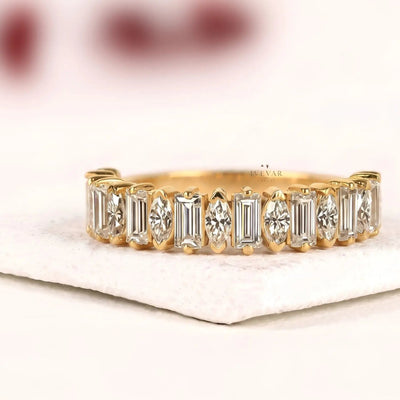
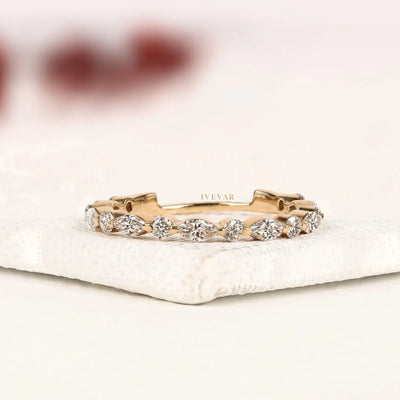
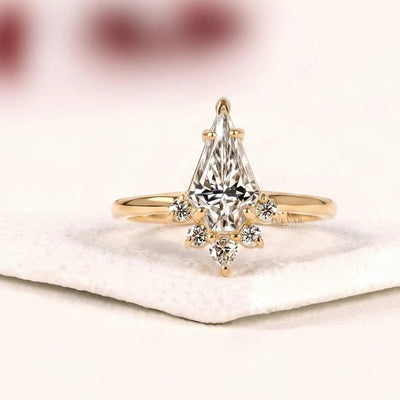
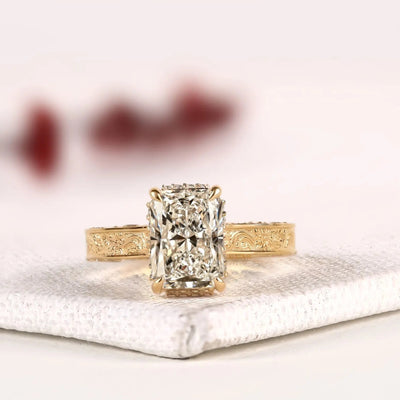
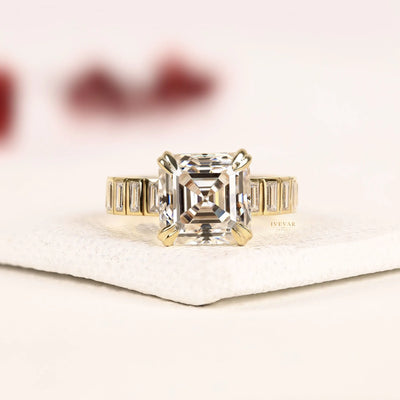
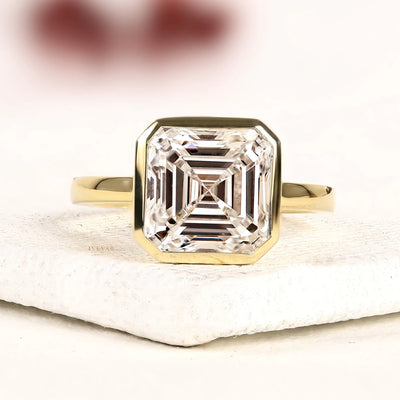
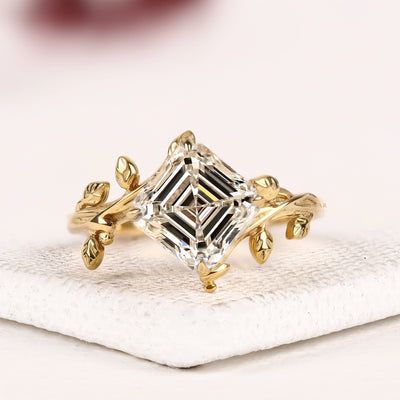
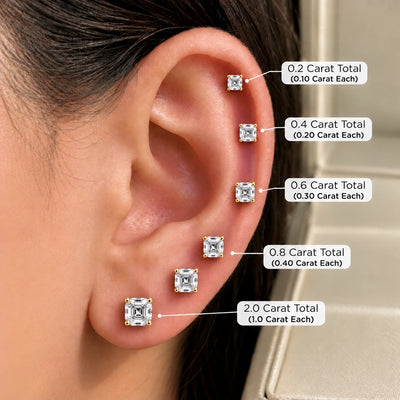
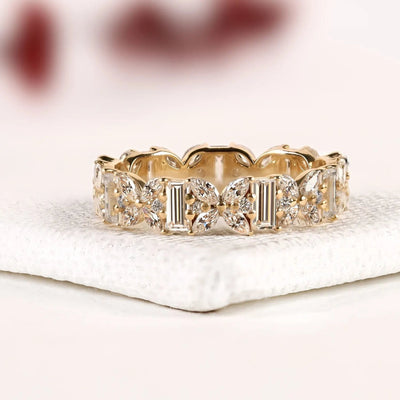
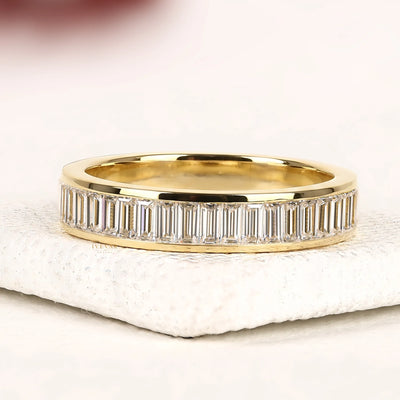
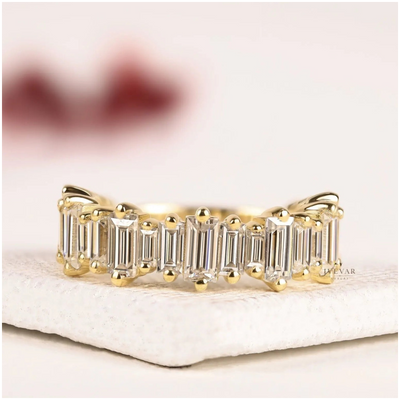
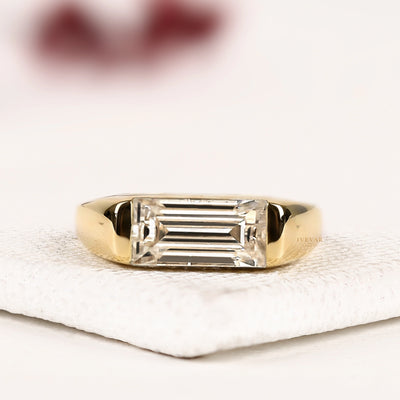
Shop the styles in this guide



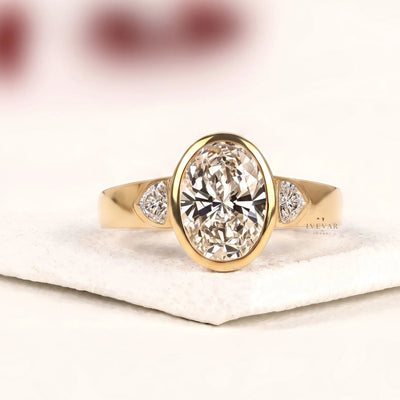
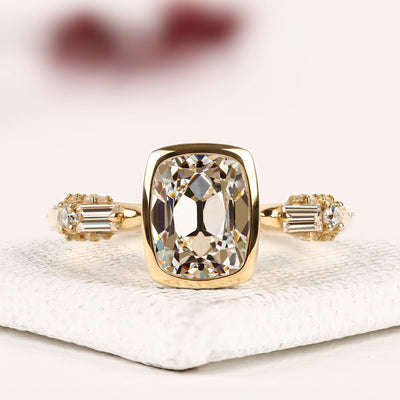
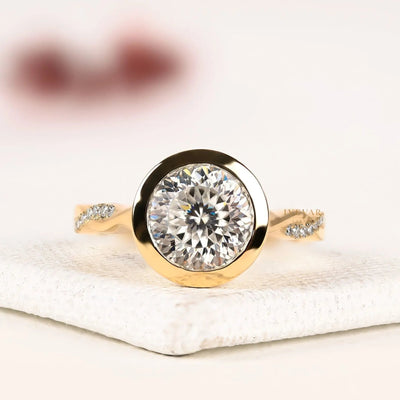
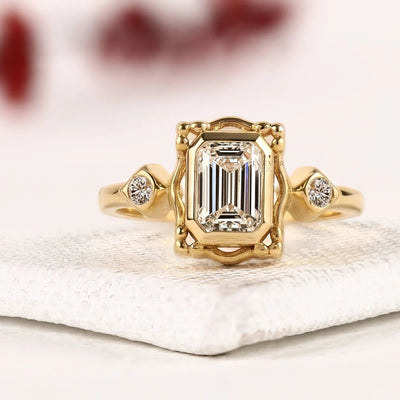
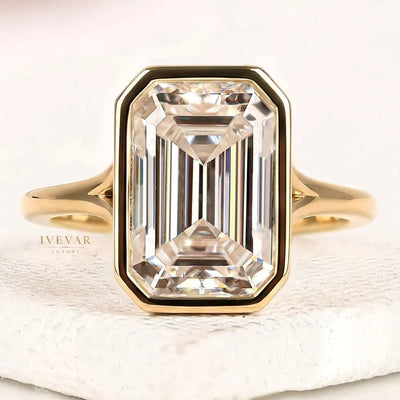
Lab Grown Diamond or Moissanite?
Both shapes are available in lab grown diamond and in moissanite, and the choice affects the look and the budget more than the shape does.
| Factor | Lab grown diamond | Moissanite |
|---|---|---|
| What it is | Real diamond, same as mined | Silicon carbide, a different gem |
| Hardness (Mohs) | 10 | 9.25 |
| Refractive index | About 2.42 | About 2.65 |
| Sparkle | Classic white and colored flashes | Stronger rainbow fire |
| Grading | Often graded by IGI or GIA | Not graded on the diamond scale |
Lab grown diamonds are chemically, physically and optically the same as mined diamonds; they are just grown by CVD or HPHT instead of being mined. Moissanite is its own gemstone, not a type of diamond, and its higher refractive index gives a more colorful fire that some people love, especially in larger ovals and pears. Browse moissanite ovals and moissanite pears if that look appeals to you.
Getting the Most From Your Budget
Because oval and pear both face up large, they already give you good visual value. A few smart choices stretch your budget further without any visible compromise.
- Prioritise cut and symmetry: a well-proportioned stone with a faint bow tie will look better than a heavier stone with a dark one. This is where your money shows most.
- Buy just under round numbers: a 0.95 carat stone looks the same as a 1.00 carat stone on the hand, and the tiny difference in millimetres is invisible.
- Be practical on clarity: eye-clean is enough. Paying for a very high clarity grade buys something you cannot see without magnification.
- Match color to metal: in yellow or rose gold, a near-colorless stone looks just as bright as a higher color grade.
- Compare by size, not weight: line up stones by their millimetre length and width to see which one actually looks bigger.
Lab grown diamonds already cost much less than mined diamonds of the same quality, which is why many buyers now choose a larger oval or pear than they first planned while keeping strong color and clarity.
Which Should You Choose?
- Oval: timeless, easy to match, great for everyday wear and for anyone who wants an elongated stone without a point.
- Pear: a standout shape with both vintage and modern appeal, for people who want their ring to feel distinctive.
- Active hands: oval, or a pear in a bezel setting.
- Flush wedding band stack: oval is the simpler choice.
- Can't decide? A pear and oval toi et moi ring combines both. See our lab grown toi et moi rings.
Tip: Try both shapes on your hand if you can, or compare them on a virtual appointment. Many people who were sure they wanted one shape change their mind after seeing it on their own finger.
Oval and Pear at Ivevar
We cut and hand-set oval and pear stones in our Surat workshop. You can choose lab grown diamonds, many with IGI certificates, or moissanite, set in 10K, 14K or 18K gold, and we also make custom designs if you want a specific ratio, setting or band pairing. Every piece ships free worldwide and comes with 30-day easy returns. Browse oval and pear lab diamonds, or explore our full range of lab diamond engagement rings.
Shop Oval and Pear Diamonds
 Oval Bypass SolitaireShop Now
 0.31 Ct D VS1 OvalShop Now
 0.32 Ct D VS1 OvalShop Now
 0.31 Ct D VS1 PearShop Now
 0.30 Ct D VS1 PearShop Now
 0.32 Ct D VS1 PearShop Now
Swipe to see more → | View oval lab diamonds
Frequently Asked Questions
Which looks bigger, oval or pear?
Both look large for their carat weight. A long pear can look slightly bigger than an oval of the same weight because of its extra length, but depth and ratio matter more than shape.
Which is more popular?
Oval is one of the most popular fancy shapes for engagement rings. Pear is less common, which is part of its appeal for people who want something different.
Do both have bow ties?
Yes. Almost all ovals and pears show some bow tie. Choose a stone where it is faint rather than dark, and check it on video.
Which is more durable?
Oval, because it has no point. A pear is equally hard but its point should be protected with a V-prong or bezel.
Can I combine oval and pear?
Yes, in a toi et moi or three stone design. Pear side stones next to an oval centre are a classic pairing.
Which way should a pear point?
Most people wear the point toward the fingertip, which lengthens the finger. Pointing it toward the wrist is less common but perfectly fine.
Do ovals and pears show more color than rounds?
They can, especially at the ends or the point. If you want a bright white look in a white gold setting, aim for the colorless to near-colorless range.
Will a straight wedding band sit flush?
Usually with an oval set low. With a pear, a curved or contour band often fits better.
The Bottom Line
Choose oval for timeless ease, pear for unique romance. Both are flattering, look larger per carat than a round, and work beautifully in lab grown diamond or moissanite. Focus on a pleasing ratio, a faint bow tie, good symmetry and, for a pear, a protected point.
Related Guides

Author Bio
Aumsri Pradhan
Founder, Ivevar Luxury
Aumsri Pradhan is the founder of Ivevar Luxury, a Surat-based fine jewelry brand that designs and handcrafts lab grown diamond and moissanite jewelry in its own workshop. She leads the brand's design and customer experience, from engagement rings and bridal sets to custom pieces made to each client's story. Through the Ivevar blog, she shares practical guidance on lab grown diamonds, moissanite, diamond grading and ring design to help buyers choose with confidence.

SI1 vs VS1 Diamond Clarity

Custom vs Ready-Made Rings

Black Diamonds vs White Diamonds

